 Add to Chrome
 Add to Firefox
 Add to Edge
Sparse Weight Decomposition for Efficient Circuit Extraction
Aug 04, 2026
Dense pretrained transformers do not naturally expose interpretable units for circuit extraction. Existing approaches obtain such units by learning auxiliary sparse representations or training sparse models, incurring substantial additional computation while potentially introducing a fidelity gap between the representation being analyzed and the original pretrained model. We propose Sparse Weight Decomposition (SWD), which reparameterizes pretrained linear projections by factorizing each weight matrix into two sparse factors whose shared intermediate coordinates serve as individually addressable circuit units. Without training a separate replacement network, this parametric representation supports the same scoring, selection, and ablation circuit extraction workflow used for methods that learn sparse features. Across single-matrix replacements, SWD matches the held-out fidelity achieved by Transcoder and other strong baselines while using less than 1% of the data that those baselines use to train their replacements. For matched replacement fidelity, SWD reaches the same circuit sufficiency and necessity targets with fewer active read/write edges and selected units across tasks on GPT-2, Qwen2.5, and Qwen3.5-27B. We further show that SWD remains effective for full-model replacement of all attention and MLP weight matrices after fine-tuning the nonzero factor values. Finally, SWD also features a zero-data variant, allowing broader use of mechanistic interpretability analysis (e.g., per-step analysis).

Diff-Foley: Synchronized Video-to-Audio Synthesis with Latent Diffusion Models
Jun 29, 2023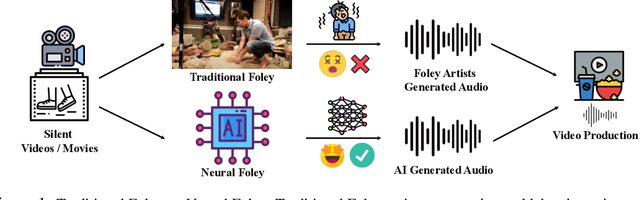
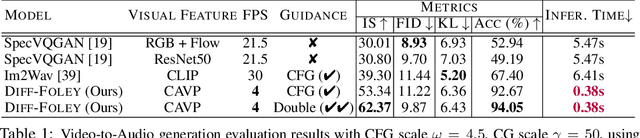
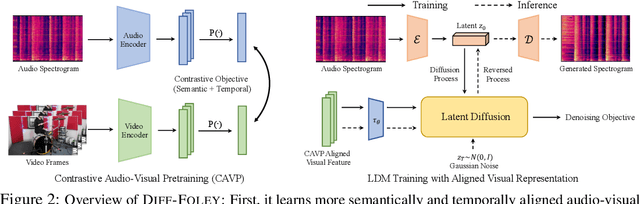

The Video-to-Audio (V2A) model has recently gained attention for its practical application in generating audio directly from silent videos, particularly in video/film production. However, previous methods in V2A have limited generation quality in terms of temporal synchronization and audio-visual relevance. We present Diff-Foley, a synchronized Video-to-Audio synthesis method with a latent diffusion model (LDM) that generates high-quality audio with improved synchronization and audio-visual relevance. We adopt contrastive audio-visual pretraining (CAVP) to learn more temporally and semantically aligned features, then train an LDM with CAVP-aligned visual features on spectrogram latent space. The CAVP-aligned features enable LDM to capture the subtler audio-visual correlation via a cross-attention module. We further significantly improve sample quality with `double guidance'. Diff-Foley achieves state-of-the-art V2A performance on current large scale V2A dataset. Furthermore, we demonstrate Diff-Foley practical applicability and generalization capabilities via downstream finetuning. Project Page: see https://diff-foley.github.io/