 Add to Chrome
 Add to Firefox
 Add to Edge
DiagFlowBench: Evaluating How Language Models Handle Off-Procedure Inputs in Grounded Diagnostic Dialogue
Jun 16, 2026
Language models increasingly serve as advisory systems in maintenance operations. To prevent hallucination, recent systems ground these models in procedural documentation to constrain them to approved steps. In practice, however, operator queries frequently stray from this path, requiring models to recognise out-of-scope inputs mid-conversation, a dynamic that current benchmarks rarely prioritise. We introduce DiagFlowBench, a dataset of 50 industrial diagnostic flowcharts from a consumer manufacturer converted into 1,676 multi-turn conversations that contrast compliant with out-of-scope utterances. Evaluating a panel of ten commercial and open-weight models reveals high variability in abstention rates, with models commonly selecting a real but contextually inadequate step rather than fabricating facts. The inherent plausibility and authority of this mapped but wrong advice exposes a challenging vulnerability for grounding systems.

FlowExtract: Procedural Knowledge Extraction from Maintenance Flowcharts
Apr 08, 2026Maintenance procedures in manufacturing facilities are often documented as flowcharts in static PDFs or scanned images. They encode procedural knowledge essential for asset lifecycle management, yet inaccessible to modern operator support systems. Vision-language models, the dominant paradigm for image understanding, struggle to reconstruct connection topology from such diagrams. We present FlowExtract, a pipeline for extracting directed graphs from ISO 5807-standardized flowcharts. The system separates element detection from connectivity reconstruction, using YOLOv8 and EasyOCR for standard domain-aligned node detection and text extraction, combined with a novel edge detection method that analyzes arrowhead orientations and traces connecting lines backward to source nodes. Evaluated on industrial troubleshooting guides, FlowExtract achieves very high node detection and substantially outperforms vision-language model baselines on edge extraction, offering organizations a practical path toward queryable procedural knowledge representations. The implementation is available athttps://github.com/guille-gil/FlowExtract.
Procedural Knowledge Extraction from Industrial Troubleshooting Guides Using Vision Language Models
Jan 30, 2026Industrial troubleshooting guides encode diagnostic procedures in flowchart-like diagrams where spatial layout and technical language jointly convey meaning. To integrate this knowledge into operator support systems, which assist shop-floor personnel in diagnosing and resolving equipment issues, the information must first be extracted and structured for machine interpretation. However, when performed manually, this extraction is labor-intensive and error-prone. Vision Language Models offer potential to automate this process by jointly interpreting visual and textual meaning, yet their performance on such guides remains underexplored. This paper evaluates two VLMs on extracting structured knowledge, comparing two prompting strategies: standard instruction-guided versus an augmented approach that cues troubleshooting layout patterns. Results reveal model-specific trade-offs between layout sensitivity and semantic robustness, informing practical deployment decisions.
SONIC-O1: A Real-World Benchmark for Evaluating Multimodal Large Language Models on Audio-Video Understanding
Jan 29, 2026Multimodal Large Language Models (MLLMs) are a major focus of recent AI research. However, most prior work focuses on static image understanding, while their ability to process sequential audio-video data remains underexplored. This gap highlights the need for a high-quality benchmark to systematically evaluate MLLM performance in a real-world setting. We introduce SONIC-O1, a comprehensive, fully human-verified benchmark spanning 13 real-world conversational domains with 4,958 annotations and demographic metadata. SONIC-O1 evaluates MLLMs on key tasks, including open-ended summarization, multiple-choice question (MCQ) answering, and temporal localization with supporting rationales (reasoning). Experiments on closed- and open-source models reveal limitations. While the performance gap in MCQ accuracy between two model families is relatively small, we observe a substantial 22.6% performance difference in temporal localization between the best performing closed-source and open-source models. Performance further degrades across demographic groups, indicating persistent disparities in model behavior. Overall, SONIC-O1 provides an open evaluation suite for temporally grounded and socially robust multimodal understanding. We release SONIC-O1 for reproducibility and research: Project page: https://vectorinstitute.github.io/sonic-o1/ Dataset: https://huggingface.co/datasets/vector-institute/sonic-o1 Github: https://github.com/vectorinstitute/sonic-o1 Leaderboard: https://huggingface.co/spaces/vector-institute/sonic-o1-leaderboard
TRiSM for Agentic AI: A Review of Trust, Risk, and Security Management in LLM-based Agentic Multi-Agent Systems
Jun 04, 2025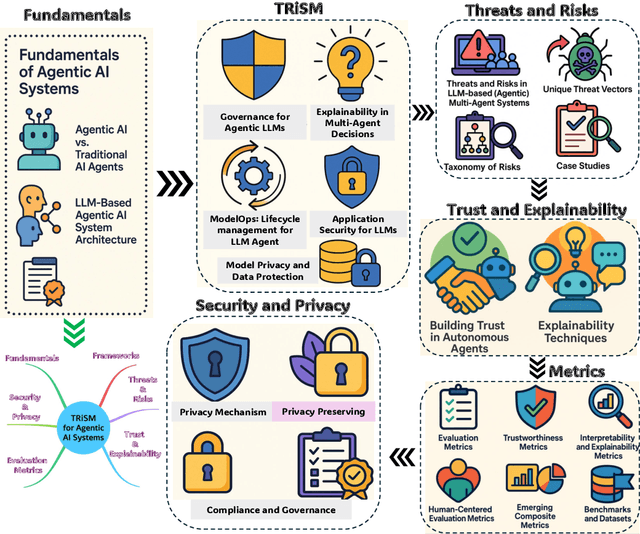
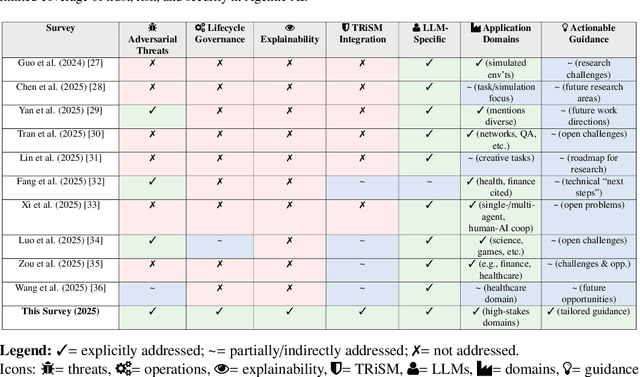
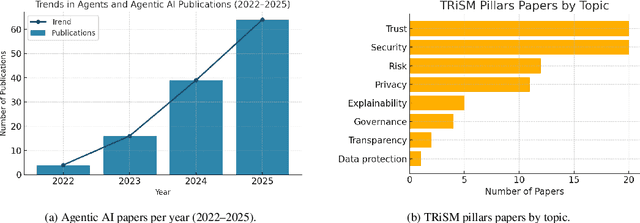
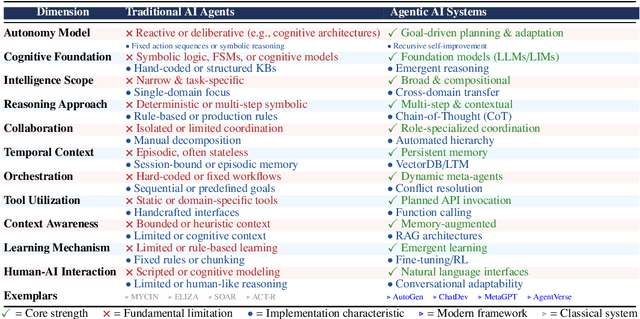
Agentic AI systems, built on large language models (LLMs) and deployed in multi-agent configurations, are redefining intelligent autonomy, collaboration and decision-making across enterprise and societal domains. This review presents a structured analysis of Trust, Risk, and Security Management (TRiSM) in the context of LLM-based agentic multi-agent systems (AMAS). We begin by examining the conceptual foundations of agentic AI, its architectural differences from traditional AI agents, and the emerging system designs that enable scalable, tool-using autonomy. The TRiSM in the agentic AI framework is then detailed through four pillars governance, explainability, ModelOps, and privacy/security each contextualized for agentic LLMs. We identify unique threat vectors and introduce a comprehensive risk taxonomy for the agentic AI applications, supported by case studies illustrating real-world vulnerabilities. Furthermore, the paper also surveys trust-building mechanisms, transparency and oversight techniques, and state-of-the-art explainability strategies in distributed LLM agent systems. Additionally, metrics for evaluating trust, interpretability, and human-centered performance are reviewed alongside open benchmarking challenges. Security and privacy are addressed through encryption, adversarial defense, and compliance with evolving AI regulations. The paper concludes with a roadmap for responsible agentic AI, proposing research directions to align emerging multi-agent systems with robust TRiSM principles for safe, accountable, and transparent deployment.
Just as Humans Need Vaccines, So Do Models: Model Immunization to Combat Falsehoods
May 23, 2025Generative AI models often learn and reproduce false information present in their training corpora. This position paper argues that, analogous to biological immunization, where controlled exposure to a weakened pathogen builds immunity, AI models should be fine tuned on small, quarantined sets of explicitly labeled falsehoods as a "vaccine" against misinformation. These curated false examples are periodically injected during finetuning, strengthening the model ability to recognize and reject misleading claims while preserving accuracy on truthful inputs. An illustrative case study shows that immunized models generate substantially less misinformation than baselines. To our knowledge, this is the first training framework that treats fact checked falsehoods themselves as a supervised vaccine, rather than relying on input perturbations or generic human feedback signals, to harden models against future misinformation. We also outline ethical safeguards and governance controls to ensure the safe use of false data. Model immunization offers a proactive paradigm for aligning AI systems with factuality.
VLDBench: Vision Language Models Disinformation Detection Benchmark
Feb 17, 2025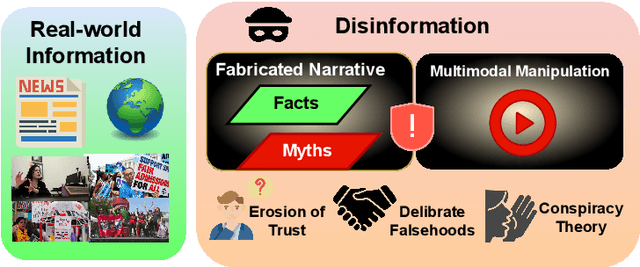
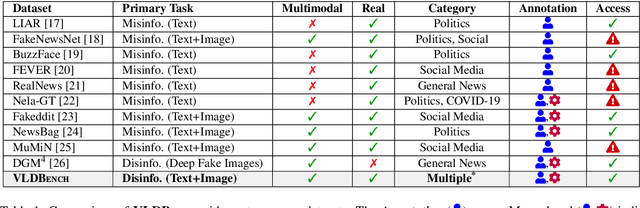
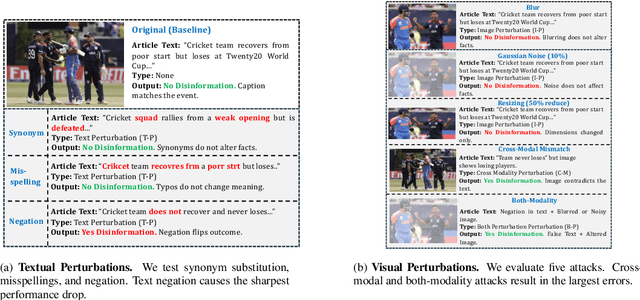
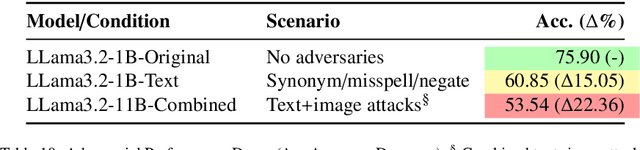
The rapid rise of AI-generated content has made detecting disinformation increasingly challenging. In particular, multimodal disinformation, i.e., online posts-articles that contain images and texts with fabricated information are specially designed to deceive. While existing AI safety benchmarks primarily address bias and toxicity, multimodal disinformation detection remains largely underexplored. To address this challenge, we present the Vision-Language Disinformation Detection Benchmark VLDBench, the first comprehensive benchmark for detecting disinformation across both unimodal (text-only) and multimodal (text and image) content, comprising 31,000} news article-image pairs, spanning 13 distinct categories, for robust evaluation. VLDBench features a rigorous semi-automated data curation pipeline, with 22 domain experts dedicating 300 plus hours} to annotation, achieving a strong inter-annotator agreement (Cohen kappa = 0.78). We extensively evaluate state-of-the-art Large Language Models (LLMs) and Vision-Language Models (VLMs), demonstrating that integrating textual and visual cues in multimodal news posts improves disinformation detection accuracy by 5 - 35 % compared to unimodal models. Developed in alignment with AI governance frameworks such as the EU AI Act, NIST guidelines, and the MIT AI Risk Repository 2024, VLDBench is expected to become a benchmark for detecting disinformation in online multi-modal contents. Our code and data will be publicly available.
Human in the AI loop via xAI and Active Learning for Visual Inspection
Jul 17, 2023Industrial revolutions have historically disrupted manufacturing by introducing automation into production. Increasing automation reshapes the role of the human worker. Advances in robotics and artificial intelligence open new frontiers of human-machine collaboration. Such collaboration can be realized considering two sub-fields of artificial intelligence: active learning and explainable artificial intelligence. Active learning aims to devise strategies that help obtain data that allows machine learning algorithms to learn better. On the other hand, explainable artificial intelligence aims to make the machine learning models intelligible to the human person. The present work first describes Industry 5.0, human-machine collaboration, and state-of-the-art regarding quality inspection, emphasizing visual inspection. Then it outlines how human-machine collaboration could be realized and enhanced in visual inspection. Finally, some of the results obtained in the EU H2020 STAR project regarding visual inspection are shared, considering artificial intelligence, human digital twins, and cybersecurity.