 Add to Chrome
 Add to Firefox
 Add to Edge
Learning to Advect: A Neural Semi-Lagrangian Architecture for Weather Forecasting
Jan 29, 2026
Recent machine-learning approaches to weather forecasting often employ a monolithic architecture, where distinct physical mechanisms (advection, transport), diffusion-like mixing, thermodynamic processes, and forcing are represented implicitly within a single large network. This representation is particularly problematic for advection, where long-range transport must be treated with expensive global interaction mechanisms or through deep, stacked convolutional layers. To mitigate this, we present PARADIS, a physics-inspired global weather prediction model that imposes inductive biases on network behavior through a functional decomposition into advection, diffusion, and reaction blocks acting on latent variables. We implement advection through a Neural Semi-Lagrangian operator that performs trajectory-based transport via differentiable interpolation on the sphere, enabling end-to-end learning of both the latent modes to be transported and their characteristic trajectories. Diffusion-like processes are modeled through depthwise-separable spatial mixing, while local source terms and vertical interactions are modeled via pointwise channel interactions, enabling operator-level physical structure. PARADIS provides state-of-the-art forecast skill at a fraction of the training cost. On ERA5-based benchmarks, the 1 degree PARADIS model, with a total training cost of less than a GPU month, meets or exceeds the performance of 0.25 degree traditional and machine-learning baselines, including the ECMWF HRES forecast and DeepMind's GraphCast.

Fixing the Double Penalty in Data-Driven Weather Forecasting Through a Modified Spherical Harmonic Loss Function
Jan 31, 2025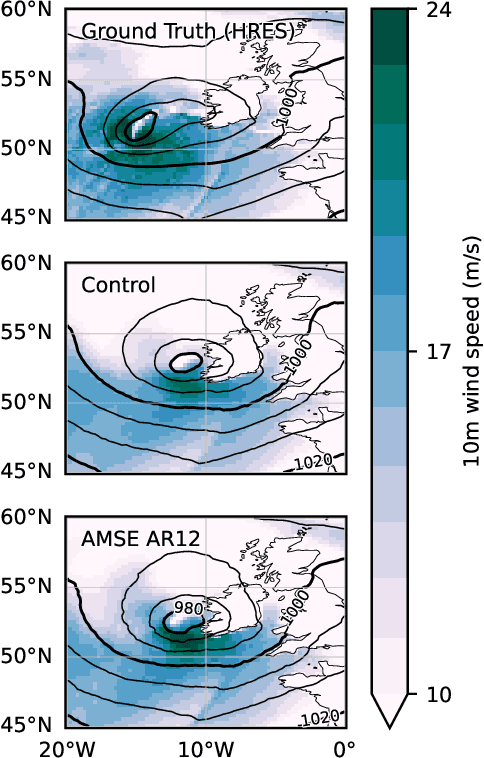
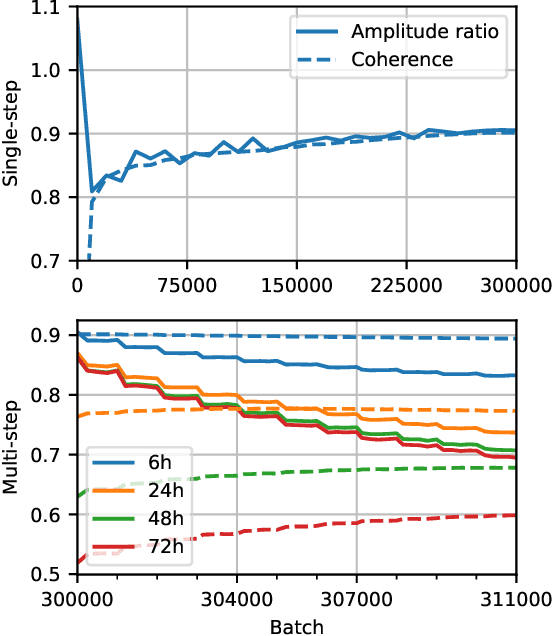
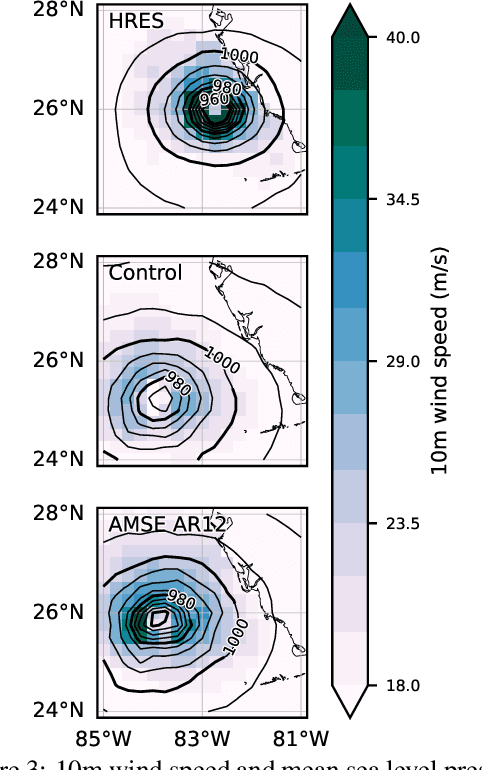
Recent advancements in data-driven weather forecasting models have delivered deterministic models that outperform the leading operational forecast systems based on traditional, physics-based models. However, these data-driven models are typically trained with a mean squared error loss function, which causes smoothing of fine scales through a "double penalty" effect. We develop a simple, parameter-free modification to this loss function that avoids this problem by separating the loss attributable to decorrelation from the loss attributable to spectral amplitude errors. Fine-tuning the GraphCast model with this new loss function results in sharp deterministic weather forecasts, an increase of the model's effective resolution from 1,250km to 160km, improvements to ensemble spread, and improvements to predictions of tropical cyclone strength and surface wind extremes.
Efficient fine-tuning of 37-level GraphCast with the Canadian global deterministic analysis
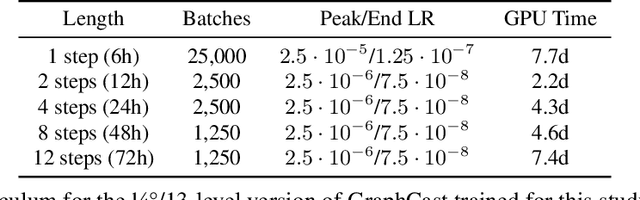
Aug 26, 2024This work describes a process for efficiently fine-tuning the GraphCast data-driven forecast model to simulate another analysis system, here the Global Deterministic Prediction System (GDPS) of Environment and Climate Change Canada (ECCC). Using two years of training data (July 2019 -- December 2021) and 37 GPU-days of computation to tune the 37-level, quarter-degree version of GraphCast, the resulting model significantly outperforms both the unmodified GraphCast and operational forecast, showing significant forecast skill in the troposphere over lead times from 1 to 10 days. This fine-tuning is accomplished through abbreviating DeepMind's original training curriculum for GraphCast, relying on a shorter single-step forecast stage to accomplish the bulk of the adaptation work and consolidating the autoregressive stages into separate 12hr, 1d, 2d, and 3d stages with larger learning rates. Additionally, training over 3d forecasts is split into two sub-steps to conserve host memory while maintaining a strong correlation with training over the full period.
Leveraging data-driven weather models for improving numerical weather prediction skill through large-scale spectral nudging
Jul 08, 2024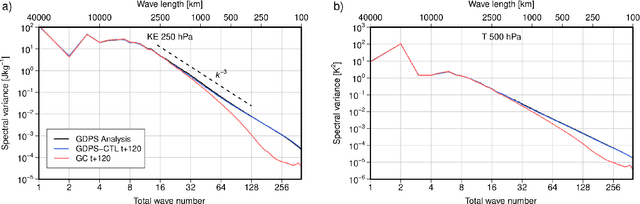
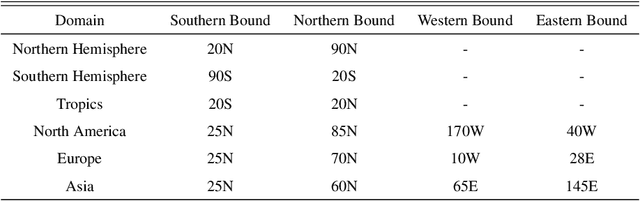
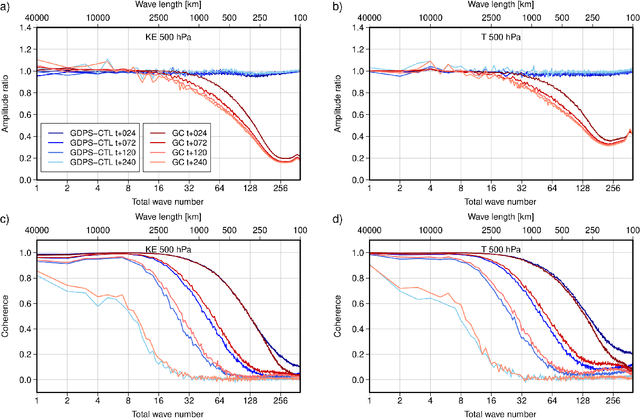
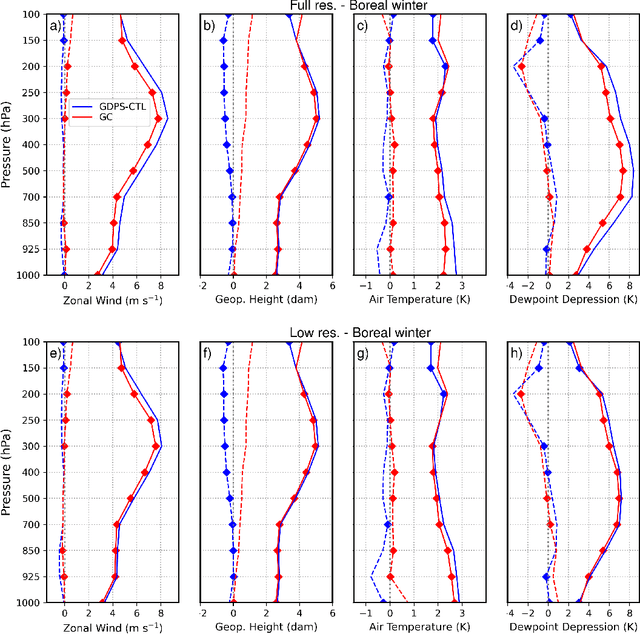
Operational meteorological forecasting has long relied on physics-based numerical weather prediction (NWP) models. Recently, this landscape has been disrupted by the advent of data-driven artificial intelligence (AI)-based weather models, which offer tremendous computational performance and competitive forecasting skill. However, data-driven models for medium-range forecasting generally suffer from major limitations, including low effective resolution and a narrow range of predicted variables. This study illustrates the relative strengths and weaknesses of these competing paradigms using the GEM (Global Environmental Multiscale) and GraphCast models to represent physics-based and AI-based approaches, respectively. By analyzing global predictions from these two models against observations and analyses in both physical and spectral spaces, this study demonstrates that GraphCast-predicted large scales outperform GEM, particularly for longer lead times. Building on this insight, a hybrid NWP-AI system is proposed, wherein GEM-predicted large-scale state variables are spectrally nudged toward GraphCast predictions, while allowing GEM to freely generate fine-scale details critical for weather extremes. Results indicate that this hybrid approach is capable of leveraging the strengths of GraphCast to enhance the prediction skill of the GEM model. Importantly, trajectories of tropical cyclones are predicted with enhanced accuracy without significant changes in intensity. Furthermore, this new hybrid system ensures that meteorologists have access to a complete set of forecast variables, including those relevant for high-impact weather events.