 Add to Chrome
 Add to Firefox
 Add to Edge
PrAda: Few-Shot Visual Adaptation for Text-Prompted Segmentation
May 19, 2026
Segmenting images is critical for visual understanding but demands extensive pixel-level annotations. Foundational models have enabled new paradigms for predicting new classes guided by textual prompts, without annotations from the target domain. Yet, on specialized target domains, far from the original pre-training, their performance degrades. We study the errors of existing methods under such domain-shift, finding that misclassification rather than mask generation is the main culprit. To address this, we introduce the novel problem of Few-Shot Visual Adaptation for text-prompted Segmentation. This kind of adaptation has been largely studied for image classification, but it remains unexplored for segmentation. We tackle this task with Prototype Adaptation (PrAda), a novel, parameter-efficient method that adapts a frozen text-prompted segmentation model. Our approach learns class-specific prototypes by combining fine-grained pixel features and high-level transformer representations, which are then fused with the original text-based predictions through a learned importance factor. This preserves the model's zero-shot potential while enabling strong adaptation to new domains. Experiments across semantic, instance, and panoptic segmentation on five benchmarks demonstrate that PrAda yields significant improvements over state-of-the-art and proposed baselines.

MARCO: Navigating the Unseen Space of Semantic Correspondence
Apr 20, 2026Recent advances in semantic correspondence rely on dual-encoder architectures, combining DINOv2 with diffusion backbones. While accurate, these billion-parameter models generalize poorly beyond training keypoints, revealing a gap between benchmark performance and real-world usability, where queried points rarely match those seen during training. Building upon DINOv2, we introduce MARCO, a unified model for generalizable correspondence driven by a novel training framework that enhances both fine-grained localization and semantic generalization. By coupling a coarse-to-fine objective that refines spatial precision with a self-distillation framework, which expands sparse supervision beyond annotated regions, our approach transforms a handful of keypoints into dense, semantically coherent correspondences. MARCO sets a new state of the art on SPair-71k, AP-10K, and PF-PASCAL, with gains that amplify at fine-grained localization thresholds (+8.9 PCK@0.01), strongest generalization to unseen keypoints (+5.1, SPair-U) and categories (+4.7, MP-100), while remaining 3x smaller and 10x faster than diffusion-based approaches. Code is available at https://github.com/visinf/MARCO .
INSID3: Training-Free In-Context Segmentation with DINOv3
Mar 30, 2026In-context segmentation (ICS) aims to segment arbitrary concepts, e.g., objects, parts, or personalized instances, given one annotated visual examples. Existing work relies on (i) fine-tuning vision foundation models (VFMs), which improves in-domain results but harms generalization, or (ii) combines multiple frozen VFMs, which preserves generalization but yields architectural complexity and fixed segmentation granularities. We revisit ICS from a minimalist perspective and ask: Can a single self-supervised backbone support both semantic matching and segmentation, without any supervision or auxiliary models? We show that scaled-up dense self-supervised features from DINOv3 exhibit strong spatial structure and semantic correspondence. We introduce INSID3, a training-free approach that segments concepts at varying granularities only from frozen DINOv3 features, given an in-context example. INSID3 achieves state-of-the-art results across one-shot semantic, part, and personalized segmentation, outperforming previous work by +7.5 % mIoU, while using 3x fewer parameters and without any mask or category-level supervision. Code is available at https://github.com/visinf/INSID3 .
Road Obstacle Video Segmentation
Sep 16, 2025With the growing deployment of autonomous driving agents, the detection and segmentation of road obstacles have become critical to ensure safe autonomous navigation. However, existing road-obstacle segmentation methods are applied on individual frames, overlooking the temporal nature of the problem, leading to inconsistent prediction maps between consecutive frames. In this work, we demonstrate that the road-obstacle segmentation task is inherently temporal, since the segmentation maps for consecutive frames are strongly correlated. To address this, we curate and adapt four evaluation benchmarks for road-obstacle video segmentation and evaluate 11 state-of-the-art image- and video-based segmentation methods on these benchmarks. Moreover, we introduce two strong baseline methods based on vision foundation models. Our approach establishes a new state-of-the-art in road-obstacle video segmentation for long-range video sequences, providing valuable insights and direction for future research.
SANSA: Unleashing the Hidden Semantics in SAM2 for Few-Shot Segmentation
May 27, 2025Few-shot segmentation aims to segment unseen object categories from just a handful of annotated examples. This requires mechanisms that can both identify semantically related objects across images and accurately produce segmentation masks. We note that Segment Anything 2 (SAM2), with its prompt-and-propagate mechanism, offers both strong segmentation capabilities and a built-in feature matching process. However, we show that its representations are entangled with task-specific cues optimized for object tracking, which impairs its use for tasks requiring higher level semantic understanding. Our key insight is that, despite its class-agnostic pretraining, SAM2 already encodes rich semantic structure in its features. We propose SANSA (Semantically AligNed Segment Anything 2), a framework that makes this latent structure explicit, and repurposes SAM2 for few-shot segmentation through minimal task-specific modifications. SANSA achieves state-of-the-art performance on few-shot segmentation benchmarks specifically designed to assess generalization, outperforms generalist methods in the popular in-context setting, supports various prompts flexible interaction via points, boxes, or scribbles, and remains significantly faster and more compact than prior approaches. Code is available at https://github.com/ClaudiaCuttano/SANSA.
To Match or Not to Match: Revisiting Image Matching for Reliable Visual Place Recognition
Apr 08, 2025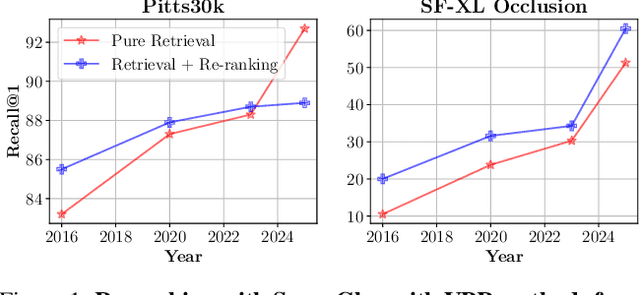
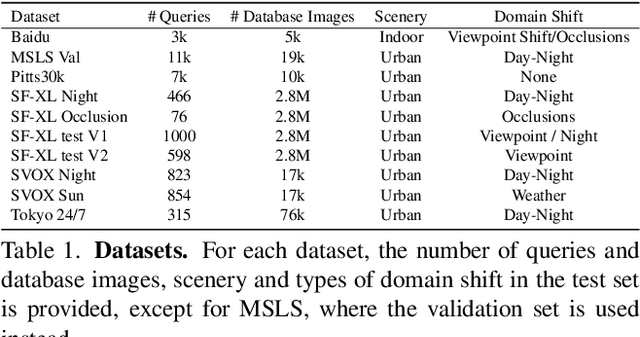
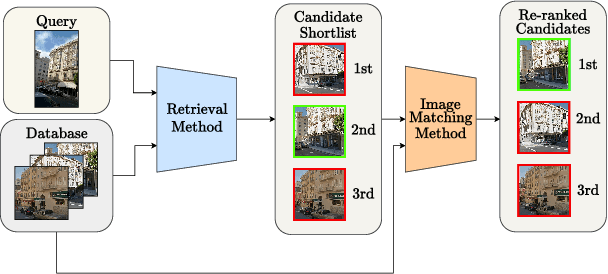
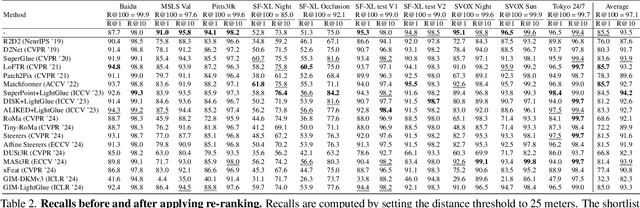
Visual Place Recognition (VPR) is a critical task in computer vision, traditionally enhanced by re-ranking retrieval results with image matching. However, recent advancements in VPR methods have significantly improved performance, challenging the necessity of re-ranking. In this work, we show that modern retrieval systems often reach a point where re-ranking can degrade results, as current VPR datasets are largely saturated. We propose using image matching as a verification step to assess retrieval confidence, demonstrating that inlier counts can reliably predict when re-ranking is beneficial. Our findings shift the paradigm of retrieval pipelines, offering insights for more robust and adaptive VPR systems.
All You Need to Know About Training Image Retrieval Models
Mar 17, 2025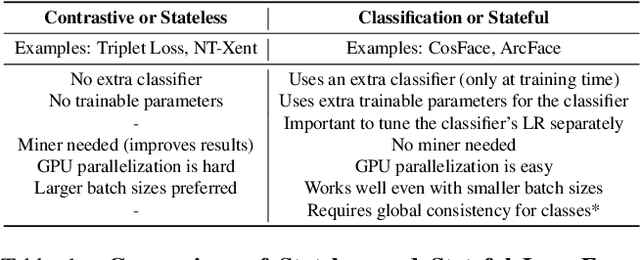
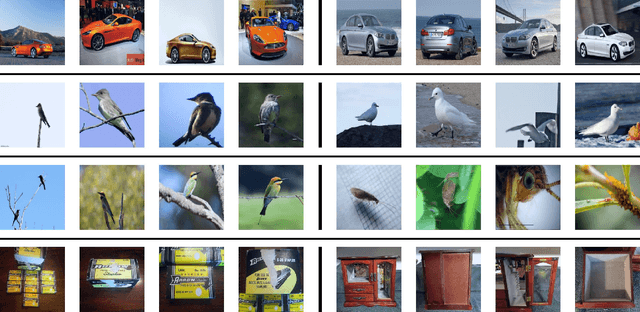

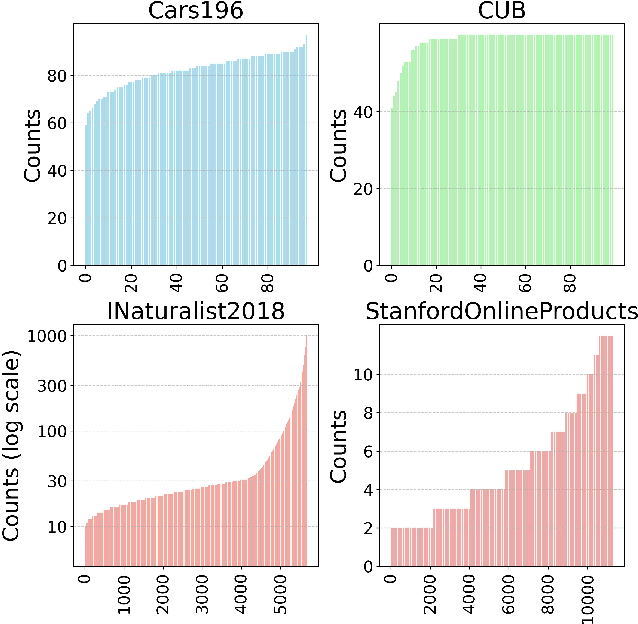
Image retrieval is the task of finding images in a database that are most similar to a given query image. The performance of an image retrieval pipeline depends on many training-time factors, including the embedding model architecture, loss function, data sampler, mining function, learning rate(s), and batch size. In this work, we run tens of thousands of training runs to understand the effect each of these factors has on retrieval accuracy. We also discover best practices that hold across multiple datasets. The code is available at https://github.com/gmberton/image-retrieval
MegaLoc: One Retrieval to Place Them All
Feb 25, 2025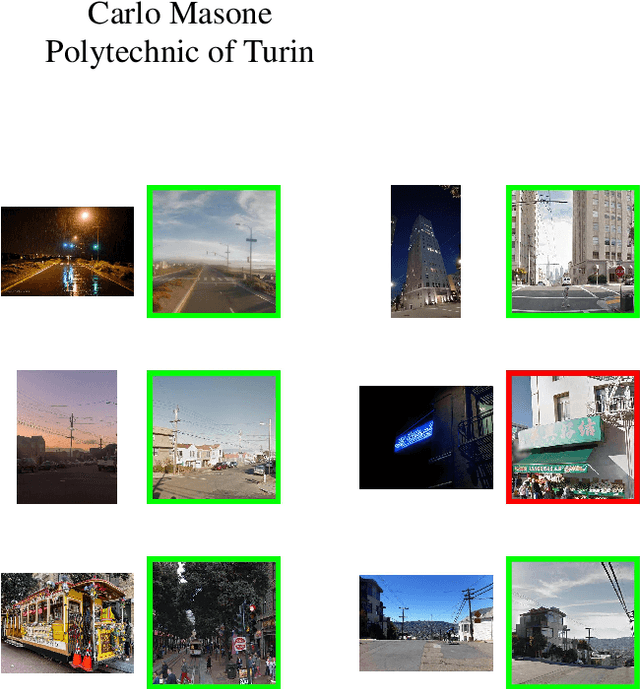

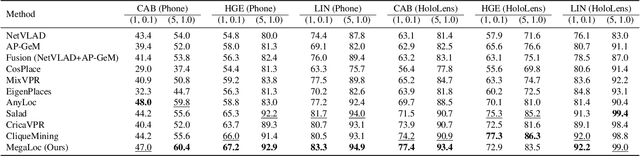
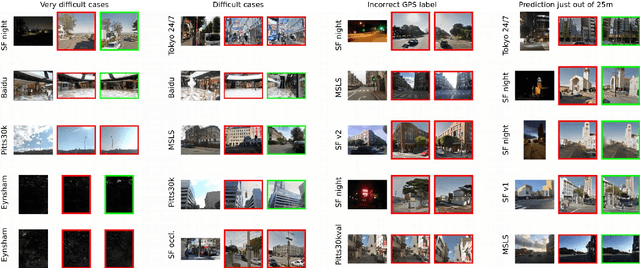
Retrieving images from the same location as a given query is an important component of multiple computer vision tasks, like Visual Place Recognition, Landmark Retrieval, Visual Localization, 3D reconstruction, and SLAM. However, existing solutions are built to specifically work for one of these tasks, and are known to fail when the requirements slightly change or when they meet out-of-distribution data. In this paper we combine a variety of existing methods, training techniques, and datasets to train a retrieval model, called MegaLoc, that is performant on multiple tasks. We find that MegaLoc (1) achieves state of the art on a large number of Visual Place Recognition datasets, (2) impressive results on common Landmark Retrieval datasets, and (3) sets a new state of the art for Visual Localization on the LaMAR datasets, where we only changed the retrieval method to the existing localization pipeline. The code for MegaLoc is available at https://github.com/gmberton/MegaLoc
AstroLoc: Robust Space to Ground Image Localizer
Feb 10, 2025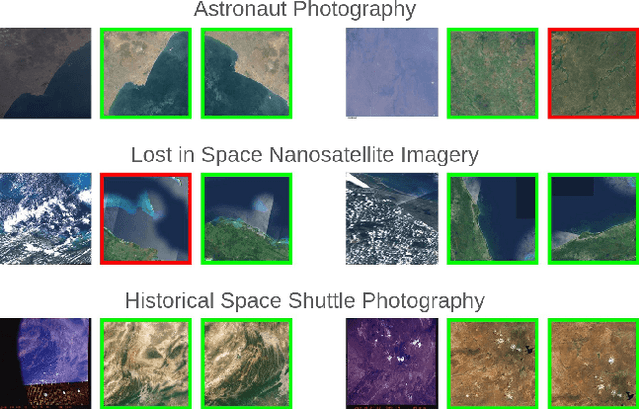
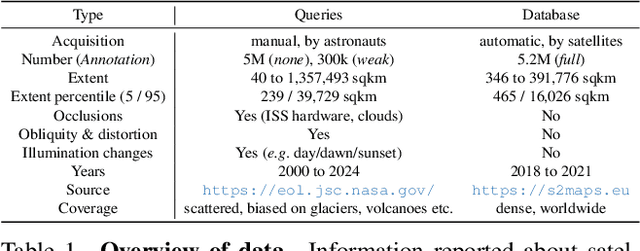
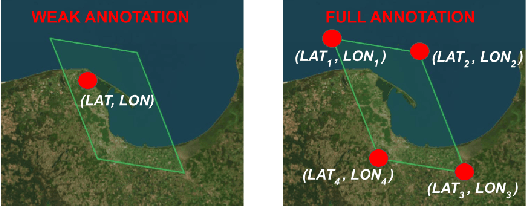

Astronauts take thousands of photos of Earth per day from the International Space Station, which, once localized on Earth's surface, are used for a multitude of tasks, ranging from climate change research to disaster management. The localization process, which has been performed manually for decades, has recently been approached through image retrieval solutions: given an astronaut photo, find its most similar match among a large database of geo-tagged satellite images, in a task called Astronaut Photography Localization (APL). Yet, existing APL approaches are trained only using satellite images, without taking advantage of the millions open-source astronaut photos. In this work we present the first APL pipeline capable of leveraging astronaut photos for training. We first produce full localization information for 300,000 manually weakly labeled astronaut photos through an automated pipeline, and then use these images to train a model, called AstroLoc. AstroLoc learns a robust representation of Earth's surface features through two losses: astronaut photos paired with their matching satellite counterparts in a pairwise loss, and a second loss on clusters of satellite imagery weighted by their relevance to astronaut photography via unsupervised mining. We find that AstroLoc achieves a staggering 35% average improvement in recall@1 over previous SOTA, pushing the limits of existing datasets with a recall@100 consistently over 99%. Finally, we note that AstroLoc, without any fine-tuning, provides excellent results for related tasks like the lost-in-space satellite problem and historical space imagery localization.
SAMWISE: Infusing wisdom in SAM2 for Text-Driven Video Segmentation
Nov 26, 2024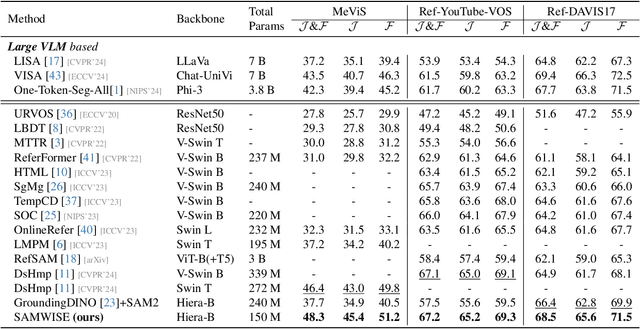
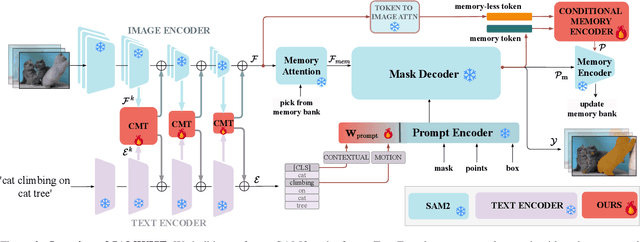
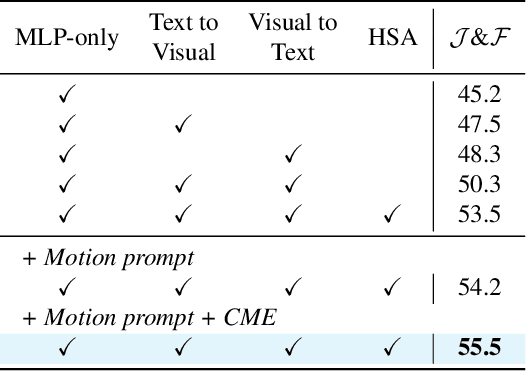
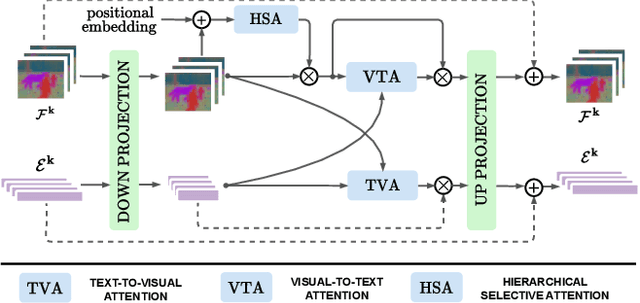
Referring Video Object Segmentation (RVOS) relies on natural language expressions to segment an object in a video clip. Existing methods restrict reasoning either to independent short clips, losing global context, or process the entire video offline, impairing their application in a streaming fashion. In this work, we aim to surpass these limitations and design an RVOS method capable of effectively operating in streaming-like scenarios while retaining contextual information from past frames. We build upon the Segment-Anything 2 (SAM2) model, that provides robust segmentation and tracking capabilities and is naturally suited for streaming processing. We make SAM2 wiser, by empowering it with natural language understanding and explicit temporal modeling at the feature extraction stage, without fine-tuning its weights, and without outsourcing modality interaction to external models. To this end, we introduce a novel adapter module that injects temporal information and multi-modal cues in the feature extraction process. We further reveal the phenomenon of tracking bias in SAM2 and propose a learnable module to adjust its tracking focus when the current frame features suggest a new object more aligned with the caption. Our proposed method, SAMWISE, achieves state-of-the-art across various benchmarks, by adding a negligible overhead of just 4.2 M parameters. The code is available at https://github.com/ClaudiaCuttano/SAMWISE