 Add to Chrome
 Add to Firefox
 Add to Edge
EII-SCL: Harnessing Emotional Inertia for Multimodal Emotion Recognition in Conversation
Jul 19, 2026
Multimodal emotion recognition in conversation (MERC) achieves accurate predictions by integrating multimodal and contextual information in dialogues. While current MERC approaches focus on modeling complex contextual dependencies in conversation, they often overlook the impact of contextual emotional inertia in emotion shift, leading to sub-optimal performance. To address this issue, we propose a novel Emotional Inertia-Informed Supervised Contrastive Learning module (EII-SCL) that informs the contrastive objective by constructing inertia-affected samples within temporal windows, effectively leveraging emotional inertia as a prior while enabling seamless integration with existing MERC models without requiring additional data. Extensive experiments on IEMOCAP and MELD show that our approach consistently outperforms state-of-the-art methods.

UNet-Based Fusion and Exponential Moving Average Adaptation for Noise-Robust Speaker Recognition
Apr 28, 2026The joint training of speech enhancement and speaker embedding networks for speaker recognition is widely adopted under noisy acoustic environments. While effective, this paradigm often fails to leverage the generalization and robustness benefits inherent in large-scale speech enhancement pre-training. Moreover, maintaining the speaker information in the denoised speech is not an explicit objective of the speech enhancement process. To address these limitations, we proposed a scalable \textbf{U}Net-based \textbf{F}usion framework (UF-EMA) that considers the noisy and enhanced speech as a multi-channel input, thereby enabling the speaker encoder to exploit speaker information effectively. In addition, an \textbf{E}xponential \textbf{M}oving \textbf{A}verage strategy is applied to a speaker encoder pre-trained on clean speech to mitigate overfitting and facilitate a smooth transition from clean to noisy conditions. Experimental results on multiple noise-contaminated test sets showcase the superiority of the proposed approach.
Asymmetric Clean Segments-Guided Self-Supervised Learning for Robust Speaker Verification
Sep 08, 2023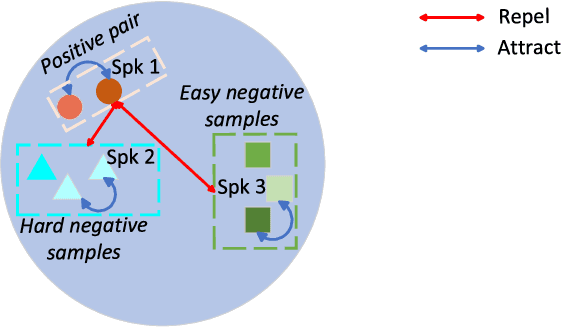
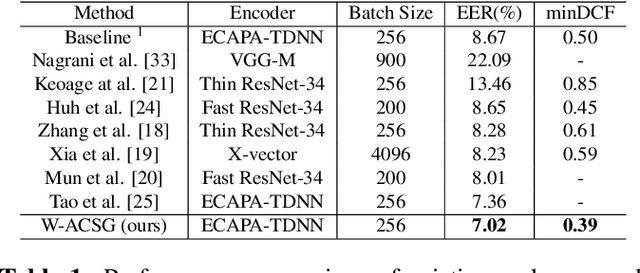
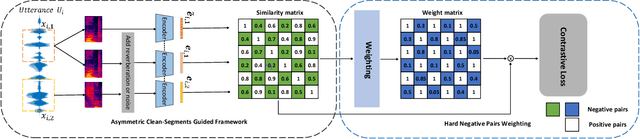
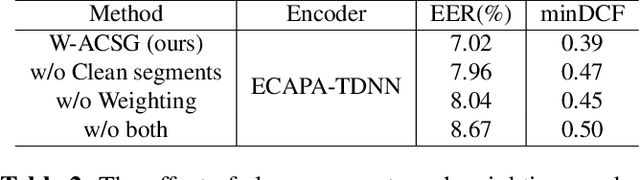
Contrastive self-supervised learning (CSL) for speaker verification (SV) has drawn increasing interest recently due to its ability to exploit unlabeled data. Performing data augmentation on raw waveforms, such as adding noise or reverberation, plays a pivotal role in achieving promising results in SV. Data augmentation, however, demands meticulous calibration to ensure intact speaker-specific information, which is difficult to achieve without speaker labels. To address this issue, we introduce a novel framework by incorporating clean and augmented segments into the contrastive training pipeline. The clean segments are repurposed to pair with noisy segments to form additional positive and negative pairs. Moreover, the contrastive loss is weighted to increase the difference between the clean and augmented embeddings of different speakers. Experimental results on Voxceleb1 suggest that the proposed framework can achieve a remarkable 19% improvement over the conventional methods, and it surpasses many existing state-of-the-art techniques.