 Add to Chrome
 Add to Firefox
 Add to Edge
Quasi-stationary Slice Detection-Based Robust Respiration Rate Estimation under Large-scale Random Body Movement
Apr 07, 2026
Radar-based non-contact respiration rate (RR) measurement has become increasingly popular due to its convenience, non-intrusiveness, and low cost. However, it is still quite challenging to accurately acquire vital signs estimation in complex measurement scenarios with large-scale random body movements (RBM), particularly for RR estimation due to strong low-frequency interferences. To cope with the RBM challenge in RR estimation, we propose a novel two-stage RR estimation scheme involving detecting the portion of signals, called as quasi-stationary slices, exhibiting the quasi-stationary pattern. At the detection stage, an enhanced deep neural network framework incorporating the dynamic snake convolution is exploited to detect the quasi-stationary slices in the micro-Doppler spectra. At the estimation stage, we mitigate RBM interferences and achieve accurate RR estimation by only using the portion of ridges consistent with the location of detected quasi-stationary slice. Extensive experimental results demonstrate that our proposed scheme can accurately detect quasi-stationary slices under normal scenarios with large-scale RBM, thereby reducing the error of subsequent RR estimation.

TheraMind: A Strategic and Adaptive Agent for Longitudinal Psychological Counseling
Oct 29, 2025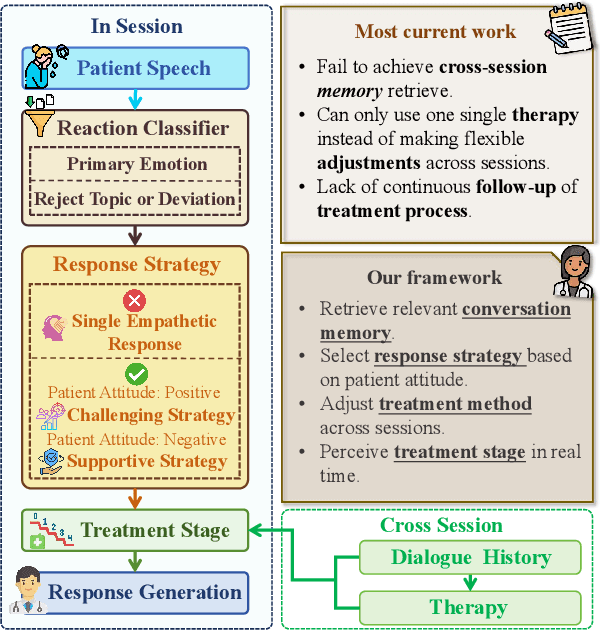
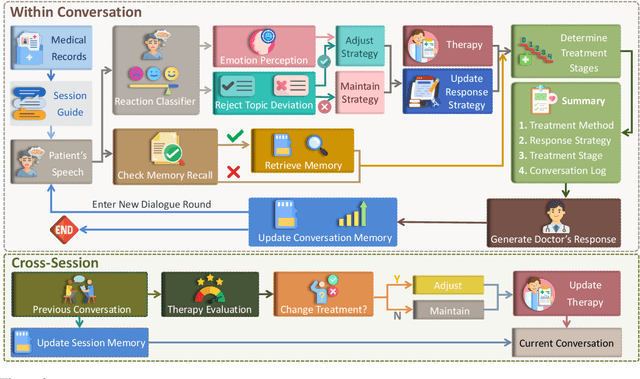
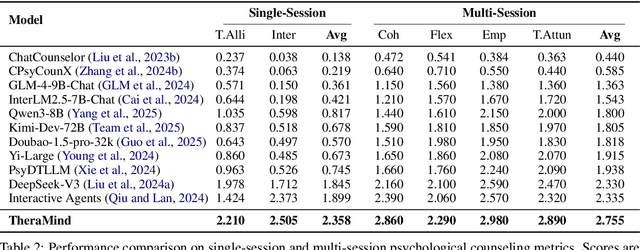
Large language models (LLMs) in psychological counseling have attracted increasing attention. However, existing approaches often lack emotional understanding, adaptive strategies, and the use of therapeutic methods across multiple sessions with long-term memory, leaving them far from real clinical practice. To address these critical gaps, we introduce TheraMind, a strategic and adaptive agent for longitudinal psychological counseling. The cornerstone of TheraMind is a novel dual-loop architecture that decouples the complex counseling process into an Intra-Session Loop for tactical dialogue management and a Cross-Session Loop for strategic therapeutic planning. The Intra-Session Loop perceives the patient's emotional state to dynamically select response strategies while leveraging cross-session memory to ensure continuity. Crucially, the Cross-Session Loop empowers the agent with long-term adaptability by evaluating the efficacy of the applied therapy after each session and adjusting the method for subsequent interactions. We validate our approach in a high-fidelity simulation environment grounded in real clinical cases. Extensive evaluations show that TheraMind outperforms other methods, especially on multi-session metrics like Coherence, Flexibility, and Therapeutic Attunement, validating the effectiveness of its dual-loop design in emulating strategic, adaptive, and longitudinal therapeutic behavior. The code is publicly available at https://0mwwm0.github.io/TheraMind/.