 Add to Chrome
 Add to Firefox
 Add to Edge
Quasi-stationary Slice Detection-Based Robust Respiration Rate Estimation under Large-scale Random Body Movement
Apr 07, 2026
Radar-based non-contact respiration rate (RR) measurement has become increasingly popular due to its convenience, non-intrusiveness, and low cost. However, it is still quite challenging to accurately acquire vital signs estimation in complex measurement scenarios with large-scale random body movements (RBM), particularly for RR estimation due to strong low-frequency interferences. To cope with the RBM challenge in RR estimation, we propose a novel two-stage RR estimation scheme involving detecting the portion of signals, called as quasi-stationary slices, exhibiting the quasi-stationary pattern. At the detection stage, an enhanced deep neural network framework incorporating the dynamic snake convolution is exploited to detect the quasi-stationary slices in the micro-Doppler spectra. At the estimation stage, we mitigate RBM interferences and achieve accurate RR estimation by only using the portion of ridges consistent with the location of detected quasi-stationary slice. Extensive experimental results demonstrate that our proposed scheme can accurately detect quasi-stationary slices under normal scenarios with large-scale RBM, thereby reducing the error of subsequent RR estimation.

mmWave-Diffusion:A Novel Framework for Respiration Sensing Using Observation-Anchored Conditional Diffusion Model
Mar 21, 2026Millimeter-wave (mmWave) radar enables contactless respiratory sensing,yet fine-grained monitoring is often degraded by nonstationary interference from body micromotions.To achieve micromotion interference removal,we propose mmWave-Diffusion,an observation-anchored conditional diffusion framework that directly models the residual between radar phase observations and the respiratory ground truth,and initializes sampling within an observation-consistent neighborhood rather than from Gaussian noise-thereby aligning the generative process with the measurement physics and reducing inference overhead. The accompanying Radar Diffusion Transformer (RDT) is explicitly conditioned on phase observations, enforces strict one-to-one temporal alignment via patch-level dual positional encodings, and injects local physical priors through banded-mask multi-head cross-attention, enabling robust denoising and interference removal in just 20 reverse steps. Evaluated on 13.25 hours of synchronized radar-respiration data, mmWave-Diffusion achieves state-of-the-art waveform reconstruction and respiratory-rate estimation with strong generalization. Code repository:https://github.com/goodluckyongw/mmWave-Diffusion.
SelaFD:Seamless Adaptation of Vision Transformer Fine-tuning for Radar-based Human Activity
Feb 07, 2025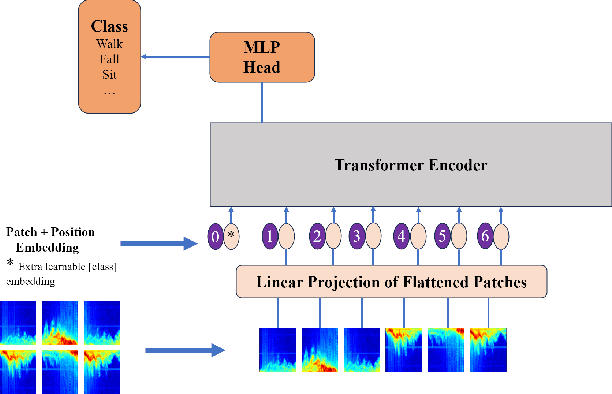
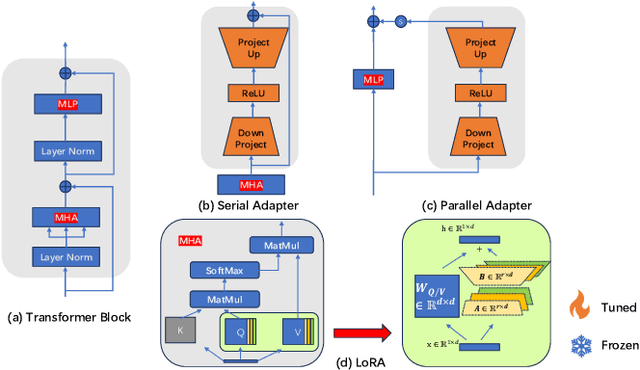
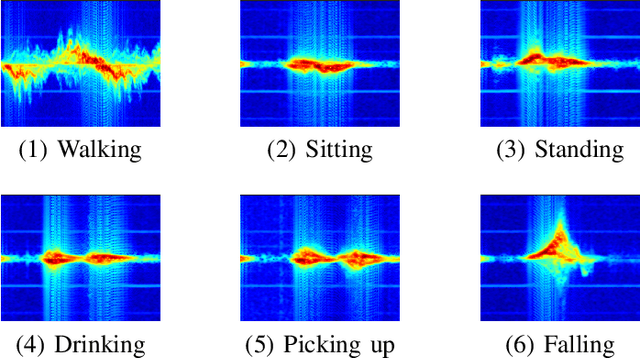
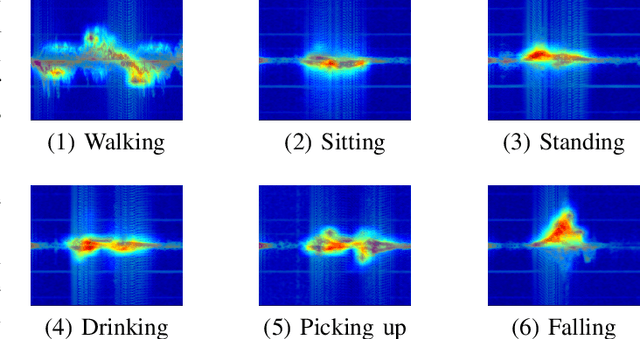
Human Activity Recognition (HAR) such as fall detection has become increasingly critical due to the aging population, necessitating effective monitoring systems to prevent serious injuries and fatalities associated with falls. This study focuses on fine-tuning the Vision Transformer (ViT) model specifically for HAR using radar-based Time-Doppler signatures. Unlike traditional image datasets, these signals present unique challenges due to their non-visual nature and the high degree of similarity among various activities. Directly fine-tuning the ViT with all parameters proves suboptimal for this application. To address this challenge, we propose a novel approach that employs Low-Rank Adaptation (LoRA) fine-tuning in the weight space to facilitate knowledge transfer from pre-trained ViT models. Additionally, to extract fine-grained features, we enhance feature representation through the integration of a serial-parallel adapter in the feature space. Our innovative joint fine-tuning method, tailored for radar-based Time-Doppler signatures, significantly improves HAR accuracy, surpassing existing state-of-the-art methodologies in this domain. Our code is released at https://github.com/wangyijunlyy/SelaFD.