 Add to Chrome
 Add to Firefox
 Add to Edge
Modality-Dependent Memory Mechanisms in Cross-Modal Neuromorphic Computing
Dec 21, 2025
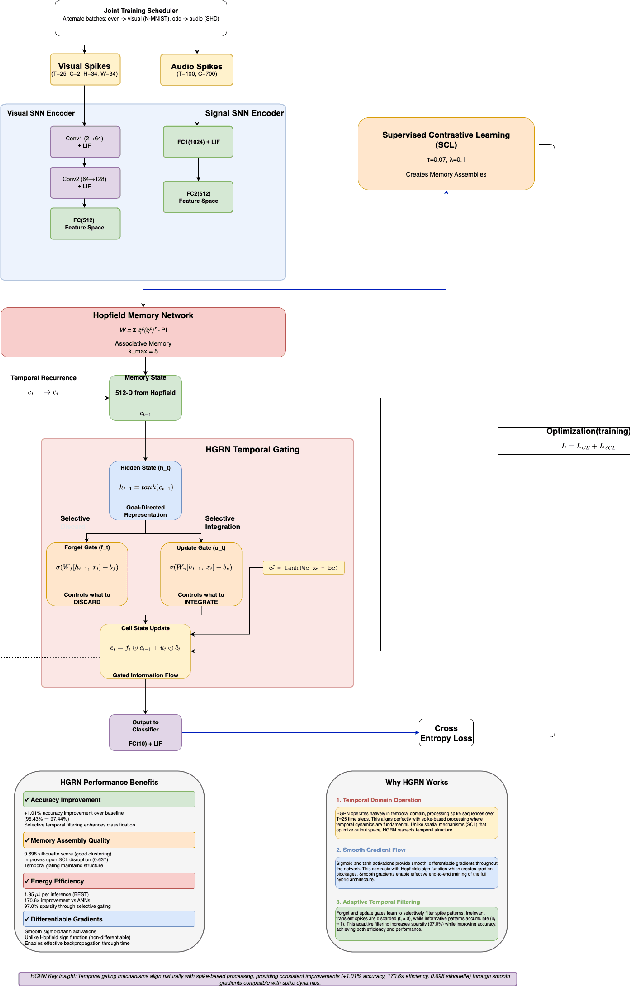
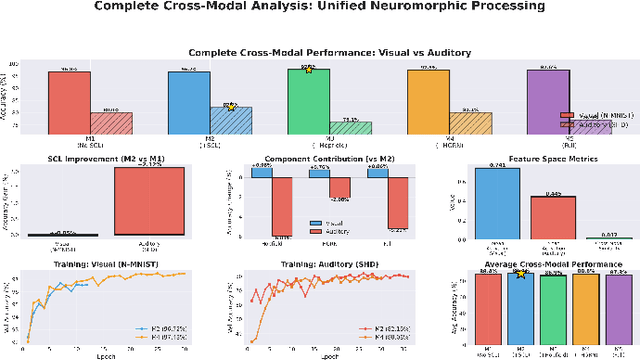
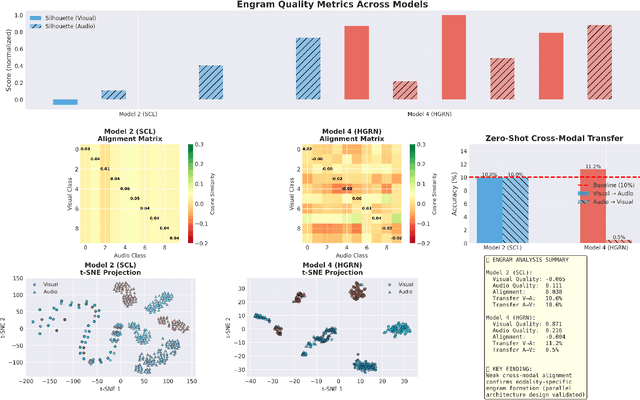
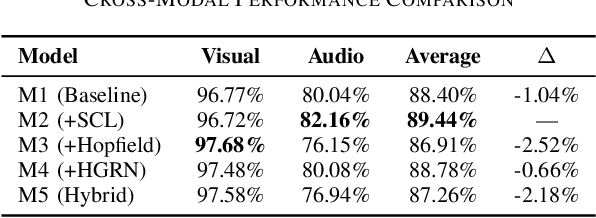
Memory-augmented spiking neural networks (SNNs) promise energy-efficient neuromorphic computing, yet their generalization across sensory modalities remains unexplored. We present the first comprehensive cross-modal ablation study of memory mechanisms in SNNs, evaluating Hopfield networks, Hierarchical Gated Recurrent Networks (HGRNs), and supervised contrastive learning (SCL) across visual (N-MNIST) and auditory (SHD) neuromorphic datasets. Our systematic evaluation of five architectures reveals striking modality-dependent performance patterns: Hopfield networks achieve 97.68% accuracy on visual tasks but only 76.15% on auditory tasks (21.53 point gap), revealing severe modality-specific specialization, while SCL demonstrates more balanced cross-modal performance (96.72% visual, 82.16% audio, 14.56 point gap). These findings establish that memory mechanisms exhibit task-specific benefits rather than universal applicability. Joint multi-modal training with HGRN achieves 94.41% visual and 79.37% audio accuracy (88.78% average), matching parallel HGRN performance through unified deployment. Quantitative engram analysis confirms weak cross-modal alignment (0.038 similarity), validating our parallel architecture design. Our work provides the first empirical evidence for modality-specific memory optimization in neuromorphic systems, achieving 603x energy efficiency over traditional neural networks.

Is GPT-OSS All You Need? Benchmarking Large Language Models for Financial Intelligence and the Surprising Efficiency Paradox
Dec 09, 2025The rapid adoption of large language models in financial services necessitates rigorous evaluation frameworks to assess their performance, efficiency, and practical applicability. This paper conducts a comprehensive evaluation of the GPT-OSS model family alongside contemporary LLMs across ten diverse financial NLP tasks. Through extensive experimentation on 120B and 20B parameter variants of GPT-OSS, we reveal a counterintuitive finding: the smaller GPT-OSS-20B model achieves comparable accuracy (65.1% vs 66.5%) while demonstrating superior computational efficiency with 198.4 Token Efficiency Score and 159.80 tokens per second processing speed [1]. Our evaluation encompasses sentiment analysis, question answering, and entity recognition tasks using real-world financial datasets including Financial PhraseBank, FiQA-SA, and FLARE FINERORD. We introduce novel efficiency metrics that capture the trade-off between model performance and resource utilization, providing critical insights for deployment decisions in production environments. The benchmark reveals that GPT-OSS models consistently outperform larger competitors including Qwen3-235B, challenging the prevailing assumption that model scale directly correlates with task performance [2]. Our findings demonstrate that architectural innovations and training strategies in GPT-OSS enable smaller models to achieve competitive performance with significantly reduced computational overhead, offering a pathway toward sustainable and cost-effective deployment of LLMs in financial applications.
Is GPT-OSS Good? A Comprehensive Evaluation of OpenAI's Latest Open Source Models
Aug 17, 2025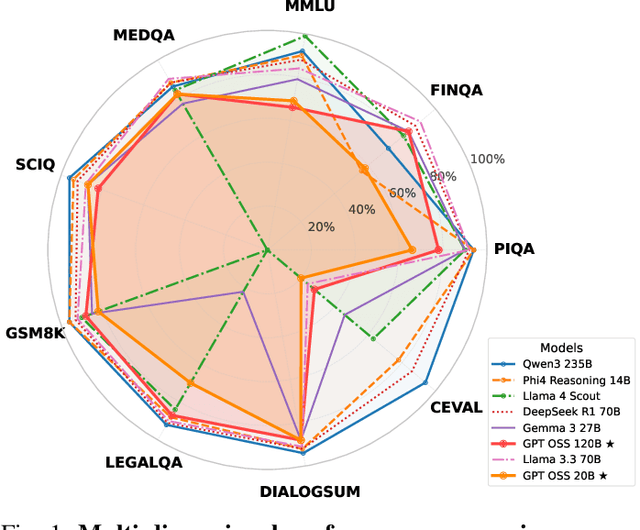
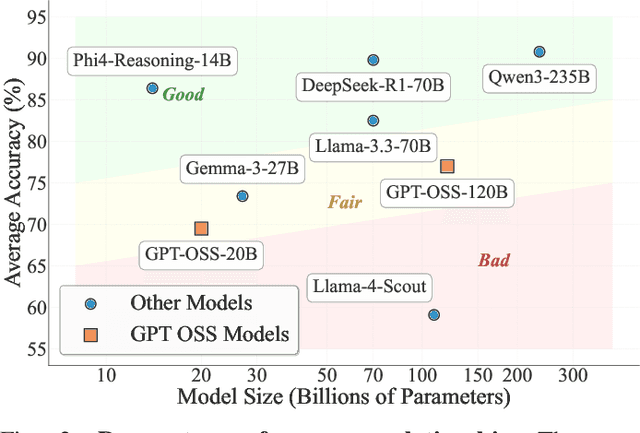
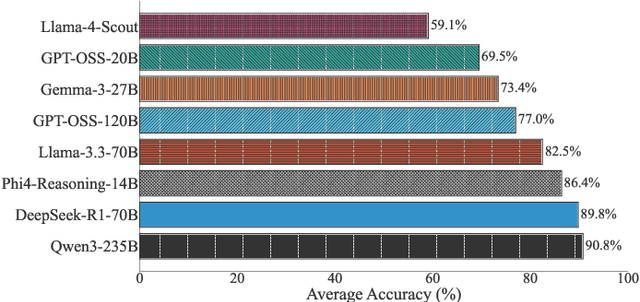
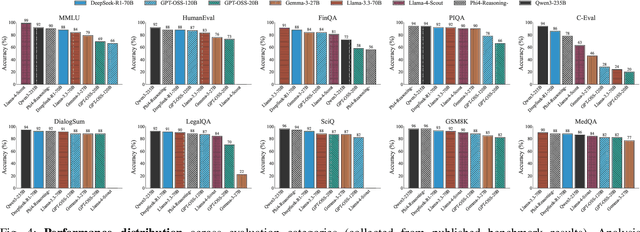
In August 2025, OpenAI released GPT-OSS models, its first open weight large language models since GPT-2 in 2019, comprising two mixture of experts architectures with 120B and 20B parameters. We evaluated both variants against six contemporary open source large language models ranging from 14.7B to 235B parameters, representing both dense and sparse designs, across ten benchmarks covering general knowledge, mathematical reasoning, code generation, multilingual understanding, and conversational ability. All models were tested in unquantised form under standardised inference settings, with statistical validation using McNemars test and effect size analysis. Results show that gpt-oss-20B consistently outperforms gpt-oss-120B on several benchmarks, such as HumanEval and MMLU, despite requiring substantially less memory and energy per response. Both models demonstrate mid-tier overall performance within the current open source landscape, with relative strength in code generation and notable weaknesses in multilingual tasks. These findings provide empirical evidence that scaling in sparse architectures may not yield proportional performance gains, underscoring the need for further investigation into optimisation strategies and informing more efficient model selection for future open source deployments.
Active Learning Methods for Efficient Data Utilization and Model Performance Enhancement
Apr 21, 2025In the era of data-driven intelligence, the paradox of data abundance and annotation scarcity has emerged as a critical bottleneck in the advancement of machine learning. This paper gives a detailed overview of Active Learning (AL), which is a strategy in machine learning that helps models achieve better performance using fewer labeled examples. It introduces the basic concepts of AL and discusses how it is used in various fields such as computer vision, natural language processing, transfer learning, and real-world applications. The paper focuses on important research topics such as uncertainty estimation, handling of class imbalance, domain adaptation, fairness, and the creation of strong evaluation metrics and benchmarks. It also shows that learning methods inspired by humans and guided by questions can improve data efficiency and help models learn more effectively. In addition, this paper talks about current challenges in the field, including the need to rebuild trust, ensure reproducibility, and deal with inconsistent methodologies. It points out that AL often gives better results than passive learning, especially when good evaluation measures are used. This work aims to be useful for both researchers and practitioners by providing key insights and proposing directions for future progress in active learning.