 Add to Chrome
 Add to Firefox
 Add to Edge
Reading Between the Frames: Interpreting Implicit and Non-literal Meaning in Social Media Videos
Aug 05, 2026
Social media videos often communicate meanings that go beyond their visible actions, captions, or speech. A mundane clip may become humorous, ironic, or satire only through the interaction of multimodal cues and cultural context, making such content a difficult test case for video-language models. In this paper, we introduce \textit{DrivelHub+}, a benchmark for evaluating whether models can infer the implicit, non-linear, and rhetorically layered meanings of social media videos that appear nonsensical on the surface but convey deliberate pragmatic meanings. DrivelHub+ consists of 1,000 videos collected from social media, each annotated with a human-written implicit narrative explanation. Unlike conventional video understanding tasks focused on recognition or description, we present a benchmark that targets contextual multimodal reasoning. We evaluate current video-language models from two perspectives: explanation, where models must explain the pragmatic comprehension of a video in natural language; and representation, where we adapt reasoning-as-retrieval to test whether model representations align videos with their corresponding implicit narratives in both video-to-text and text-to-video retrieval. Our benchmark provides a diagnostic setting for measuring the gap between multimodal perception and pragmatic comprehension, asking whether current models can move beyond describing what is shown to inferring what is meant.

Drivel-ology: Challenging LLMs with Interpreting Nonsense with Depth
Sep 04, 2025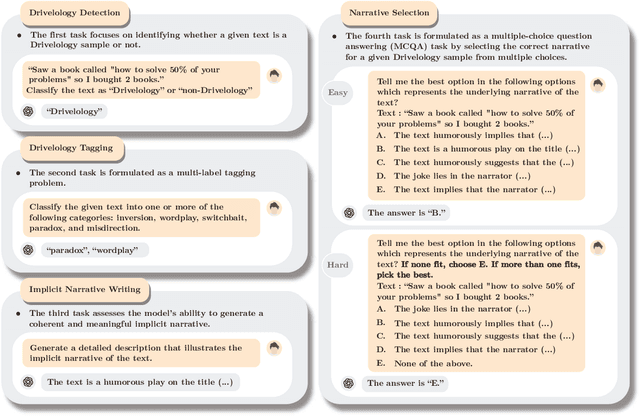
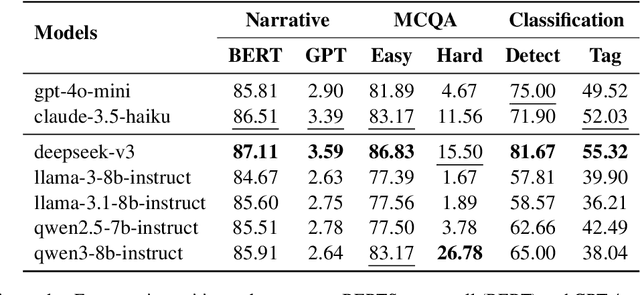
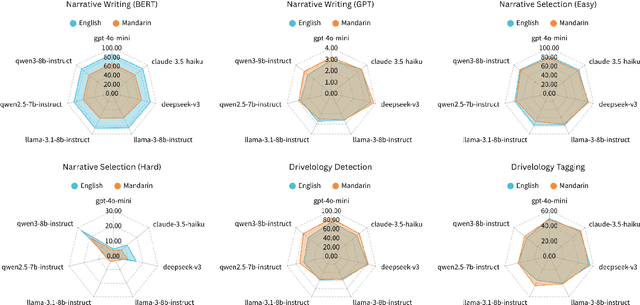
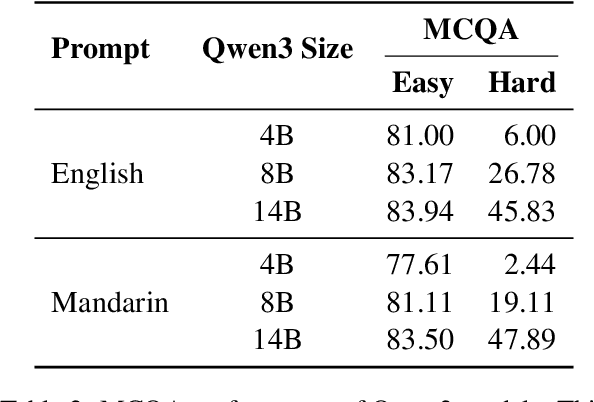
We introduce Drivelology, a unique linguistic phenomenon characterised as "nonsense with depth", utterances that are syntactically coherent yet pragmatically paradoxical, emotionally loaded, or rhetorically subversive. While such expressions may resemble surface-level nonsense, they encode implicit meaning requiring contextual inference, moral reasoning, or emotional interpretation. We find that current large language models (LLMs), despite excelling at many natural language processing (NLP) tasks, consistently fail to grasp the layered semantics of Drivelological text. To investigate this, we construct a small but diverse benchmark dataset of over 1,200 meticulously curated examples, with select instances in English, Mandarin, Spanish, French, Japanese, and Korean. Annotation was especially challenging: each of the examples required careful expert review to verify that it truly reflected Drivelological characteristics. The process involved multiple rounds of discussion and adjudication to address disagreements, highlighting the subtle and subjective nature of the Drivelology. We evaluate a range of LLMs on classification, generation, and reasoning tasks. Our results reveal clear limitations of LLMs: models often confuse Drivelology with shallow nonsense, produce incoherent justifications, or miss the implied rhetorical function altogether. These findings highlight a deeper representational gap in LLMs' pragmatic understanding and challenge the assumption that statistical fluency implies cognitive comprehension. We release our dataset and code to facilitate further research in modelling linguistic depth beyond surface-level coherence.