 Add to Chrome
 Add to Firefox
 Add to Edge
SPARC: Scenario Planning and Reasoning for Automated C Unit Test Generation
Feb 18, 2026
Automated unit test generation for C remains a formidable challenge due to the semantic gap between high-level program intent and the rigid syntactic constraints of pointer arithmetic and manual memory management. While Large Language Models (LLMs) exhibit strong generative capabilities, direct intent-to-code synthesis frequently suffers from the leap-to-code failure mode, where models prematurely emit code without grounding in program structure, constraints, and semantics. This will result in non-compilable tests, hallucinated function signatures, low branch coverage, and semantically irrelevant assertions that cannot properly capture bugs. We introduce SPARC, a neuro-symbolic, scenario-based framework that bridges this gap through four stages: (1) Control Flow Graph (CFG) analysis, (2) an Operation Map that grounds LLM reasoning in validated utility helpers, (3) Path-targeted test synthesis, and (4) an iterative, self-correction validation loop using compiler and runtime feedback. We evaluate SPARC on 59 real-world and algorithmic subjects, where it outperforms the vanilla prompt generation baseline by 31.36% in line coverage, 26.01% in branch coverage, and 20.78% in mutation score, matching or exceeding the symbolic execution tool KLEE on complex subjects. SPARC retains 94.3% of tests through iterative repair and produces code with significantly higher developer-rated readability and maintainability. By aligning LLM reasoning with program structure, SPARC provides a scalable path for industrial-grade testing of legacy C codebases.

DeSTA2.5-Audio: Toward General-Purpose Large Audio Language Model with Self-Generated Cross-Modal Alignment
Jul 03, 2025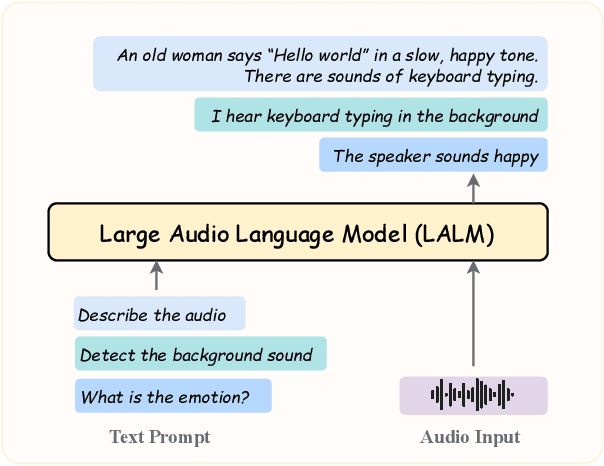
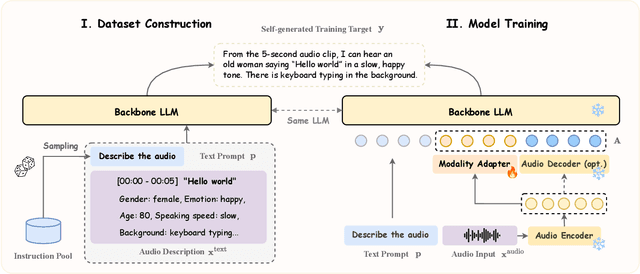
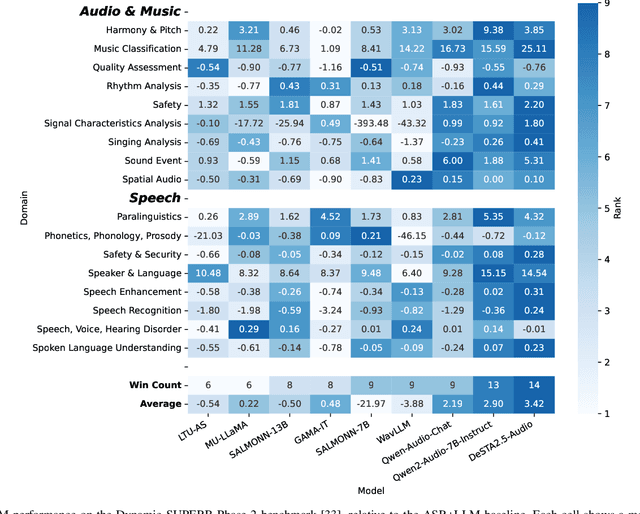
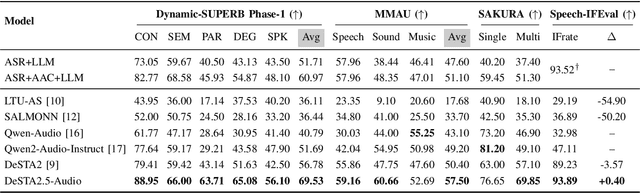
We introduce DeSTA2.5-Audio, a general-purpose Large Audio Language Model (LALM) designed for robust auditory perception and instruction-following, without requiring task-specific audio instruction-tuning. Recent LALMs typically augment Large Language Models (LLMs) with auditory capabilities by training on large-scale, manually curated or LLM-synthesized audio-instruction datasets. However, these approaches have often suffered from the catastrophic forgetting of the LLM's original language abilities. To address this, we revisit the data construction pipeline and propose DeSTA, a self-generated cross-modal alignment strategy in which the backbone LLM generates its own training targets. This approach preserves the LLM's native language proficiency while establishing effective audio-text alignment, thereby enabling zero-shot generalization without task-specific tuning. Using DeSTA, we construct DeSTA-AQA5M, a large-scale, task-agnostic dataset containing 5 million training samples derived from 7,000 hours of audio spanning 50 diverse datasets, including speech, environmental sounds, and music. DeSTA2.5-Audio achieves state-of-the-art or competitive performance across a wide range of audio-language benchmarks, including Dynamic-SUPERB, MMAU, SAKURA, Speech-IFEval, and VoiceBench. Comprehensive comparative studies demonstrate that our self-generated strategy outperforms widely adopted data construction and training strategies in both auditory perception and instruction-following capabilities. Our findings underscore the importance of carefully designed data construction in LALM development and offer practical insights for building robust, general-purpose LALMs.