 Add to Chrome
 Add to Firefox
 Add to Edge
MM-SCALE: Grounded Multimodal Moral Reasoning via Scalar Judgment and Listwise Alignment
Feb 03, 2026
Vision-Language Models (VLMs) continue to struggle to make morally salient judgments in multimodal and socially ambiguous contexts. Prior works typically rely on binary or pairwise supervision, which often fail to capture the continuous and pluralistic nature of human moral reasoning. We present MM-SCALE (Multimodal Moral Scale), a large-scale dataset for aligning VLMs with human moral preferences through 5-point scalar ratings and explicit modality grounding. Each image-scenario pair is annotated with moral acceptability scores and grounded reasoning labels by humans using an interface we tailored for data collection, enabling listwise preference optimization over ranked scenario sets. By moving from discrete to scalar supervision, our framework provides richer alignment signals and finer calibration of multimodal moral reasoning. Experiments show that VLMs fine-tuned on MM-SCALE achieve higher ranking fidelity and more stable safety calibration than those trained with binary signals.

Emotional Support Evaluation Framework via Controllable and Diverse Seeker Simulator
Jan 12, 2026As emotional support chatbots have recently gained significant traction across both research and industry, a common evaluation strategy has emerged: use help-seeker simulators to interact with supporter chatbots. However, current simulators suffer from two critical limitations: (1) they fail to capture the behavioral diversity of real-world seekers, often portraying them as overly cooperative, and (2) they lack the controllability required to simulate specific seeker profiles. To address these challenges, we present a controllable seeker simulator driven by nine psychological and linguistic features that underpin seeker behavior. Using authentic Reddit conversations, we train our model via a Mixture-of-Experts (MoE) architecture, which effectively differentiates diverse seeker behaviors into specialized parameter subspaces, thereby enhancing fine-grained controllability. Our simulator achieves superior profile adherence and behavioral diversity compared to existing approaches. Furthermore, evaluating 7 prominent supporter models with our system uncovers previously obscured performance degradations. These findings underscore the utility of our framework in providing a more faithful and stress-tested evaluation for emotional support chatbots.
Comparing Neighbors Together Makes it Easy: Jointly Comparing Multiple Candidates for Efficient and Effective Retrieval
May 21, 2024
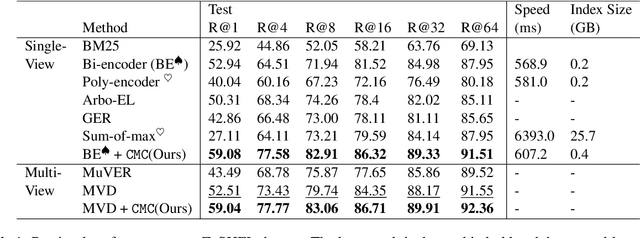


A common retrieve-and-rerank paradigm involves retrieving a broad set of relevant candidates using a scalable bi-encoder, followed by expensive but more accurate cross-encoders to a limited candidate set. However, this small subset often leads to error propagation from the bi-encoders, thereby restricting the performance of the overall pipeline. To address these issues, we propose the Comparing Multiple Candidates (CMC) framework, which compares a query and multiple candidate embeddings jointly through shallow self-attention layers. While providing contextualized representations, CMC is scalable enough to handle multiple comparisons simultaneously, where comparing 2K candidates takes only twice as long as comparing 100. Practitioners can use CMC as a lightweight and effective reranker to improve top-1 accuracy. Moreover, when integrated with another retriever, CMC reranking can function as a virtually enhanced retriever. This configuration adds only negligible latency compared to using a single retriever (virtual), while significantly improving recall at K (enhanced).} Through experiments, we demonstrate that CMC, as a virtually enhanced retriever, significantly improves Recall@k (+6.7, +3.5%-p for R@16, R@64) compared to the initial retrieval stage on the ZeSHEL dataset. Meanwhile, we conduct experiments for direct reranking on entity, passage, and dialogue ranking. The results indicate that CMC is not only faster (11x) than cross-encoders but also often more effective, with improved prediction performance in Wikipedia entity linking (+0.7%-p) and DSTC7 dialogue ranking (+3.3%-p). The code and link to datasets are available at https://github.com/yc-song/cmc