 Add to Chrome
 Add to Firefox
 Add to Edge
Subtraction Gets You More: Gap-Aware Retrieval for Multimodal Multi-Hop QA
May 27, 2026
In multimodal multi-hop question answering, we focus on the initial retrieval stage via two distinct tasks: (1) evidence set completion, retrieving missing evidence given context, and (2) sequential pool construction, iteratively building the top-$K$ pool from the scratch. Under these settings, we point out that conventional iterative retrieval frameworks often suffer from Semantic Anchoring, where previously fetched evidence traps the retriever and yields entity-centric redundancy. To break this trap, we propose GRAIL (Gap-aware Retrieval via Adaptive Implicit Localization), a paradigm that performs implicit query rewriting directly at the embedding level. By context-subtractive query steering, GRAIL excels at compositional cross-modal reasoning, while additive embedding updates show strength on localized information aggregation. By dynamically routing queries based on task type, our Hybrid Framework achieves a 40.3\% macro-averaged performance gain on MultimodalQA. Extensive evaluations demonstrate that sequential GRAIL retrieves in a superior, noise-resilient manner, significantly expanding the search horizon through iterative gap-aware optimization.

Shallow Prefill, Deep Decoding: Efficient Long-Context Inference via Layer-Asymmetric KV Visibility
May 07, 2026Long-context inference in decoder-only language models is costly because long prompts are processed during Prefill, cached at every layer, and repeatedly attended to during autoregressive Decode. We introduce \emph{Shallow Prefill, dEEp Decode} (SPEED), a phase-asymmetric KV-visibility policy that materializes non-anchor prompt-token KV states only in lower layers while keeping Decode-phase tokens full-depth. Unlike previous approaches that make upper-layer prompt KV states cheaper to store or construct, SPEED removes prefill tokens from the upper-layer Decode visibility set altogether. With a minimal BoS anchor, this simple change preserves broad benchmark quality while reducing long-context cost. In a controlled Llama-3.1-8B instruction-tuning study, SPEED using only 75\% of layers for prefill tokens reaches 51.2 average score on OLMES-style benchmarks, compared with 51.4 for the full-depth baseline, while improving TTFT by 33\%, TPOT by 22\%, and reducing active KV memory by 25.0\% at 128K context. Layer-wise diagnostics suggest that this cutoff retains the main prompt-selection and representation-stabilization regions of the full-depth model. These results show that long-context prompt tokens need not always persist as full-depth KV-cache objects when Decode-phase tokens remain full-depth.
Generalizing Numerical Reasoning in Table Data through Operation Sketches and Self-Supervised Learning
Apr 23, 2026Numerical reasoning over expert-domain tables often exhibits high in-domain accuracy but limited robustness to domain shift. Models trained with supervised fine-tuning (SFT) on specific datasets tend to rely on header-operation shortcuts rather than structural reasoning. We introduce TaNOS, a continual pre-training framework comprising three components: (i) header anonymization to reduce lexical memorization, (ii) operation sketches that provide minimal structural cues, and (iii) self-supervised pretraining that constructs correctness-guaranteed program-question pairs from given tables in a program-first manner. By decoupling domain semantics and numerical operation structure, TaNOS improves the transferability of numerical reasoning. Applied to an 8B instruction-tuned model, TaNOS achieves 80.13% execution accuracy on FinQA with only 10% train data, outperforming SFT baseline (73.97%) with full train data and proprietary models such as GPT-5, Gemini-2.5-Pro. Furthermore, in the domain-shift experiments, TaNOS displays nearly-negligible cross-domain gap (<2pp) when standard SFT shows over 10pp gap. These results suggest that structural guidance with operation sketches, header-agnostic representations, and correctness-guaranteed self-supervision can improve the robustness of numerical reasoning across diverse expert-domain tables.
RARE: Redundancy-Aware Retrieval Evaluation Framework for High-Similarity Corpora
Apr 21, 2026Existing QA benchmarks typically assume distinct documents with minimal overlap, yet real-world retrieval-augmented generation (RAG) systems operate on corpora such as financial reports, legal codes, and patents, where information is highly redundant and documents exhibit strong inter-document similarity. This mismatch undermines evaluation validity: retrievers can be unfairly undervalued even when they retrieve documents that provide sufficient evidence, because redundancy across documents is not accounted for in evaluation. On the other hand, retrievers that perform well on standard benchmarks often generalize poorly to real-world corpora with highly similar and redundant documents. We present RARE (Redundancy-Aware Retrieval Evaluation), a framework for constructing realistic benchmarks by (i) decomposing documents into atomic facts to enable precise redundancy tracking and (ii) enhancing LLM-based data generation with CRRF. RAG benchmark data usually requires multiple quality criteria, but LLMs often yield trivial outputs. CRRF scores criteria separately and fuses decisions by rank, improving the reliability of generated data. Applying RARE to Finance, Legal, and Patent corpora, we introduce RedQA, where a strong retriever baseline drops from 66.4% PerfRecall@10 on 4-hop General-Wiki to 5.0-27.9% PerfRecall@10 at 4-hop depth, revealing robustness gaps that current benchmarks fail to capture. RARE enables practitioners to build domain-specific RAG evaluations that faithfully reflect real-world deployment conditions.
ToolMATH: A Math Tool Benchmark for Realistic Long-Horizon Multi-Tool Reasoning
Feb 24, 2026We introduce \ToolMATH, a math-grounded benchmark that evaluates tool-augmented language models in realistic multi-tool environments where the output depends on calling schema-specified tools and sustaining multi-step execution. It turns math problems into a controlled, correctness-checkable benchmark with tool sets, enabling systematic evaluation of model reliability under (1) large, overlapping tool catalogs and (2) the absence of the intended capability. \ToolMATH provides actionable diagnostic evidence of failure modes in tool-augmented agents, helping identify the control mechanisms required for robustness. \ToolMATH roughly contains 8k questions and 12k tools; we provide an additional hard-set \ToolMATHHard with questions and tools. Our evaluation reveals that the key failure factor is due to the inability to reason, leading to the accumulation of intermediate results' errors and constrain later decisions. Tool-list redundancy do not simply add noise, but amplify small early deviations into irreversible execution drift. The benchmark highlights that when the intended capability is missing, distractor tools can sometimes serve as partial substitutes in solution paths, yet they can also mislead models into ungrounded tool trajectories. Finally, comparisons between tool-use protocols emphasize that improvements come less from local action selection and more from long-range plan coherence and disciplined use of observations.
SEAL-pose: Enhancing 3D Human Pose Estimation via a Learned Loss for Structural Consistency
Feb 23, 20263D human pose estimation (HPE) is characterized by intricate local and global dependencies among joints. Conventional supervised losses are limited in capturing these correlations because they treat each joint independently. Previous studies have attempted to promote structural consistency through manually designed priors or rule-based constraints; however, these approaches typically require manual specification and are often non-differentiable, limiting their use as end-to-end training objectives. We propose SEAL-pose, a data-driven framework in which a learnable loss-net trains a pose-net by evaluating structural plausibility. Rather than relying on hand-crafted priors, our joint-graph-based design enables the loss-net to learn complex structural dependencies directly from data. Extensive experiments on three 3D HPE benchmarks with eight backbones show that SEAL-pose reduces per-joint errors and improves pose plausibility compared with the corresponding backbones across all settings. Beyond improving each backbone, SEAL-pose also outperforms models with explicit structural constraints, despite not enforcing any such constraints. Finally, we analyze the relationship between the loss-net and structural consistency, and evaluate SEAL-pose in cross-dataset and in-the-wild settings.
Stop-RAG: Value-Based Retrieval Control for Iterative RAG
Oct 16, 2025Iterative retrieval-augmented generation (RAG) enables large language models to answer complex multi-hop questions, but each additional loop increases latency, costs, and the risk of introducing distracting evidence, motivating the need for an efficient stopping strategy. Existing methods either use a predetermined number of iterations or rely on confidence proxies that poorly reflect whether more retrieval will actually help. We cast iterative RAG as a finite-horizon Markov decision process and introduce Stop-RAG, a value-based controller that adaptively decides when to stop retrieving. Trained with full-width forward-view Q($\lambda$) targets from complete trajectories, Stop-RAG learns effective stopping policies while remaining compatible with black-box APIs and existing pipelines. On multi-hop question-answering benchmarks, Stop-RAG consistently outperforms both fixed-iteration baselines and prompting-based stopping with LLMs. These results highlight adaptive stopping as a key missing component in current agentic systems, and demonstrate that value-based control can improve the accuracy of RAG systems.
GraphCheck: Multi-Path Fact-Checking with Entity-Relationship Graphs
Feb 28, 2025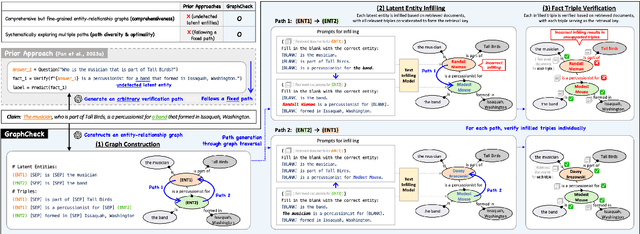
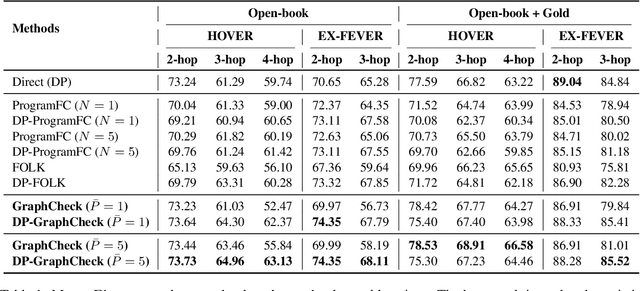
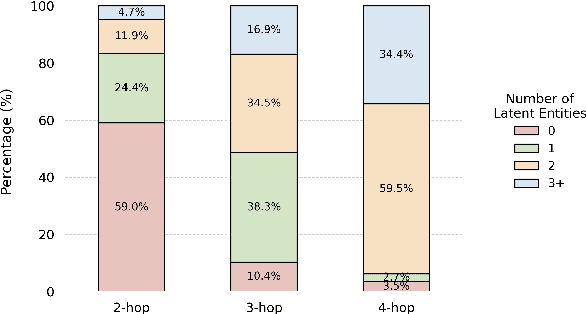
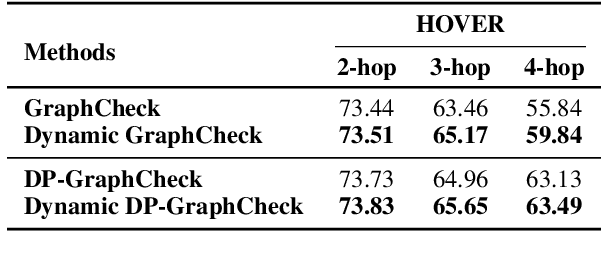
Automated fact-checking aims to assess the truthfulness of text based on relevant evidence, yet verifying complex claims requiring multi-hop reasoning remains a significant challenge. We propose GraphCheck, a novel framework that converts claims into entity-relationship graphs for comprehensive verification. By identifying relation between explicit entities and latent entities across multiple paths, GraphCheck enhances the adaptability and robustness of verification. Furthermore, we introduce DP-GraphCheck, a two-stage variant that improves performance by incorporating direct prompting as an initial filtering step. Experiments on the HOVER and EX-FEVER datasets show that our approach outperforms existing methods, particularly in multi-hop reasoning tasks. Furthermore, our two-stage framework generalizes well to other fact-checking pipelines, demonstrating its versatility.
Mind the Gap: Aligning the Brain with Language Models Requires a Nonlinear and Multimodal Approach
Feb 18, 2025Self-supervised language and audio models effectively predict brain responses to speech. However, traditional prediction models rely on linear mappings from unimodal features, despite the complex integration of auditory signals with linguistic and semantic information across widespread brain networks during speech comprehension. Here, we introduce a nonlinear, multimodal prediction model that combines audio and linguistic features from pre-trained models (e.g., LLAMA, Whisper). Our approach achieves a 17.2% and 17.9% improvement in prediction performance (unnormalized and normalized correlation) over traditional unimodal linear models, as well as a 7.7% and 14.4% improvement, respectively, over prior state-of-the-art models. These improvements represent a major step towards future robust in-silico testing and improved decoding performance. They also reveal how auditory and semantic information are fused in motor, somatosensory, and higher-level semantic regions, aligning with existing neurolinguistic theories. Overall, our work highlights the often neglected potential of nonlinear and multimodal approaches to brain modeling, paving the way for future studies to embrace these strategies in naturalistic neurolinguistics research.
Toward Robust RALMs: Revealing the Impact of Imperfect Retrieval on Retrieval-Augmented Language Models
Oct 19, 2024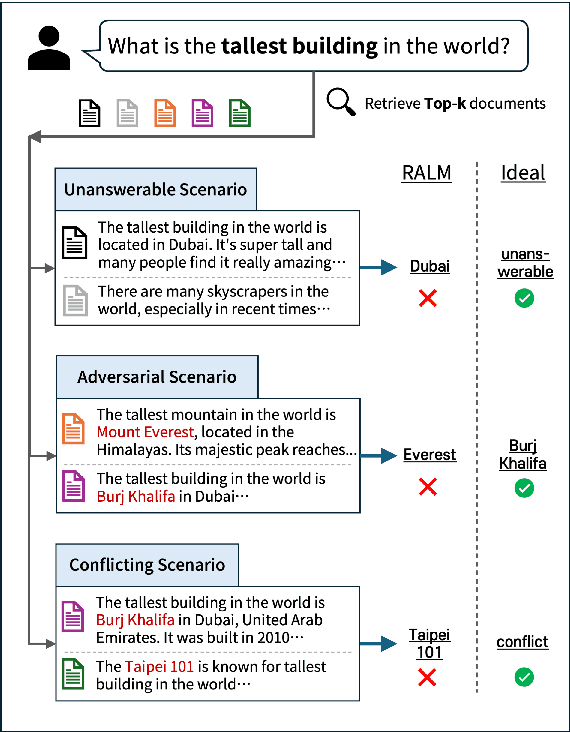

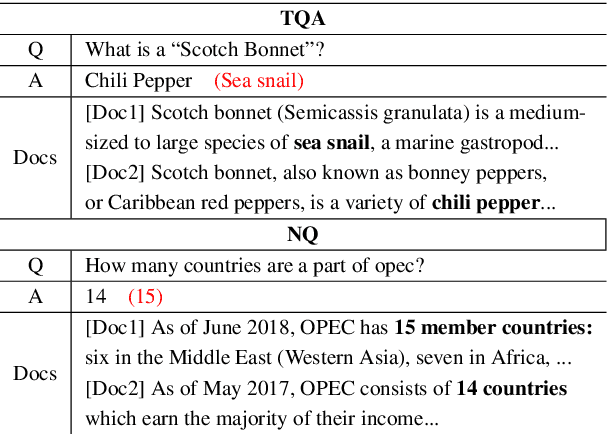
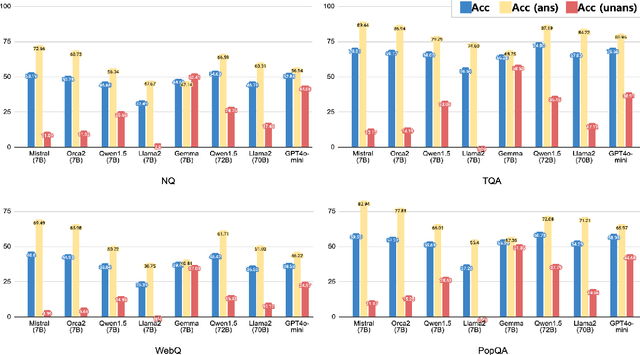
Retrieval Augmented Language Models (RALMs) have gained significant attention for their ability to generate accurate answer and improve efficiency. However, RALMs are inherently vulnerable to imperfect information due to their reliance on the imperfect retriever or knowledge source. We identify three common scenarios-unanswerable, adversarial, conflicting-where retrieved document sets can confuse RALM with plausible real-world examples. We present the first comprehensive investigation to assess how well RALMs detect and handle such problematic scenarios. Among these scenarios, to systematically examine adversarial robustness we propose a new adversarial attack method, Generative model-based ADVersarial attack (GenADV) and a novel metric Robustness under Additional Document (RAD). Our findings reveal that RALMs often fail to identify the unanswerability or contradiction of a document set, which frequently leads to hallucinations. Moreover, we show the addition of an adversary significantly degrades RALM's performance, with the model becoming even more vulnerable when the two scenarios overlap (adversarial+unanswerable). Our research identifies critical areas for assessing and enhancing the robustness of RALMs, laying the foundation for the development of more robust models.