 Add to Chrome
 Add to Firefox
 Add to Edge
Trajectory Optimization for Collision-Aware Redundant Robotic Multi-Axis Additive Manufacturing by Constrained Gradient Projection
Jun 29, 2026
Redundant robotic multi-axis additive manufacturing (MAAM) enables support-free and conformal fabrication, but trajectory optimization for long-horizon paths remains challenging under strict deposition-position constraints and time-varying collision constraints. This work proposes a computational framework for collision-aware trajectory optimization in redundant robotic MAAM. We first formulate nozzle-workpiece relative kinematics using a relative Jacobian, and develop a differentiable SDF-based collision model that captures fabrication-induced geometry evolution and provides optimization gradients. The deposition position is then enforced as a hard waypoint-wise equality constraint through iterative projection onto the self-motion manifold, with the loss gradient restricted to the corresponding tangent space. Experiments on an 8-DOF robotic MAAM platform with diverse long-horizon support-free and conformal toolpaths show that our method maintains a mean nozzle-position error below 10μm, reduces maximum joint jerk by up to $77.6\%$, and eliminates all sampled collision and orientation violations. Compared with the SQP-based baseline, it achieves up to a 10.2x speedup and improved convergence. Physical fabrication experiments further verify that the resulting smooth, collision-free trajectories enable successful printing of complex geometries with fewer visible deposition artifacts.

Scale-Adaptive Power Flow Analysis with Local Topology Slicing and Multi-Task Graph Learning
Jan 04, 2026Developing deep learning models with strong adaptability to topological variations is of great practical significance for power flow analysis. To enhance model performance under variable system scales and improve robustness in branch power prediction, this paper proposes a Scale-adaptive Multi-task Power Flow Analysis (SaMPFA) framework. SaMPFA introduces a Local Topology Slicing (LTS) sampling technique that extracts subgraphs of different scales from the complete power network to strengthen the model's cross-scale learning capability. Furthermore, a Reference-free Multi-task Graph Learning (RMGL) model is designed for robust power flow prediction. Unlike existing approaches, RMGL predicts bus voltages and branch powers instead of phase angles. This design not only avoids the risk of error amplification in branch power calculation but also guides the model to learn the physical relationships of phase angle differences. In addition, the loss function incorporates extra terms that encourage the model to capture the physical patterns of angle differences and power transmission, further improving consistency between predictions and physical laws. Simulations on the IEEE 39-bus system and a real provincial grid in China demonstrate that the proposed model achieves superior adaptability and generalization under variable system scales, with accuracy improvements of 4.47% and 36.82%, respectively.
On Minimization/Maximization of the Generalized Multi-Order Complex Quadratic Form With Constant-Modulus Constraints
Aug 27, 2025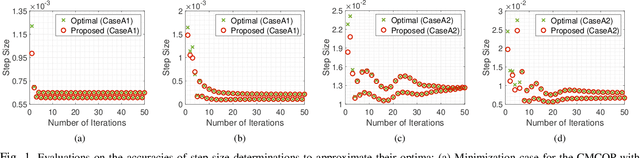
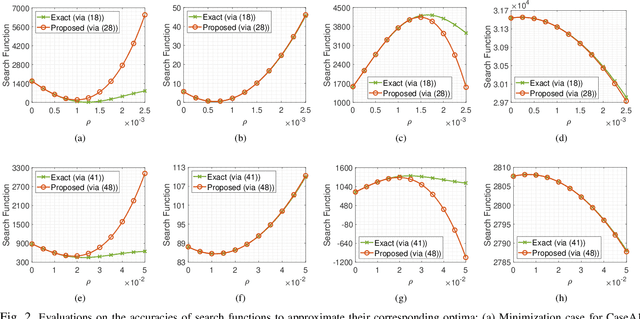
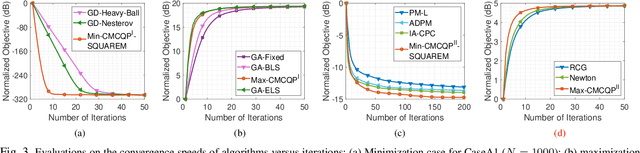

In this paper, we study the generalized problem that minimizes or maximizes a multi-order complex quadratic form with constant-modulus constraints on all elements of its optimization variable. Such a mathematical problem is commonly encountered in various applications of signal processing. We term it as the constant-modulus multi-order complex quadratic programming (CMCQP) in this paper. In general, the CMCQP is non-convex and difficult to solve. Its objective function typically relates to metrics such as signal-to-noise ratio, Cram\'er-Rao bound, integrated sidelobe level, etc., and constraints normally correspond to requirements on similarity to desired aspects, peak-to-average-power ratio, or constant-modulus property in practical scenarios. In order to find efficient solutions to the CMCQP, we first reformulate it into an unconstrained optimization problem with respect to phase values of the studied variable only. Then, we devise a steepest descent/ascent method with fast determinations on its optimal step sizes. Specifically, we convert the step-size searching problem into a polynomial form that leads to closed-form solutions of high accuracy, wherein the third-order Taylor expansion of the search function is conducted. Our major contributions also lie in investigating the effect of the order and specific form of matrices embedded in the CMCQP, for which two representative cases are identified. Examples of related applications associated with the two cases are also provided for completeness. The proposed methods are summarized into algorithms, whose convergence speeds are verified to be fast by comprehensive simulations and comparisons to existing methods. The accuracy of our proposed fast step-size determination is also evaluated.