 Add to Chrome
 Add to Firefox
 Add to Edge
NavOne: One-Step Global Planning for Vision-Language Navigation on Top-Down Maps
May 07, 2026
Existing Vision-Language Navigation (VLN) methods typically adopt an egocentric, step-by-step paradigm, which struggles with error accumulation and limits efficiency. While recent approaches attempt to leverage pre-built environment maps, they often rely on incrementally updating memory graphs or scoring discrete path proposals, which restricts continuous spatial reasoning and creates discrete bottlenecks. We propose Top-Down VLN (TD-VLN), reformulating navigation as a one-step global path planning problem on pre-built top-down maps, supported by our newly constructed R2R-TopDown dataset. To solve this, we introduce NavOne, a unified framework that directly predicts dense path probabilities over multi-modal maps in a single end-to-end forward pass. NavOne features a Top-Down Map Fuser for joint multi-modal map representation, and extends Attention Residuals for spatial-aware depth mixing. Extensive experiments on R2R-TopDown show that NavOne achieves state-of-the-art performance among map-based VLN methods, with a planning-stage speedup of 8x over existing map-based baselines and 80x over egocentric methods, enabling highly efficient global navigation.

RecDreamer: Consistent Text-to-3D Generation via Uniform Score Distillation
Feb 18, 2025Current text-to-3D generation methods based on score distillation often suffer from geometric inconsistencies, leading to repeated patterns across different poses of 3D assets. This issue, known as the Multi-Face Janus problem, arises because existing methods struggle to maintain consistency across varying poses and are biased toward a canonical pose. While recent work has improved pose control and approximation, these efforts are still limited by this inherent bias, which skews the guidance during generation. To address this, we propose a solution called RecDreamer, which reshapes the underlying data distribution to achieve a more consistent pose representation. The core idea behind our method is to rectify the prior distribution, ensuring that pose variation is uniformly distributed rather than biased toward a canonical form. By modifying the prescribed distribution through an auxiliary function, we can reconstruct the density of the distribution to ensure compliance with specific marginal constraints. In particular, we ensure that the marginal distribution of poses follows a uniform distribution, thereby eliminating the biases introduced by the prior knowledge. We incorporate this rectified data distribution into existing score distillation algorithms, a process we refer to as uniform score distillation. To efficiently compute the posterior distribution required for the auxiliary function, RecDreamer introduces a training-free classifier that estimates pose categories in a plug-and-play manner. Additionally, we utilize various approximation techniques for noisy states, significantly improving system performance. Our experimental results demonstrate that RecDreamer effectively mitigates the Multi-Face Janus problem, leading to more consistent 3D asset generation across different poses.
Rotation-Adaptive Point Cloud Domain Generalization via Intricate Orientation Learning
Feb 04, 2025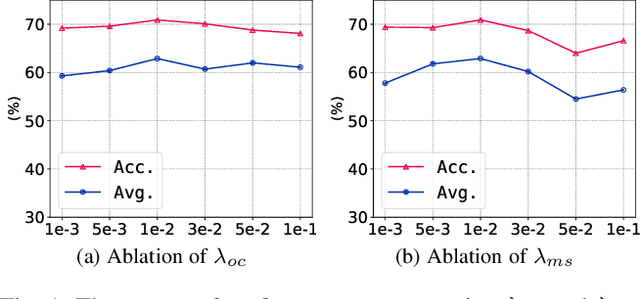

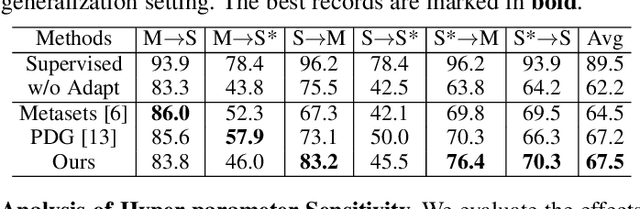
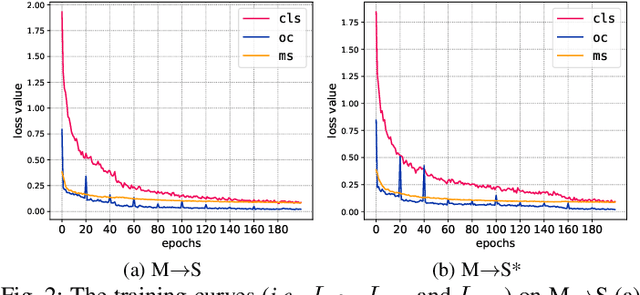
The vulnerability of 3D point cloud analysis to unpredictable rotations poses an open yet challenging problem: orientation-aware 3D domain generalization. Cross-domain robustness and adaptability of 3D representations are crucial but not easily achieved through rotation augmentation. Motivated by the inherent advantages of intricate orientations in enhancing generalizability, we propose an innovative rotation-adaptive domain generalization framework for 3D point cloud analysis. Our approach aims to alleviate orientational shifts by leveraging intricate samples in an iterative learning process. Specifically, we identify the most challenging rotation for each point cloud and construct an intricate orientation set by optimizing intricate orientations. Subsequently, we employ an orientation-aware contrastive learning framework that incorporates an orientation consistency loss and a margin separation loss, enabling effective learning of categorically discriminative and generalizable features with rotation consistency. Extensive experiments and ablations conducted on 3D cross-domain benchmarks firmly establish the state-of-the-art performance of our proposed approach in the context of orientation-aware 3D domain generalization.
VrdONE: One-stage Video Visual Relation Detection
Aug 18, 2024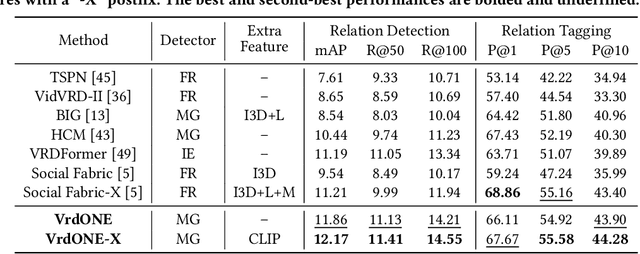
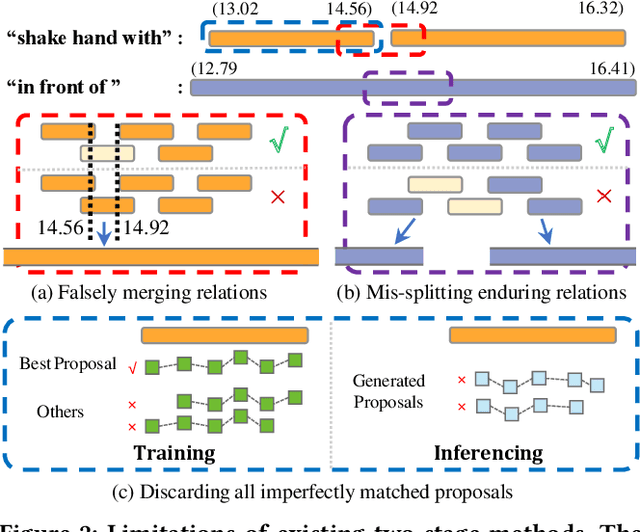
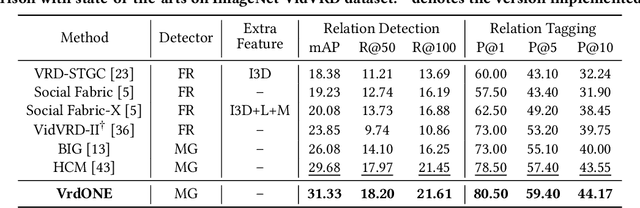
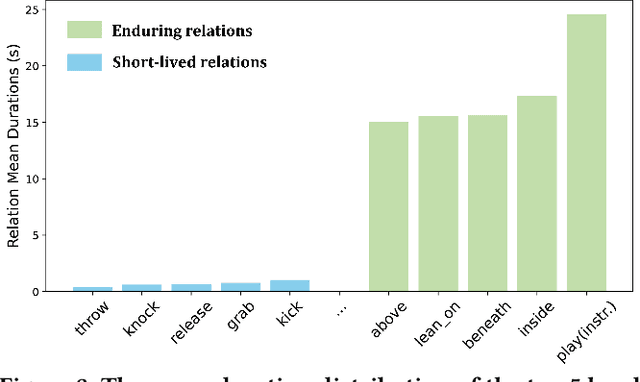
Video Visual Relation Detection (VidVRD) focuses on understanding how entities interact over time and space in videos, a key step for gaining deeper insights into video scenes beyond basic visual tasks. Traditional methods for VidVRD, challenged by its complexity, typically split the task into two parts: one for identifying what relation categories are present and another for determining their temporal boundaries. This split overlooks the inherent connection between these elements. Addressing the need to recognize entity pairs' spatiotemporal interactions across a range of durations, we propose VrdONE, a streamlined yet efficacious one-stage model. VrdONE combines the features of subjects and objects, turning predicate detection into 1D instance segmentation on their combined representations. This setup allows for both relation category identification and binary mask generation in one go, eliminating the need for extra steps like proposal generation or post-processing. VrdONE facilitates the interaction of features across various frames, adeptly capturing both short-lived and enduring relations. Additionally, we introduce the Subject-Object Synergy (SOS) module, enhancing how subjects and objects perceive each other before combining. VrdONE achieves state-of-the-art performances on the VidOR benchmark and ImageNet-VidVRD, showcasing its superior capability in discerning relations across different temporal scales. The code is available at \textcolor[RGB]{228,58,136}{\href{https://github.com/lucaspk512/vrdone}{https://github.com/lucaspk512/vrdone}}.
Beat-It: Beat-Synchronized Multi-Condition 3D Dance Generation
Jul 10, 2024Dance, as an art form, fundamentally hinges on the precise synchronization with musical beats. However, achieving aesthetically pleasing dance sequences from music is challenging, with existing methods often falling short in controllability and beat alignment. To address these shortcomings, this paper introduces Beat-It, a novel framework for beat-specific, key pose-guided dance generation. Unlike prior approaches, Beat-It uniquely integrates explicit beat awareness and key pose guidance, effectively resolving two main issues: the misalignment of generated dance motions with musical beats, and the inability to map key poses to specific beats, critical for practical choreography. Our approach disentangles beat conditions from music using a nearest beat distance representation and employs a hierarchical multi-condition fusion mechanism. This mechanism seamlessly integrates key poses, beats, and music features, mitigating condition conflicts and offering rich, multi-conditioned guidance for dance generation. Additionally, a specially designed beat alignment loss ensures the generated dance movements remain in sync with the designated beats. Extensive experiments confirm Beat-It's superiority over existing state-of-the-art methods in terms of beat alignment and motion controllability.