 Add to Chrome
 Add to Firefox
 Add to Edge
Wan-Weaver: Interleaved Multi-modal Generation via Decoupled Training
Mar 26, 2026
Recent unified models have made unprecedented progress in both understanding and generation. However, while most of them accept multi-modal inputs, they typically produce only single-modality outputs. This challenge of producing interleaved content is mainly due to training data scarcity and the difficulty of modeling long-range cross-modal context. To address this issue, we decompose interleaved generation into textual planning and visual consistency modeling, and introduce a framework consisting of a planner and a visualizer. The planner produces dense textual descriptions for visual content, while the visualizer synthesizes images accordingly. Under this guidance, we construct large-scale textual-proxy interleaved data (where visual content is represented in text) to train the planner, and curate reference-guided image data to train the visualizer. These designs give rise to Wan-Weaver, which exhibits emergent interleaved generation ability with long-range textual coherence and visual consistency. Meanwhile, the integration of diverse understanding and generation data into planner training enables Wan-Weaver to achieve robust task reasoning and generation proficiency. To assess the model's capability in interleaved generation, we further construct a benchmark that spans a wide range of use cases across multiple dimensions. Extensive experiments demonstrate that, even without access to any real interleaved data, Wan-Weaver achieves superior performance over existing methods.

UFO: A Unified Approach to Fine-grained Visual Perception via Open-ended Language Interface
Mar 04, 2025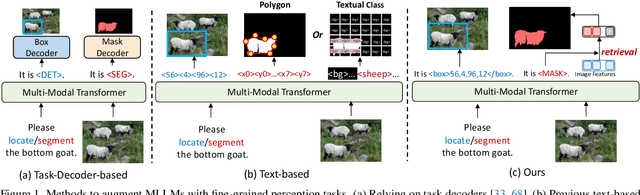
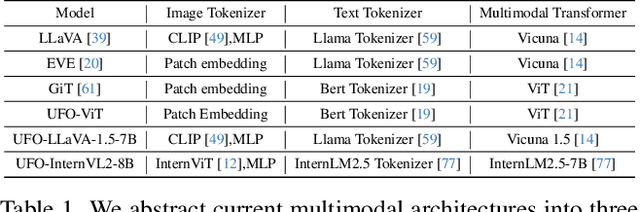
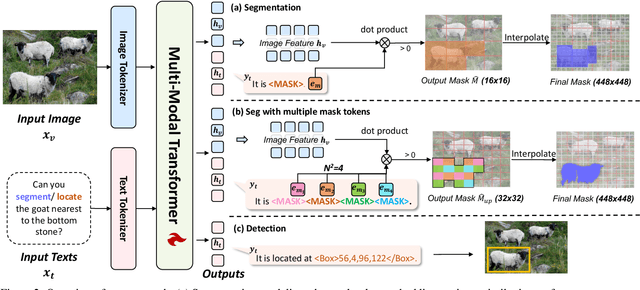
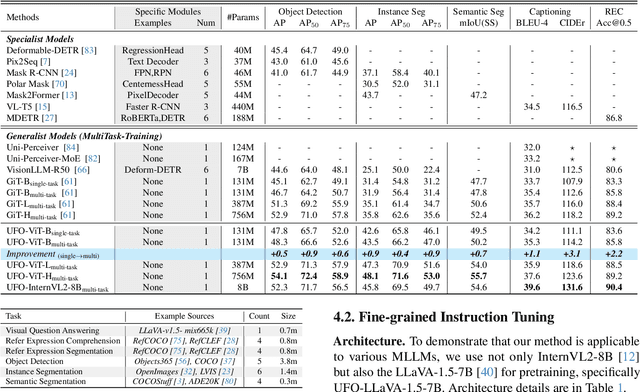
Generalist models have achieved remarkable success in both language and vision-language tasks, showcasing the potential of unified modeling. However, effectively integrating fine-grained perception tasks like detection and segmentation into these models remains a significant challenge. This is primarily because these tasks often rely heavily on task-specific designs and architectures that can complicate the modeling process. To address this challenge, we present \ours, a framework that \textbf{U}nifies \textbf{F}ine-grained visual perception tasks through an \textbf{O}pen-ended language interface. By transforming all perception targets into the language space, \ours unifies object-level detection, pixel-level segmentation, and image-level vision-language tasks into a single model. Additionally, we introduce a novel embedding retrieval approach that relies solely on the language interface to support segmentation tasks. Our framework bridges the gap between fine-grained perception and vision-language tasks, significantly simplifying architectural design and training strategies while achieving comparable or superior performance to methods with intricate task-specific designs. After multi-task training on five standard visual perception datasets, \ours outperforms the previous state-of-the-art generalist models by 12.3 mAP on COCO instance segmentation and 3.3 mIoU on ADE20K semantic segmentation. Furthermore, our method seamlessly integrates with existing MLLMs, effectively combining fine-grained perception capabilities with their advanced language abilities, thereby enabling more challenging tasks such as reasoning segmentation. Code and models are available at https://github.com/nnnth/UFO.