 Add to Chrome
 Add to Firefox
 Add to Edge
Teaching Large Language Models When Not to Know: Learning Temporal Critique for Ex-Ante Reasoning
May 14, 2026
Large language models (LLMs) often fail to reason under temporal cutoffs: when prompted to answer from the standpoint of an earlier time, they exploit knowledge that became available only later. We study this failure through the lens of ex-ante reasoning, where a model must rely exclusively on information knowable before a cutoff. Through a systematic analysis of prompt-level interventions, we find that temporal leakage is highly sensitive to cutoff formulation and instruction placement: explicit cutoff statements outperform implicit historical framings, and prefix constraints reduce leakage more effectively than suffix constraints. These findings indicate that prompting can steer models into a temporal frame, but does not endow them with the ability to verify whether a response is temporally admissible. We further argue that supervised fine-tuning is insufficient, since ex-ante correctness is not an intrinsic property of an answer, but a relation between the answer and the cutoff. To address this gap, we propose TCFT, a Temporal Critique Fine-Tuning framework that trains models to acquire cutoff-aware temporal verification. Given a query, a cutoff, and a candidate response, TCFT teaches the model to identify post-cutoff leakage, explain temporal boundary violations, and judge temporal admissibility. Experiments with Qwen2.5-7B-Instruct and Qwen2.5-14B-Instruct show that TCFT consistently outperforms prompting and SFT baselines, reducing average leakage by 41.89 and 37.79 percentage points, respectively.

Unified Parameter-Efficient Unlearning for LLMs
Nov 30, 2024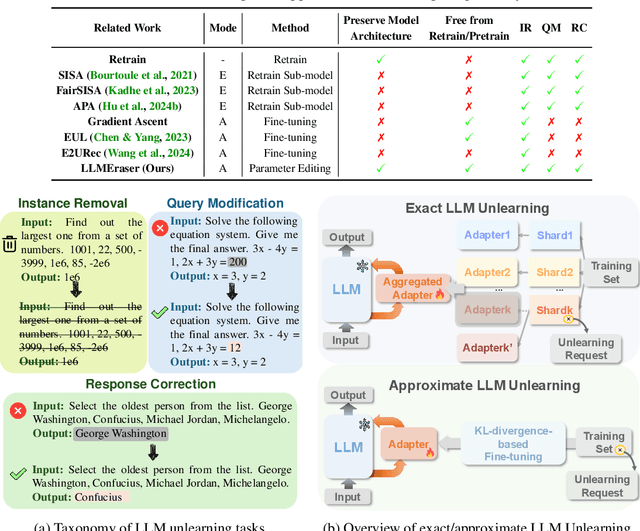
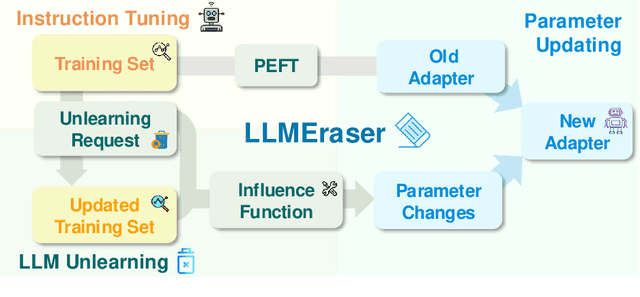
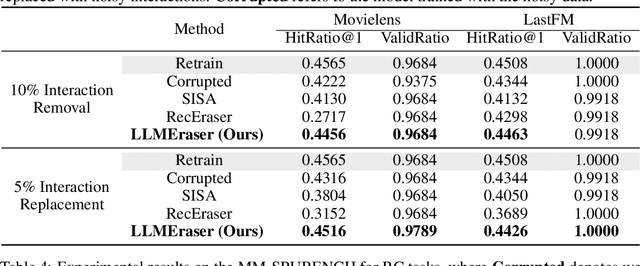
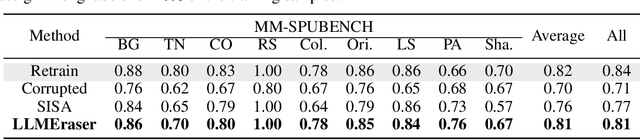
The advent of Large Language Models (LLMs) has revolutionized natural language processing, enabling advanced understanding and reasoning capabilities across a variety of tasks. Fine-tuning these models for specific domains, particularly through Parameter-Efficient Fine-Tuning (PEFT) strategies like LoRA, has become a prevalent practice due to its efficiency. However, this raises significant privacy and security concerns, as models may inadvertently retain and disseminate sensitive or undesirable information. To address these issues, we introduce a novel instance-wise unlearning framework, LLMEraser, which systematically categorizes unlearning tasks and applies precise parameter adjustments using influence functions. Unlike traditional unlearning techniques that are often limited in scope and require extensive retraining, LLMEraser is designed to handle a broad spectrum of unlearning tasks without compromising model performance. Extensive experiments on benchmark datasets demonstrate that LLMEraser excels in efficiently managing various unlearning scenarios while maintaining the overall integrity and efficacy of the models.