 Add to Chrome
 Add to Firefox
 Add to Edge
IDEA: Insensitive to Dynamics Mismatch via Effect Alignment for Sim-to-Real Transfer in Multi-Agent Control
Jun 25, 2026
Complex multi-agent control tasks remain challenging for traditional rule-based and model-based approaches, motivating the adoption of learning-based methods. However, learning-based methods often struggle with sim-to-real transfer because they rely on accurate dynamics modeling or system identification and learn policies in low-level control spaces that are highly sensitive to dynamics mismatch, making them costly and fragile in complex environments. To address this issue, we propose a sim-to-real method for multi-agent control, which is insensitive to dynamics mismatch via effect alignment. Our method combines random environmental structure with discrete semantic actions through closed-loop control, elevating policy learning to a semantic abstraction level. Additionally, we develop an action synchronization mechanism that mitigates inter-agent action timing mismatches, thereby enhancing the temporal consistency of the system. Experiments on four multi-agent navigation tasks demonstrate that our method substantially improves training efficiency over mainstream transfer methods and achieves higher success rates in real-world scenarios, thereby improving the robustness and deployment stability of multi-agent systems under dynamics mismatch.

Dataset Bias in Few-shot Image Recognition
Sep 07, 2020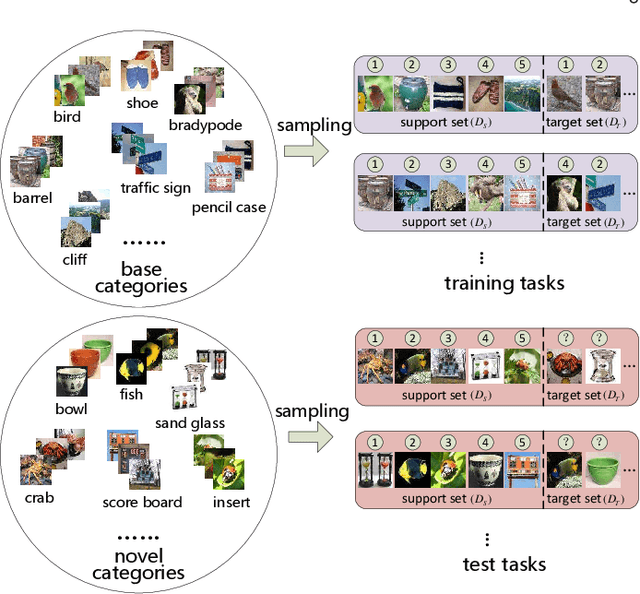
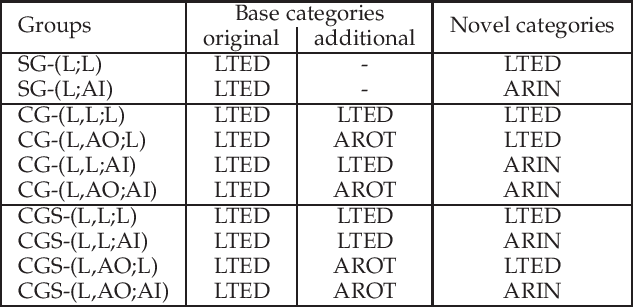
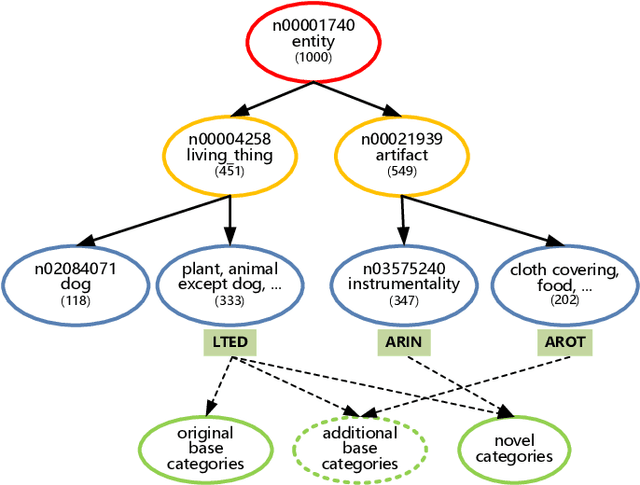
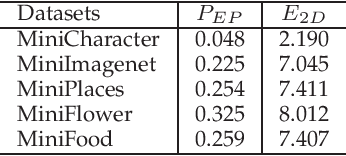
The goal of few-shot image recognition (FSIR) is to identify novel categories with a small number of annotated samples by exploiting transferable knowledge from training data (base categories). Most current studies assume that the transferable knowledge can be well used to identify novel categories. However, such transferable capability may be impacted by the dataset bias, and this problem has rarely been investigated before. Besides, most of few-shot learning methods are biased to different datasets, which is also an important issue that needs to be investigated deeply. In this paper, we first investigate the impact of transferable capabilities learned from base categories. Specifically, we use the relevance to measure relationships between base categories and novel categories. Distributions of base categories are depicted via the instance density and category diversity. The FSIR model learns better transferable knowledge from relevant training data. In the relevant data, dense instances or diverse categories can further enrich the learned knowledge. Experimental results on different sub-datasets of ImagNet demonstrate category relevance, instance density and category diversity can depict transferable bias from base categories. Second, we investigate performance differences on different datasets from dataset structures and different few-shot learning methods. Specifically, we introduce image complexity, intra-concept visual consistency, and inter-concept visual similarity to quantify characteristics of dataset structures. We use these quantitative characteristics and four few-shot learning methods to analyze performance differences on five different datasets. Based on the experimental analysis, some insightful observations are obtained from the perspective of both dataset structures and few-shot learning methods. We hope these observations are useful to guide future FSIR research.