 Add to Chrome
 Add to Firefox
 Add to Edge
X-Mind: Efficient Visual Chain-of-Thought via Predictive World Model for End-to-End Driving
Jun 27, 2026
Predicting future states is essential for autonomous agents, yet current Vision-Language-Action (VLA) models fundamentally lack this capability, relying instead on reactive perception-action mapping. While integrating Predictive World Models (PWMs) addresses this gap, existing approaches either incur prohibitive cascaded latency or act as shallow terminal tasks that fail to deeply embed forward-looking reasoning. To endow VLA models with this reasoning capability, we propose X-Mind. Rather than treating PWMs as an external auxiliary module, this framework internalizes them as the Visual Chain-of-Thought (Visual CoT). By enforcing a world rollout prior to action, the model is constrained to imagine future evolution first, yielding a driving policy that is robustly grounded in environmental dynamics and aware of the future consequences its actions will unfold. The challenge here is efficiency, and we tackle it on two fronts. First, we introduce a compact representation of visual thinking: an abstract sketch that fuses a Bird's-Eye-View (BEV) layout with abstract driving priors (e.g., navigation intents and traffic rules). Rather than rolling out dense future frames, the model reasons over this sketch as a mental canvas; aided by a Deep Compression Autoencoder (DC-AE), a 12-frame future rollout is reduced to merely 96 tokens, alleviating the long-context computational bottleneck. Second, to accelerate generation further, we propose a recurrent block diffusion scheme that unrolls the denoising steps across the layers of the large drive model, folding iterative refinement into the backbone's one forward pass. Trained and validated on large-scale real-world data, X-Mind achieves competitive end-to-end driving performance, which makes it a highly practical, low-latency solution that successfully deploys large-scale cognitive reasoning directly onto resource-constrained vehicle platforms.

FS-Depth: Focal-and-Scale Depth Estimation from a Single Image in Unseen Indoor Scene
Jul 27, 2023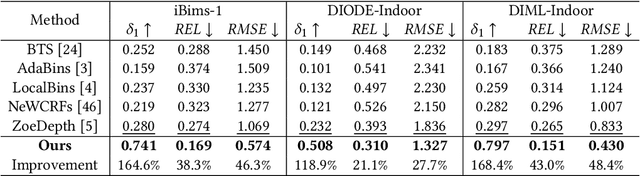
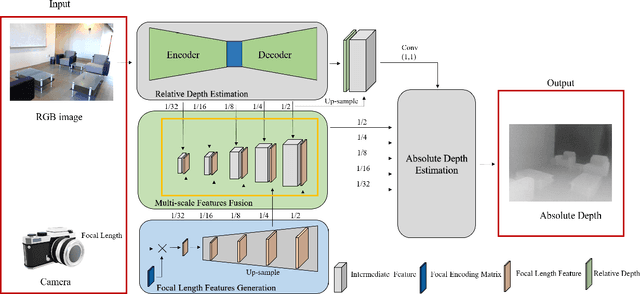
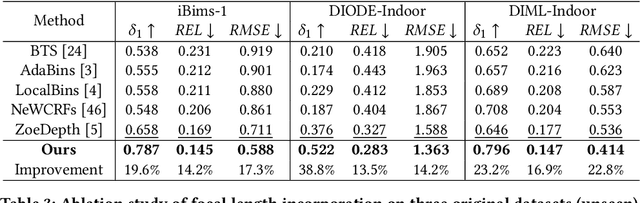
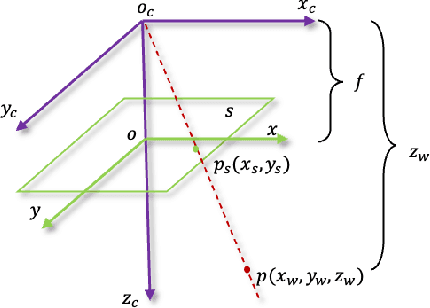
It has long been an ill-posed problem to predict absolute depth maps from single images in real (unseen) indoor scenes. We observe that it is essentially due to not only the scale-ambiguous problem but also the focal-ambiguous problem that decreases the generalization ability of monocular depth estimation. That is, images may be captured by cameras of different focal lengths in scenes of different scales. In this paper, we develop a focal-and-scale depth estimation model to well learn absolute depth maps from single images in unseen indoor scenes. First, a relative depth estimation network is adopted to learn relative depths from single images with diverse scales/semantics. Second, multi-scale features are generated by mapping a single focal length value to focal length features and concatenating them with intermediate features of different scales in relative depth estimation. Finally, relative depths and multi-scale features are jointly fed into an absolute depth estimation network. In addition, a new pipeline is developed to augment the diversity of focal lengths of public datasets, which are often captured with cameras of the same or similar focal lengths. Our model is trained on augmented NYUDv2 and tested on three unseen datasets. Our model considerably improves the generalization ability of depth estimation by 41%/13% (RMSE) with/without data augmentation compared with five recent SOTAs and well alleviates the deformation problem in 3D reconstruction. Notably, our model well maintains the accuracy of depth estimation on original NYUDv2.