 Add to Chrome
 Add to Firefox
 Add to Edge
X-Mind: Efficient Visual Chain-of-Thought via Predictive World Model for End-to-End Driving
Jun 27, 2026
Predicting future states is essential for autonomous agents, yet current Vision-Language-Action (VLA) models fundamentally lack this capability, relying instead on reactive perception-action mapping. While integrating Predictive World Models (PWMs) addresses this gap, existing approaches either incur prohibitive cascaded latency or act as shallow terminal tasks that fail to deeply embed forward-looking reasoning. To endow VLA models with this reasoning capability, we propose X-Mind. Rather than treating PWMs as an external auxiliary module, this framework internalizes them as the Visual Chain-of-Thought (Visual CoT). By enforcing a world rollout prior to action, the model is constrained to imagine future evolution first, yielding a driving policy that is robustly grounded in environmental dynamics and aware of the future consequences its actions will unfold. The challenge here is efficiency, and we tackle it on two fronts. First, we introduce a compact representation of visual thinking: an abstract sketch that fuses a Bird's-Eye-View (BEV) layout with abstract driving priors (e.g., navigation intents and traffic rules). Rather than rolling out dense future frames, the model reasons over this sketch as a mental canvas; aided by a Deep Compression Autoencoder (DC-AE), a 12-frame future rollout is reduced to merely 96 tokens, alleviating the long-context computational bottleneck. Second, to accelerate generation further, we propose a recurrent block diffusion scheme that unrolls the denoising steps across the layers of the large drive model, folding iterative refinement into the backbone's one forward pass. Trained and validated on large-scale real-world data, X-Mind achieves competitive end-to-end driving performance, which makes it a highly practical, low-latency solution that successfully deploys large-scale cognitive reasoning directly onto resource-constrained vehicle platforms.

Mamba Integrated with Physics Principles Masters Long-term Chaotic System Forecasting
May 29, 2025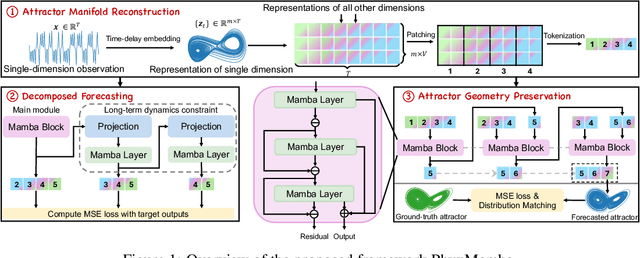
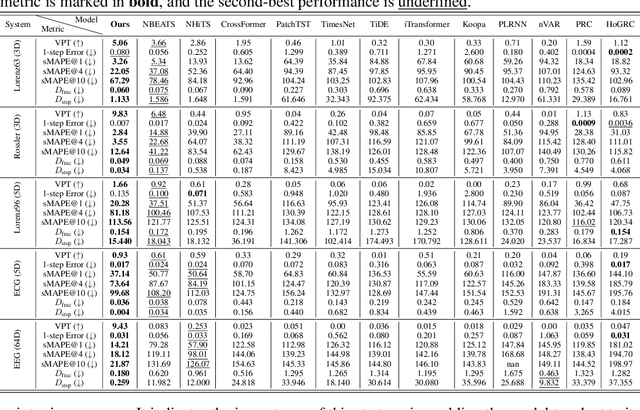
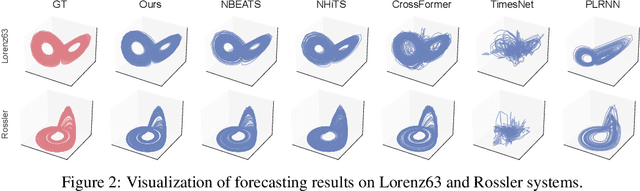
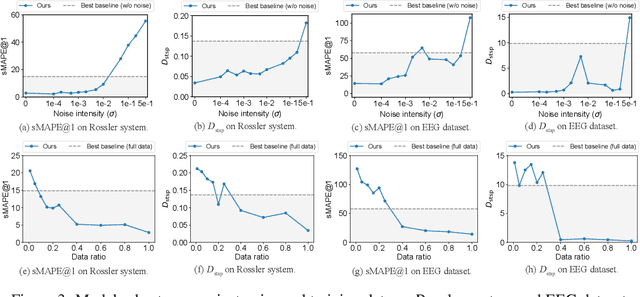
Long-term forecasting of chaotic systems from short-term observations remains a fundamental and underexplored challenge due to the intrinsic sensitivity to initial conditions and the complex geometry of strange attractors. Existing approaches often rely on long-term training data or focus on short-term sequence correlations, struggling to maintain predictive stability and dynamical coherence over extended horizons. We propose PhyxMamba, a novel framework that integrates a Mamba-based state-space model with physics-informed principles to capture the underlying dynamics of chaotic systems. By reconstructing the attractor manifold from brief observations using time-delay embeddings, PhyxMamba extracts global dynamical features essential for accurate forecasting. Our generative training scheme enables Mamba to replicate the physical process, augmented by multi-token prediction and attractor geometry regularization for physical constraints, enhancing prediction accuracy and preserving key statistical invariants. Extensive evaluations on diverse simulated and real-world chaotic systems demonstrate that PhyxMamba delivers superior long-term forecasting and faithfully captures essential dynamical invariants from short-term data. This framework opens new avenues for reliably predicting chaotic systems under observation-scarce conditions, with broad implications across climate science, neuroscience, epidemiology, and beyond. Our code is open-source at https://github.com/tsinghua-fib-lab/PhyxMamba.