 Add to Chrome
 Add to Firefox
 Add to Edge
Beyond Few-Step Inference: Accelerating Video Diffusion Transformer Model Serving with Inter-Request Caching Reuse
Apr 06, 2026
Video Diffusion Transformer (DiT) models are a dominant approach for high-quality video generation but suffer from high inference cost due to iterative denoising. Existing caching approaches primarily exploit similarity within the diffusion process of a single request to skip redundant denoising steps. In this paper, we introduce Chorus, a caching approach that leverages similarity across requests to accelerate video diffusion model serving. Chorus achieves up to 45\% speedup on industrial 4-step distilled models, where prior intra-request caching approaches are ineffective. Particularly, Chorus employs a three-stage caching strategy along the denoising process. Stage 1 performs full reuse of latent features from similar requests. Stage 2 exploits inter-request caching in specific latent regions during intermediate denoising steps. This stage is combined with Token-Guided Attention Amplification to improve semantic alignment between the generated video and the conditional prompts, thereby extending the applicability of full reuse to later denoising steps.

Towards Efficient Multi-Scale Deformable Attention on NPU
May 20, 2025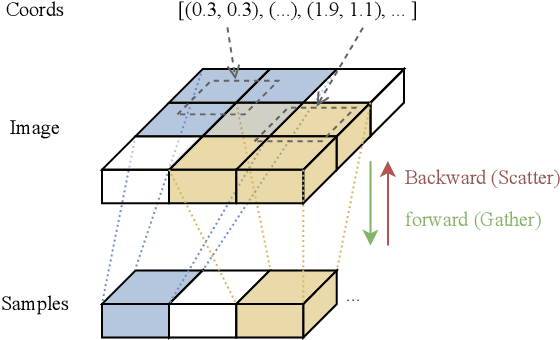

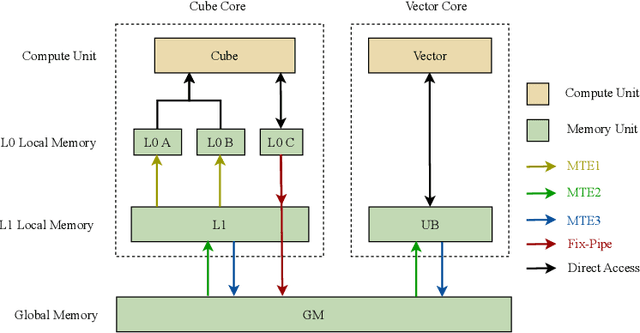
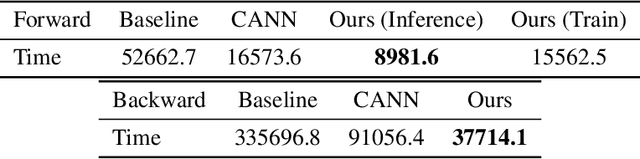
Multi-scale deformable attention (MSDA) is a flexible and powerful feature extraction mechanism for visual tasks, but its random-access grid sampling strategy poses significant optimization challenges, especially on domain-specific accelerators such as NPUs. In this work, we present a co-design approach that systematically rethinks memory access and computation strategies for MSDA on the Ascend NPU architecture. With this co-design approach, our implementation supports both efficient forward and backward computation, is fully adapted for training workloads, and incorporates a suite of hardware-aware optimizations. Extensive experiments show that our solution achieves up to $5.9\times$ (forward), $8.9\times$ (backward), and $7.3\times$ (end-to-end training) speedup over the grid sample-based baseline, and $1.9\times$, $2.4\times$, and $2.0\times$ acceleration over the latest vendor library, respectively.