 Add to Chrome
 Add to Firefox
 Add to Edge
Mask-Proof: An LLM-based Automated Data Curation Pipeline on Mathematical Proofs
Jun 13, 2026
Large language models (LLMs) are increasingly capable of mathematical problem solving and can even assist with research-level proofs, yet we still lack a scalable and reproducible way to measure step-level reasoning in long proofs across diverse sources. This evaluation gap limits trustworthy AI assistance in proof-certified scientific progress. Existing evaluations often emphasize final answers or rely on costly expert grading, while end-to-end proof generation remains open-ended and hard to verify automatically. We introduce Mask-Proof, a pipeline that turns real proofs into automatically checkable masked-step tasks. It masks key formula steps, provides the necessary surrounding context, and evaluates model reconstructions with an LLM-based equivalence judge using repeated votes for stability. The resulting Mask-ProofBench contains 292 curated problems across diverse research areas. Experiments with 17 models show that reasoning-enhanced models outperform standard models by 12% to 27%. Our evaluator achieves 96.8% agreement with expert annotators, enabling faithful, reproducible, and comparable measurement of step-level mathematical reasoning. Benchmark, annotations, and code are available at https://github.com/weating/Mask-Proof.

Make LoRA Great Again: Boosting LoRA with Adaptive Singular Values and Mixture-of-Experts Optimization Alignment
Feb 26, 2025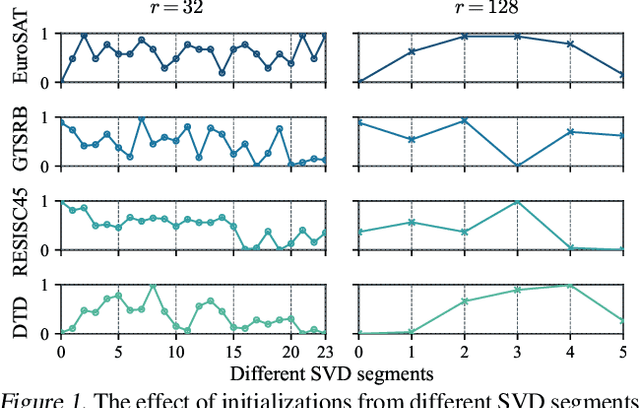
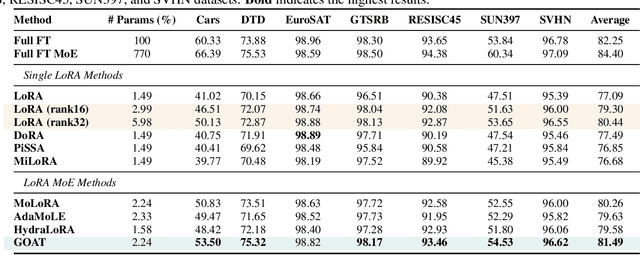
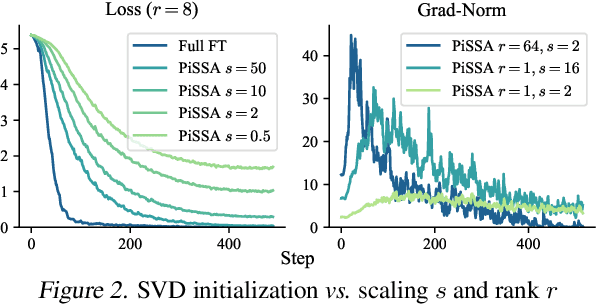
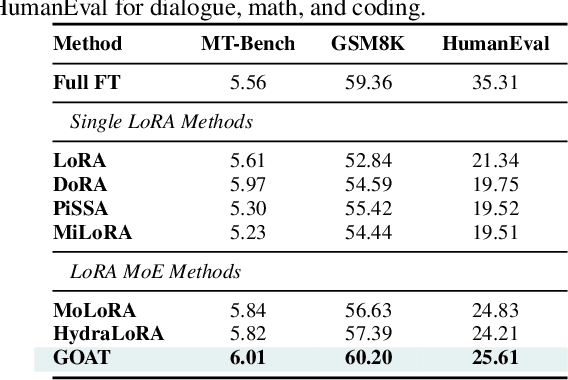
While Low-Rank Adaptation (LoRA) enables parameter-efficient fine-tuning for Large Language Models (LLMs), its performance often falls short of Full Fine-Tuning (Full FT). Current methods optimize LoRA by initializing with static singular value decomposition (SVD) subsets, leading to suboptimal leveraging of pre-trained knowledge. Another path for improving LoRA is incorporating a Mixture-of-Experts (MoE) architecture. However, weight misalignment and complex gradient dynamics make it challenging to adopt SVD prior to the LoRA MoE architecture. To mitigate these issues, we propose \underline{G}reat L\underline{o}R\underline{A} Mixture-of-Exper\underline{t} (GOAT), a framework that (1) adaptively integrates relevant priors using an SVD-structured MoE, and (2) aligns optimization with full fine-tuned MoE by deriving a theoretical scaling factor. We demonstrate that proper scaling, without modifying the architecture or training algorithms, boosts LoRA MoE's efficiency and performance. Experiments across 25 datasets, including natural language understanding, commonsense reasoning, image classification, and natural language generation, demonstrate GOAT's state-of-the-art performance, closing the gap with Full FT.