 Add to Chrome
 Add to Firefox
 Add to Edge
From Foundation to Application: Improving VLA Models in Practice
Jul 07, 2026
Despite recent progress of VLA foundation models, the disparity between laboratory conditions and real-world applications continues to impede their practical implementation. To bridge this gap, we present LingBot-VLA 2.0, which advances LingBot-VLA through improvements in three functional domains. (1) Generalization across tasks and embodiments. Compared to the previous version, we revamp the data processing pipeline and curate around 60,000 hours of data for pretraining, including 50,000 hours of robot trajectories spanning 20 robot configurations and 10,000 hours of egocentric human videos. (2) Expanded action space in addition to dual-arm hardware platforms. In particular, our system accommodates degrees of freedom for the heads, waists, mobile bases, and dexterous hands, thereby empowering the robots to tackle more complex tasks in practical scenarios. (3) Predictive dynamics modeling for improved temporal reasoning. Specifically, we formulate future prediction as a proxy task, facilitated by a video representation model for semantic priors and a depth estimation model for geometric cues. Evaluations on the GM-100 benchmark, conducted in a generalist setting, validate the beneficial impact of these proposed modifications. Furthermore, benefiting from the expanded pretraining data that covers whole-body degrees of freedom, LingBot-VLA-2.0 demonstrates strong cross-embodiment long-horizon mobile manipulation capability across the two robotic platforms.

Hybrid RAG-empowered Multi-modal LLM for Secure Healthcare Data Management: A Diffusion-based Contract Theory Approach
Jul 01, 2024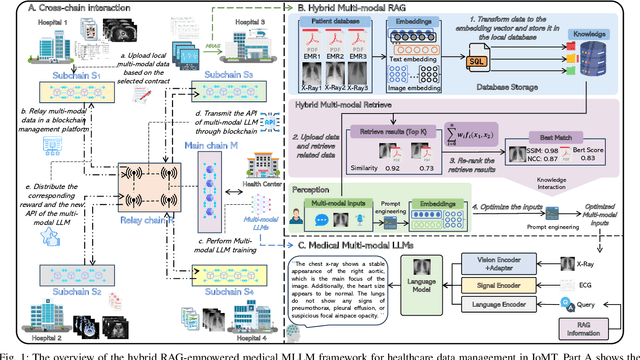

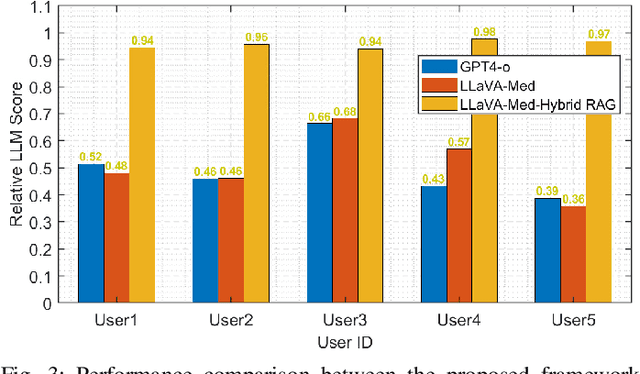
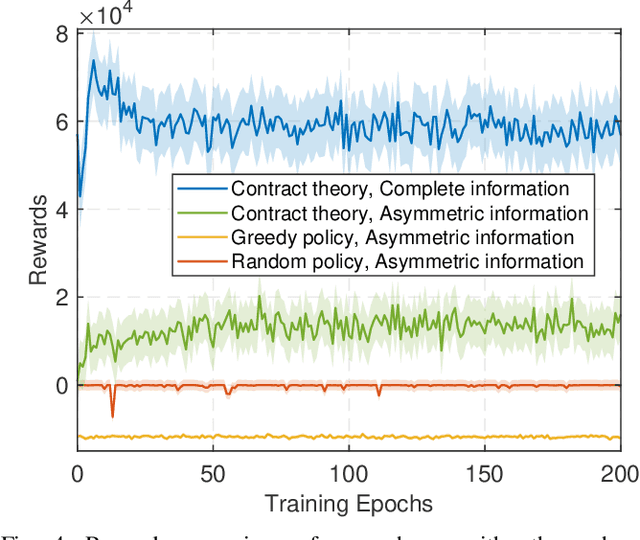
Secure data management and effective data sharing have become paramount in the rapidly evolving healthcare landscape. The advancement of generative artificial intelligence has positioned Multi-modal Large Language Models (MLLMs) as crucial tools for managing healthcare data. MLLMs can support multi-modal inputs and generate diverse types of content by leveraging large-scale training on vast amounts of multi-modal data. However, critical challenges persist in developing medical MLLMs, including healthcare data security and freshness issues, affecting the output quality of MLLMs. In this paper, we propose a hybrid Retrieval-Augmented Generation (RAG)-empowered medical MLLMs framework for healthcare data management. This framework leverages a hierarchical cross-chain architecture to facilitate secure data training. Moreover, it enhances the output quality of MLLMs through hybrid RAG, which employs multi-modal metrics to filter various unimodal RAG results and incorporates these retrieval results as additional inputs to MLLMs. Additionally, we employ age of information to indirectly evaluate the data freshness impact of MLLMs and utilize contract theory to incentivize healthcare data holders to share fresh data, mitigating information asymmetry in data sharing. Finally, we utilize a generative diffusion model-based reinforcement learning algorithm to identify the optimal contract for efficient data sharing. Numerical results demonstrate the effectiveness of the proposed schemes, which achieve secure and efficient healthcare data management.