 Add to Chrome
 Add to Firefox
 Add to Edge
An Ultra-Low Profile Metasurface for Enhanced Non-Diffractive OAM Beam Generation Based on Sparse Feed Array
Aug 07, 2026
This paper proposes a novel ultra-low profile transmitted metasurface to generate enhanced non-diffractive orbital angular momentum (OAM) beams, employing a sparse feed array (SFA) to create a quasi-plane wave excitation for the first time. Our simulation indicates that with uniform amplitude excitation, the non-diffraction performance of Bessel beam produced by metasurface, surpasses that of conventional single-feed excitation. Based on this principle, a 5 * 5 sparse feed array is introduced and positioned less than one wavelength from the metasurface, ensuring a quasi-uniform amplitude excitation across all units. Further, this metasurface leverages its flexible phase control capability and integrates the spatial phase, OAM phase, and axicon phase to generate an enhanced high-order Bessel beam. The simulated results confirm a successful non-diffractive Bessel beam generation carrying OAM with mode l = +2, exhibiting reduced beam divergence and higher gain. This design also offers benefits of ultra-low profile, high aperture efficiency, low structural complexity.
* 4 pages, 12 figures

Flexible Wideband Filtering Monopole Antenna With Stable High Omnidirectionality
Aug 02, 2026This article presents a wideband flexible filtering monopole antenna with symmetric structure for stable high omnidirectionality. It is based on a monopole antenna, which is printed on a single-layer flexible substrate. Two folded parasitic strips with different length are devised on both sides of the driven monopole, giving filtering responses in the higher and lower band without filtering circuits. Since the asymmetric filtering structure adversely affects in-band omnidirectionality, this baseline design is extended with symmetric filtering structure to improve omnidirectionality and bandwidth. In the proposed design, a pair of parasitic strips are devised on the both sides of monopole antenna symmetrically, achieving a radiation null in the higher band. Then, by loading a pair of folded parasitic strips on the both sides of feed line with slotted metal ground, a radiation null is realized in the lower band. Besides, the driven monopole is slotted symmetrically for wideband operation. By adopting a fully symmetric filtering structure, the proposed design effectively suppresses the impact of the parasitic elements on the in-band omnidirectional radiation pattern, thereby achieving high omnidirectionality. Furthermore, the proposed antenna exhibits stable performance under different bending radii. To verify our design concept, an antenna prototype is fabricated. Both the flat and bent antennas are measured. The results show that the proposed antenna has a -10 dB impedance bandwidth of 45.6%, an in-band gain about 2 dBi, and an out-of-band radiation suppression more than 11 dB. The measured omnidirectionality has variations less than 0.8 dB without bending and 1 dB with a bending radius of 30 mm. This design offers several advantages including stable high omnidirectionality across a wide bandwidth, flexible conformal capability, and filtering property.
A Wideband Multibeam Planar Quasi-Yagi Array Antenna Based on Parasitic Pixel Strips
Aug 02, 2026This letter presents a low-complexity parasitic pixel strip (PPS) structure for array antenna to generate six radiations with flexible beam control. To realize multibeam operation, three groups of symmetrical strip-shaped pixels are integrated with the feed antenna, the connection state of which can be controlled by PIN diode. Leveraging the reconfigurable parasitic configuration, the coupling path of the antenna can be strategically manipulated, achieving the desired multibeam property. Thus, by utilizing the PPS structure in conjunction with a planar quasi-Yagi antenna, this single antenna can operate at four states with beam direction towards 40°, -40°, 0°, along with a dual-beam at +/-45°, within the frequency range from 5.0 to 5.6 GHz. Moreover, a prototype of a 1 * 2 array with the PPS structure is also fabricated to achieve six beams with a scan range of 40°, 20°, 0°, -20°, -40° and a dual-beam at +/-30°. Notably, only four PIN diodes are utilized to implement six radiations, verifying that this approach effectively minimizes the excessive use of switches and extends the variety of beams, which provides a low complexity method for multibeam array antenna without complicated beamforming network. These antennas satisfy the benefits of wideband, planner structure, low structural complexity, low cost, and flexible beam control.
* 5 pages, 11 figures
ViRED: Prediction of Visual Relations in Engineering Drawings
Sep 02, 2024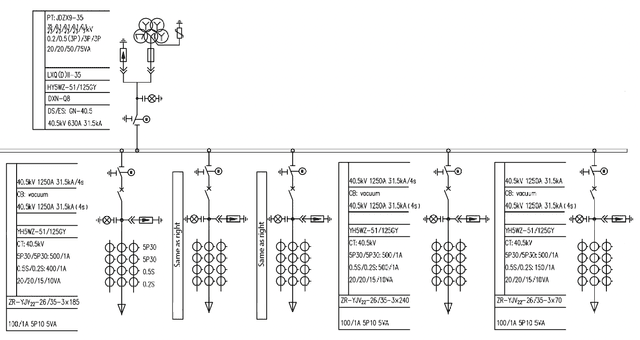


To accurately understand engineering drawings, it is essential to establish the correspondence between images and their description tables within the drawings. Existing document understanding methods predominantly focus on text as the main modality, which is not suitable for documents containing substantial image information. In the field of visual relation detection, the structure of the task inherently limits its capacity to assess relationships among all entity pairs in the drawings. To address this issue, we propose a vision-based relation detection model, named ViRED, to identify the associations between tables and circuits in electrical engineering drawings. Our model mainly consists of three parts: a vision encoder, an object encoder, and a relation decoder. We implement ViRED using PyTorch to evaluate its performance. To validate the efficacy of ViRED, we conduct a series of experiments. The experimental results indicate that, within the engineering drawing dataset, our approach attained an accuracy of 96\% in the task of relation prediction, marking a substantial improvement over existing methodologies. The results also show that ViRED can inference at a fast speed even when there are numerous objects in a single engineering drawing.
Lost in Overlap: Exploring Watermark Collision in LLMs
Mar 15, 2024


The proliferation of large language models (LLMs) in generating content raises concerns about text copyright. Watermarking methods, particularly logit-based approaches, embed imperceptible identifiers into text to address these challenges. However, the widespread use of watermarking across diverse LLMs has led to an inevitable issue known as watermark collision during common tasks like question answering and paraphrasing. This study focuses on dual watermark collisions, where two watermarks are present simultaneously in the same text. The research demonstrates that watermark collision poses a threat to detection performance for detectors of both upstream and downstream watermark algorithms.