 Add to Chrome
 Add to Firefox
 Add to Edge
DINOde: Continuous Vision-Text Alignment for Open-Vocabulary Semantic Segmentation
Jul 23, 2026
Open-vocabulary semantic segmentation (OVSS) leverages textual semantics to segment objects beyond predefined categories. While the self-supervised model DINOv3 provides strong structured visual representations, its lack of native textual alignment hinders its direct application to OVSS. To bridge this gap, we propose DINOde, an ODE-based framework that continuously aligns CLIP text embeddings with the DINO visual manifold. Our approach employs two complementary components: (i) Semantic Text Flow (STF), which evolves text embeddings toward the DINO manifold through a continuous ODE trajectory, and (ii) Global Context Flow (GCF), which progressively refines the holistic image representation carried by DINO's CLS token. To preserve the hyperspherical geometry of the feature space during this evolution, we further introduce Velocity Tangent Projection, which constrains the learned velocity field to the tangent space. By modeling alignment as a continuous trajectory, DINOde avoids the manifold entanglement inherent in discrete MLP projections and yields more robust cross-modal alignment. Extensive experiments demonstrate that DINOde consistently outperforms existing methods and achieves state-of-the-art performance across multiple OVSS benchmarks. The code is available at https://github.com/yoon307/DINOde.

Task-oriented Learnable Diffusion Timesteps for Universal Few-shot Learning of Dense Tasks
Dec 29, 2025Denoising diffusion probabilistic models have brought tremendous advances in generative tasks, achieving state-of-the-art performance thus far. Current diffusion model-based applications exploit the power of learned visual representations from multistep forward-backward Markovian processes for single-task prediction tasks by attaching a task-specific decoder. However, the heuristic selection of diffusion timestep features still heavily relies on empirical intuition, often leading to sub-optimal performance biased towards certain tasks. To alleviate this constraint, we investigate the significance of versatile diffusion timestep features by adaptively selecting timesteps best suited for the few-shot dense prediction task, evaluated on an arbitrary unseen task. To this end, we propose two modules: Task-aware Timestep Selection (TTS) to select ideal diffusion timesteps based on timestep-wise losses and similarity scores, and Timestep Feature Consolidation (TFC) to consolidate the selected timestep features to improve the dense predictive performance in a few-shot setting. Accompanied by our parameter-efficient fine-tuning adapter, our framework effectively achieves superiority in dense prediction performance given only a few support queries. We empirically validate our learnable timestep consolidation method on the large-scale challenging Taskonomy dataset for dense prediction, particularly for practical universal and few-shot learning scenarios.
BIPS: Bi-modal Indoor Panorama Synthesis via Residual Depth-aided Adversarial Learning
Dec 12, 2021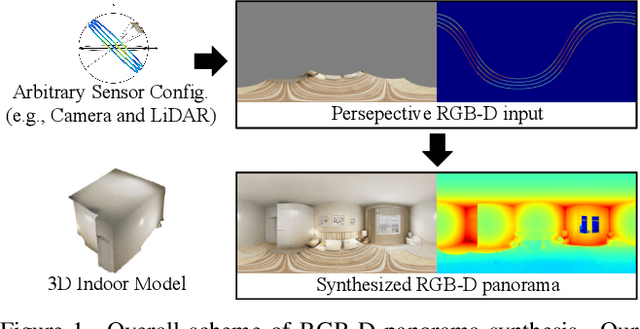
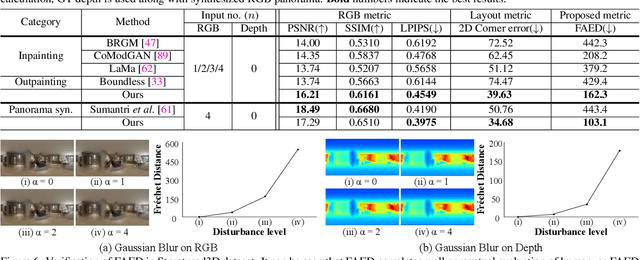
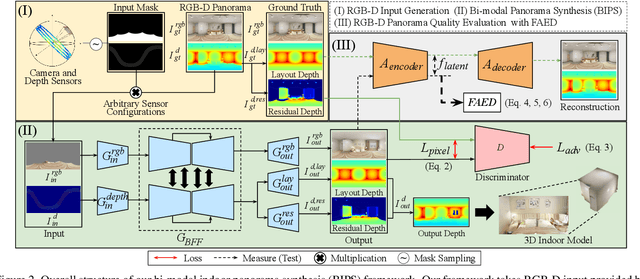
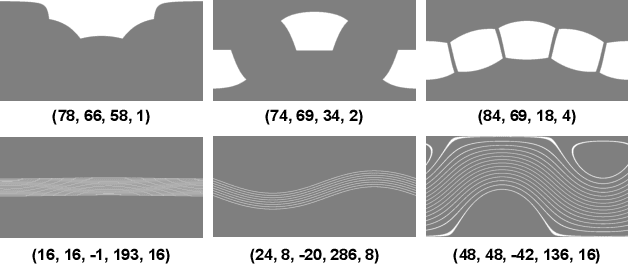
Providing omnidirectional depth along with RGB information is important for numerous applications, eg, VR/AR. However, as omnidirectional RGB-D data is not always available, synthesizing RGB-D panorama data from limited information of a scene can be useful. Therefore, some prior works tried to synthesize RGB panorama images from perspective RGB images; however, they suffer from limited image quality and can not be directly extended for RGB-D panorama synthesis. In this paper, we study a new problem: RGB-D panorama synthesis under the arbitrary configurations of cameras and depth sensors. Accordingly, we propose a novel bi-modal (RGB-D) panorama synthesis (BIPS) framework. Especially, we focus on indoor environments where the RGB-D panorama can provide a complete 3D model for many applications. We design a generator that fuses the bi-modal information and train it with residual-aided adversarial learning (RDAL). RDAL allows to synthesize realistic indoor layout structures and interiors by jointly inferring RGB panorama, layout depth, and residual depth. In addition, as there is no tailored evaluation metric for RGB-D panorama synthesis, we propose a novel metric to effectively evaluate its perceptual quality. Extensive experiments show that our method synthesizes high-quality indoor RGB-D panoramas and provides realistic 3D indoor models than prior methods. Code will be released upon acceptance.