 Add to Chrome
 Add to Firefox
 Add to Edge
F4Splat: Feed-Forward Predictive Densification for Feed-Forward 3D Gaussian Splatting
Mar 22, 2026
Feed-forward 3D Gaussian Splatting methods enable single-pass reconstruction and real-time rendering. However, they typically adopt rigid pixel-to-Gaussian or voxel-to-Gaussian pipelines that uniformly allocate Gaussians, leading to redundant Gaussians across views. Moreover, they lack an effective mechanism to control the total number of Gaussians while maintaining reconstruction fidelity. To address these limitations, we present F4Splat, which performs Feed-Forward predictive densification for Feed-Forward 3D Gaussian Splatting, introducing a densification-score-guided allocation strategy that adaptively distributes Gaussians according to spatial complexity and multi-view overlap. Our model predicts per-region densification scores to estimate the required Gaussian density and allows explicit control over the final Gaussian budget without retraining. This spatially adaptive allocation reduces redundancy in simple regions and minimizes duplicate Gaussians across overlapping views, producing compact yet high-quality 3D representations. Extensive experiments demonstrate that our model achieves superior novel-view synthesis performance compared to prior uncalibrated feed-forward methods, while using significantly fewer Gaussians.

T-FIX: Text-Based Explanations with Features Interpretable to eXperts
Nov 06, 2025As LLMs are deployed in knowledge-intensive settings (e.g., surgery, astronomy, therapy), users expect not just answers, but also meaningful explanations for those answers. In these settings, users are often domain experts (e.g., doctors, astrophysicists, psychologists) who require explanations that reflect expert-level reasoning. However, current evaluation schemes primarily emphasize plausibility or internal faithfulness of the explanation, which fail to capture whether the content of the explanation truly aligns with expert intuition. We formalize expert alignment as a criterion for evaluating explanations with T-FIX, a benchmark spanning seven knowledge-intensive domains. In collaboration with domain experts, we develop novel metrics to measure the alignment of LLM explanations with expert judgment.
The FIX Benchmark: Extracting Features Interpretable to eXperts
Sep 20, 2024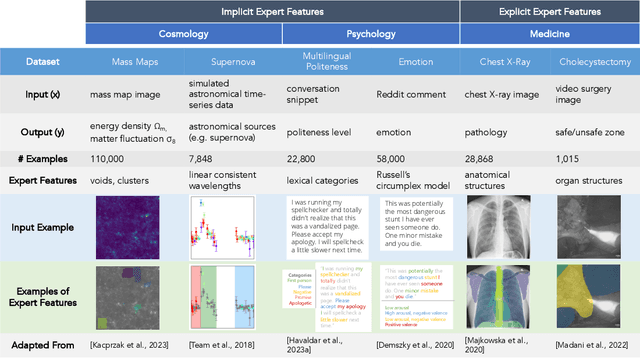

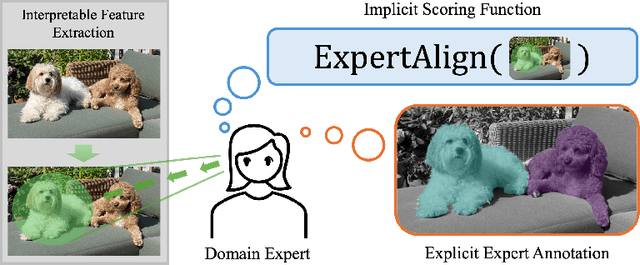

Feature-based methods are commonly used to explain model predictions, but these methods often implicitly assume that interpretable features are readily available. However, this is often not the case for high-dimensional data, and it can be hard even for domain experts to mathematically specify which features are important. Can we instead automatically extract collections or groups of features that are aligned with expert knowledge? To address this gap, we present FIX (Features Interpretable to eXperts), a benchmark for measuring how well a collection of features aligns with expert knowledge. In collaboration with domain experts, we have developed feature interpretability objectives across diverse real-world settings and unified them into a single framework that is the FIX benchmark. We find that popular feature-based explanation methods have poor alignment with expert-specified knowledge, highlighting the need for new methods that can better identify features interpretable to experts.