 Add to Chrome
 Add to Firefox
 Add to Edge
The Illusion of Equivalency: Statistical Characterization of Quantization Effects in LLMs
Jul 09, 2026
Post-training quantization is widely used to deploy large language models in resource-constrained settings, yet its evaluation relies almost exclusively on accuracy and perplexity. We show that these metrics fail to capture behavioral changes induced by quantization. We introduce correctness agreement, a decision-level metric that measures overlap in correct predictions between a base model and its quantized variants, independent of absolute accuracy. Across multiple models and quantization schemes from 8-bit to 2-bit, we find that behavioral divergence emerges under moderate quantization even when task performance appears preserved. To explain this effect, we analyze quantization as a structural operator on attention weights and quantify layer-wise distortions using statistical and distributional measures. Our results reveal non-linear breakpoints at low bit-widths and show that query and key projections are consistently more sensitive than value and output projections. These findings expose an illusion of equivalence between base and quantized models and motivate behavioral evaluation beyond conventional performance metrics.

MolGraph-xLSTM: A graph-based dual-level xLSTM framework with multi-head mixture-of-experts for enhanced molecular representation and interpretability
Jan 30, 2025Predicting molecular properties is essential for drug discovery, and computational methods can greatly enhance this process. Molecular graphs have become a focus for representation learning, with Graph Neural Networks (GNNs) widely used. However, GNNs often struggle with capturing long-range dependencies. To address this, we propose MolGraph-xLSTM, a novel graph-based xLSTM model that enhances feature extraction and effectively models molecule long-range interactions. Our approach processes molecular graphs at two scales: atom-level and motif-level. For atom-level graphs, a GNN-based xLSTM framework with jumping knowledge extracts local features and aggregates multilayer information to capture both local and global patterns effectively. Motif-level graphs provide complementary structural information for a broader molecular view. Embeddings from both scales are refined via a multi-head mixture of experts (MHMoE), further enhancing expressiveness and performance. We validate MolGraph-xLSTM on 10 molecular property prediction datasets, covering both classification and regression tasks. Our model demonstrates consistent performance across all datasets, with improvements of up to 7.03% on the BBBP dataset for classification and 7.54% on the ESOL dataset for regression compared to baselines. On average, MolGraph-xLSTM achieves an AUROC improvement of 3.18\% for classification tasks and an RMSE reduction of 3.83\% across regression datasets compared to the baseline methods. These results confirm the effectiveness of our model, offering a promising solution for molecular representation learning for drug discovery.
Hyperedge Anomaly Detection with Hypergraph Neural Network
Dec 07, 2024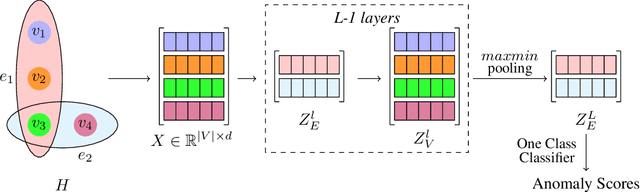
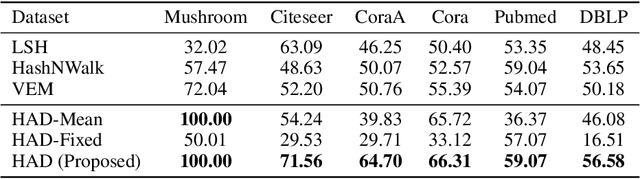
Hypergraph is a data structure that enables us to model higher-order associations among data entities. Conventional graph-structured data can represent pairwise relationships only, whereas hypergraph enables us to associate any number of entities, which is essential in many real-life applications. Hypergraph learning algorithms have been well-studied for numerous problem settings, such as node classification, link prediction, etc. However, much less research has been conducted on anomaly detection from hypergraphs. Anomaly detection identifies events that deviate from the usual pattern and can be applied to hypergraphs to detect unusual higher-order associations. In this work, we propose an end-to-end hypergraph neural network-based model for identifying anomalous associations in a hypergraph. Our proposed algorithm operates in an unsupervised manner without requiring any labeled data. Extensive experimentation on several real-life datasets demonstrates the effectiveness of our model in detecting anomalous hyperedges.