 Add to Chrome
 Add to Firefox
 Add to Edge
CATS: Curvature Aware Temporal Selection for efficient long video understanding
May 09, 2026
Understanding long videos with multimodal large language models (MLLMs) requires selecting a small subset of informative frames under strict computational budgets, where exhaustive processing is infeasible and optimal selection is combinatorial. We propose CATS, a curvature-aware frame selection method that explicitly models the temporal geometry of query-frame relevance to identify salient events and their surrounding context. By leveraging temporal curvature to adapt selection density, CATS captures both abrupt transitions and gradually evolving content while suppressing redundant frames. Under a fixed backbone and frame budget, CATS consistently outperforms prior lightweight approaches such as AKS on LongVideoBench and VideoMME. While multi-stage methods such as MIRA achieve higher absolute accuracy, they incur substantial computational overhead; in contrast, CATS retains approximately 93-95% of MIRA's performance while requiring only 3-4% of its preprocessing cost, yielding a favorable efficiency-accuracy trade-off. Beyond answer accuracy, we evaluate description generation using an LLM-as-a-judge protocol, and the obtained results show that CATS produces more coherent and informative outputs, indicating improved grounding in visual evidence. These results position CATS as a computationally efficient and principled approach to long-video understanding.

Hyperedge Anomaly Detection with Hypergraph Neural Network
Dec 07, 2024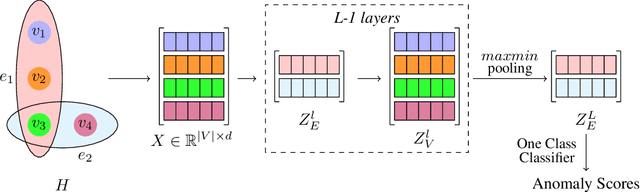
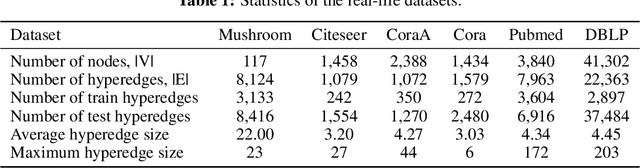
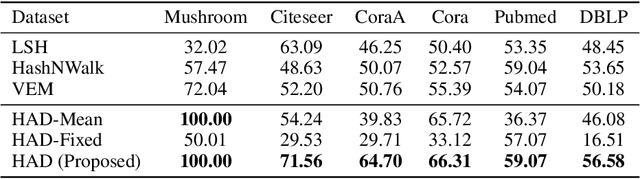
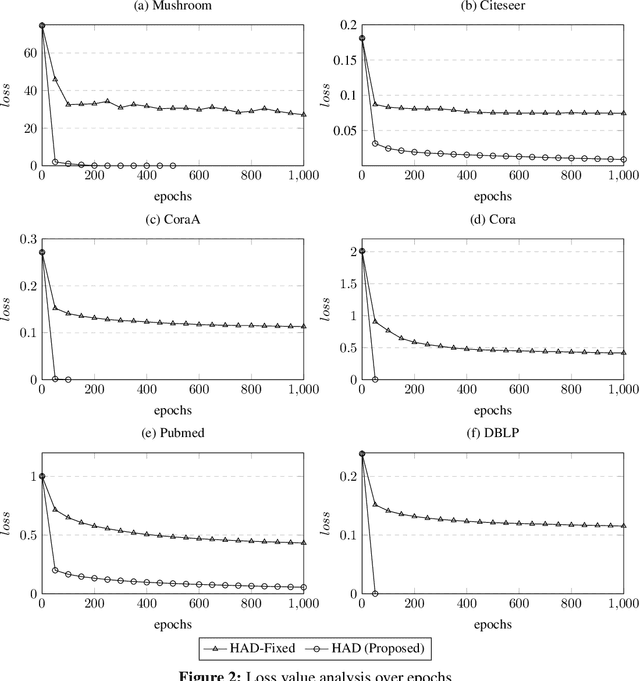
Hypergraph is a data structure that enables us to model higher-order associations among data entities. Conventional graph-structured data can represent pairwise relationships only, whereas hypergraph enables us to associate any number of entities, which is essential in many real-life applications. Hypergraph learning algorithms have been well-studied for numerous problem settings, such as node classification, link prediction, etc. However, much less research has been conducted on anomaly detection from hypergraphs. Anomaly detection identifies events that deviate from the usual pattern and can be applied to hypergraphs to detect unusual higher-order associations. In this work, we propose an end-to-end hypergraph neural network-based model for identifying anomalous associations in a hypergraph. Our proposed algorithm operates in an unsupervised manner without requiring any labeled data. Extensive experimentation on several real-life datasets demonstrates the effectiveness of our model in detecting anomalous hyperedges.