 Add to Chrome
 Add to Firefox
 Add to Edge
OracleAgent: A Multimodal Reasoning Agent for Oracle Bone Script Research
Oct 30, 2025
As one of the earliest writing systems, Oracle Bone Script (OBS) preserves the cultural and intellectual heritage of ancient civilizations. However, current OBS research faces two major challenges: (1) the interpretation of OBS involves a complex workflow comprising multiple serial and parallel sub-tasks, and (2) the efficiency of OBS information organization and retrieval remains a critical bottleneck, as scholars often spend substantial effort searching for, compiling, and managing relevant resources. To address these challenges, we present OracleAgent, the first agent system designed for the structured management and retrieval of OBS-related information. OracleAgent seamlessly integrates multiple OBS analysis tools, empowered by large language models (LLMs), and can flexibly orchestrate these components. Additionally, we construct a comprehensive domain-specific multimodal knowledge base for OBS, which is built through a rigorous multi-year process of data collection, cleaning, and expert annotation. The knowledge base comprises over 1.4M single-character rubbing images and 80K interpretation texts. OracleAgent leverages this resource through its multimodal tools to assist experts in retrieval tasks of character, document, interpretation text, and rubbing image. Extensive experiments demonstrate that OracleAgent achieves superior performance across a range of multimodal reasoning and generation tasks, surpassing leading mainstream multimodal large language models (MLLMs) (e.g., GPT-4o). Furthermore, our case study illustrates that OracleAgent can effectively assist domain experts, significantly reducing the time cost of OBS research. These results highlight OracleAgent as a significant step toward the practical deployment of OBS-assisted research and automated interpretation systems.

DVHGNN: Multi-Scale Dilated Vision HGNN for Efficient Vision Recognition
Mar 19, 2025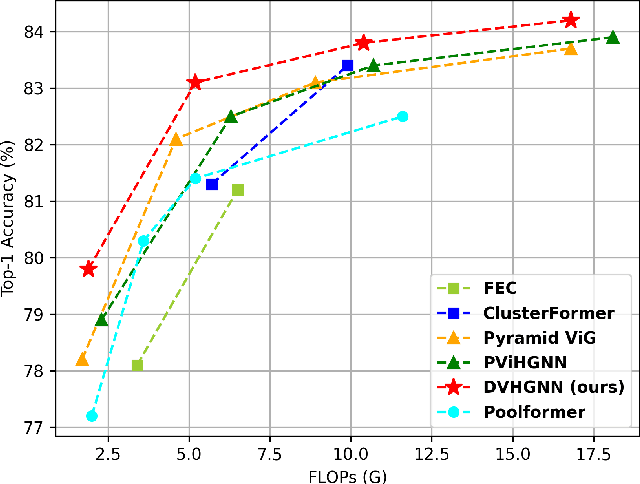
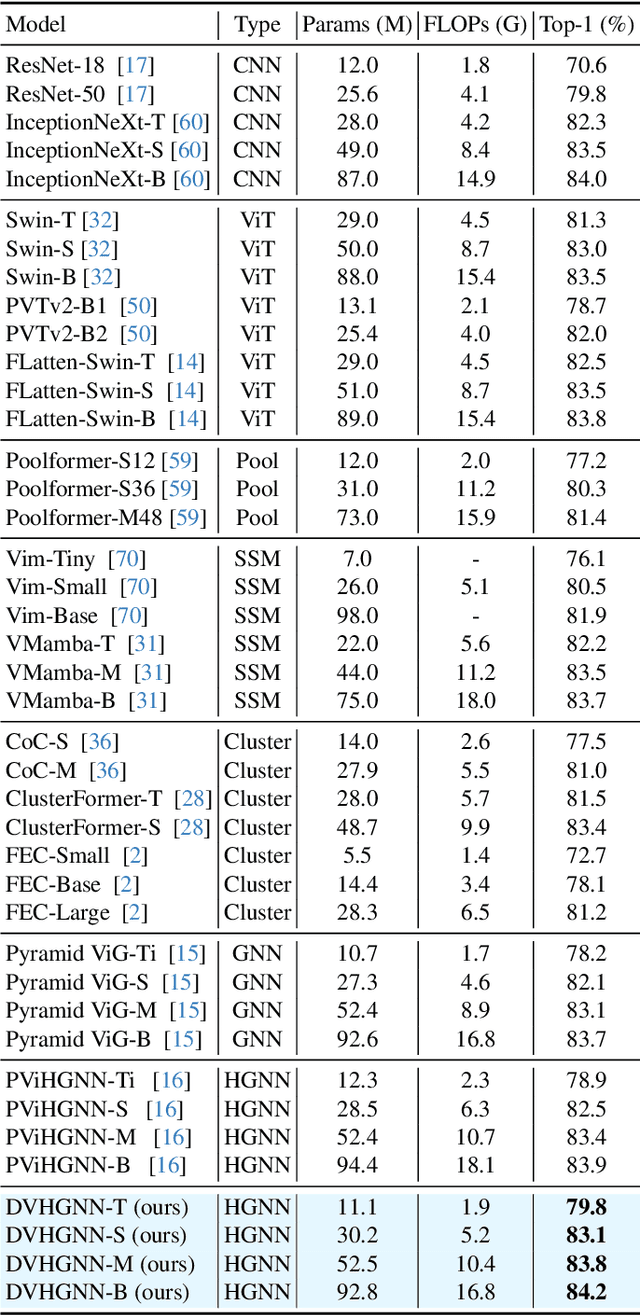
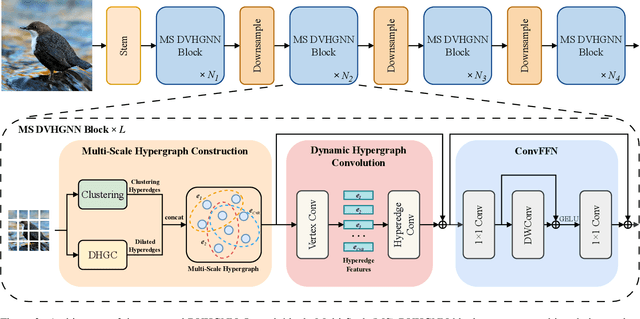
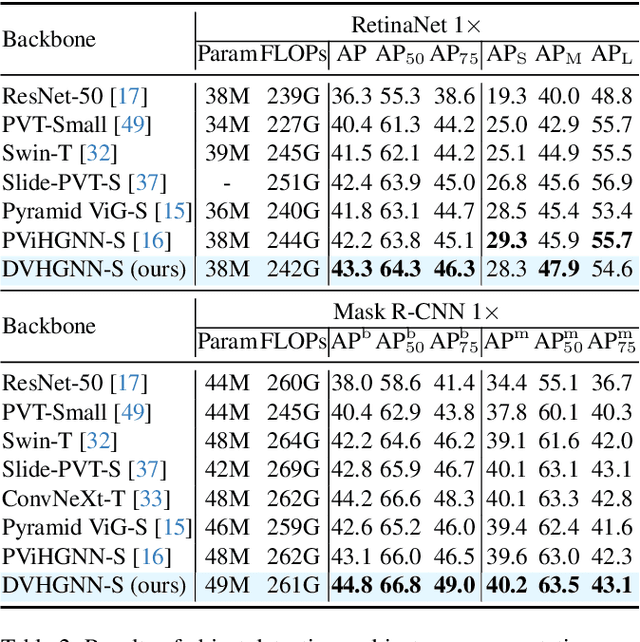
Recently, Vision Graph Neural Network (ViG) has gained considerable attention in computer vision. Despite its groundbreaking innovation, Vision Graph Neural Network encounters key issues including the quadratic computational complexity caused by its K-Nearest Neighbor (KNN) graph construction and the limitation of pairwise relations of normal graphs. To address the aforementioned challenges, we propose a novel vision architecture, termed Dilated Vision HyperGraph Neural Network (DVHGNN), which is designed to leverage multi-scale hypergraph to efficiently capture high-order correlations among objects. Specifically, the proposed method tailors Clustering and Dilated HyperGraph Construction (DHGC) to adaptively capture multi-scale dependencies among the data samples. Furthermore, a dynamic hypergraph convolution mechanism is proposed to facilitate adaptive feature exchange and fusion at the hypergraph level. Extensive qualitative and quantitative evaluations of the benchmark image datasets demonstrate that the proposed DVHGNN significantly outperforms the state-of-the-art vision backbones. For instance, our DVHGNN-S achieves an impressive top-1 accuracy of 83.1% on ImageNet-1K, surpassing ViG-S by +1.0% and ViHGNN-S by +0.6%.
DAMamba: Vision State Space Model with Dynamic Adaptive Scan
Feb 18, 2025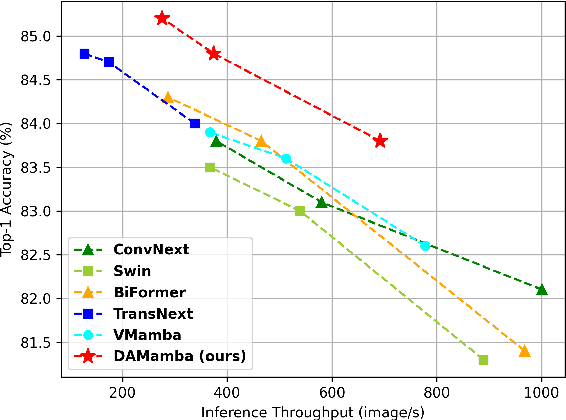
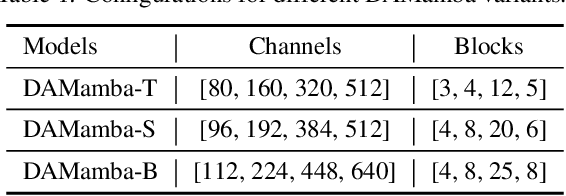
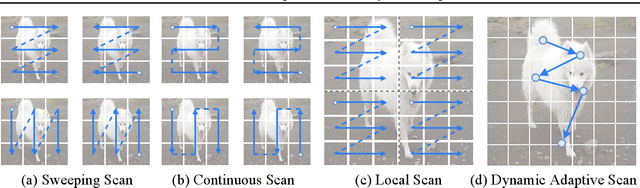
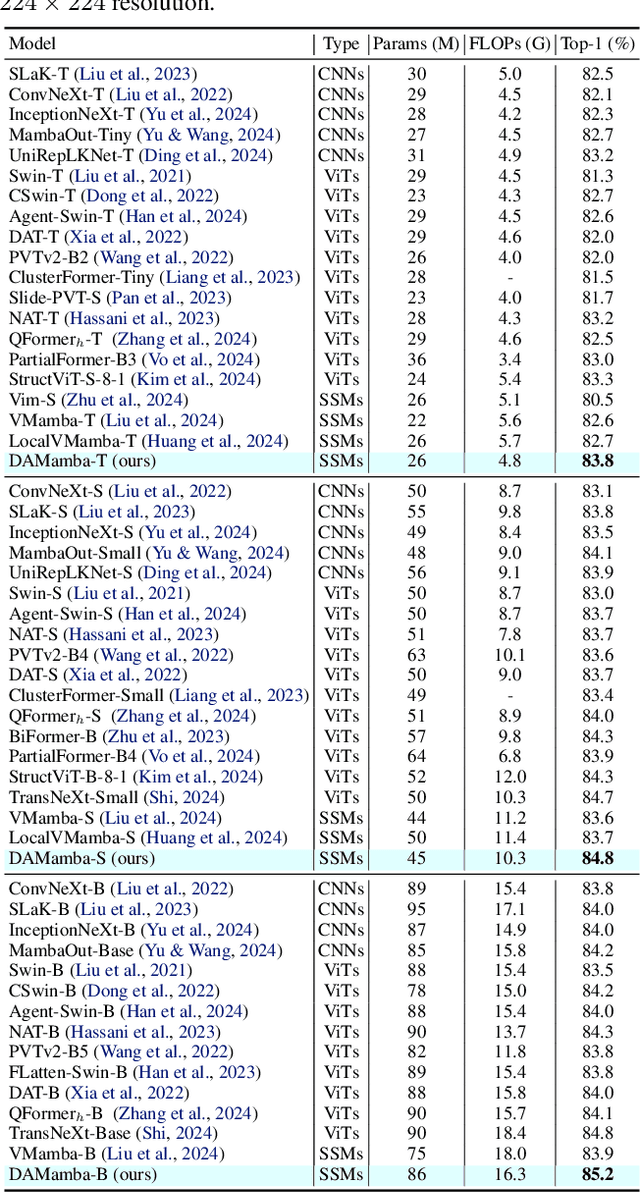
State space models (SSMs) have recently garnered significant attention in computer vision. However, due to the unique characteristics of image data, adapting SSMs from natural language processing to computer vision has not outperformed the state-of-the-art convolutional neural networks (CNNs) and Vision Transformers (ViTs). Existing vision SSMs primarily leverage manually designed scans to flatten image patches into sequences locally or globally. This approach disrupts the original semantic spatial adjacency of the image and lacks flexibility, making it difficult to capture complex image structures. To address this limitation, we propose Dynamic Adaptive Scan (DAS), a data-driven method that adaptively allocates scanning orders and regions. This enables more flexible modeling capabilities while maintaining linear computational complexity and global modeling capacity. Based on DAS, we further propose the vision backbone DAMamba, which significantly outperforms current state-of-the-art vision Mamba models in vision tasks such as image classification, object detection, instance segmentation, and semantic segmentation. Notably, it surpasses some of the latest state-of-the-art CNNs and ViTs. Code will be available at https://github.com/ltzovo/DAMamba.