 Add to Chrome
 Add to Firefox
 Add to Edge
FailForge: Distilling Procedural Competence from Persistent Failures into Code Agents
Aug 09, 2026
Rejection sampling fine-tuning (RFT) is widely used to train code agents by generating trajectories on verifiable software engineering tasks, retaining those that pass the tests, and fine-tuning on the successful rollouts. However, even strong code agents repeatedly fail on a substantial fraction of such tasks, and standard RFT simply discards these failures. The discarded samples are precisely the hardest and most informative ones, drawn from verifiable instances that are costly to curate. Stronger base models may reduce the number of failures, but the remaining hard cases still define the frontier for further improvement. We propose FailForge, an agentic framework that converts failed rollouts into training signal. For each failed instance, an agent diagnoses the failure from error feedback and execution traces, distills the diagnosis into a concise and actionable skill, and injects the skill into the agent context for a guided second attempt. Trajectories that succeed under skill guidance are folded back into the RFT corpus. Crucially, the skill is removed at training time, so the model internalizes the recovered behavior rather than relying on external hints at inference. FailForge recovers over 26% of previously failed instances at marginal additional cost, and training Qwen3.5-4B on the augmented corpus improves the SWE-bench Verified resolve rate by 6.6 points over a strong RFT baseline, with gains concentrated on the hardest problems.

Efficient Reasoning via Thought-Training and Thought-Free Inference
Nov 05, 2025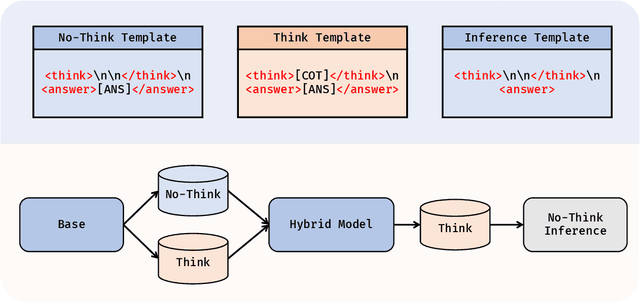
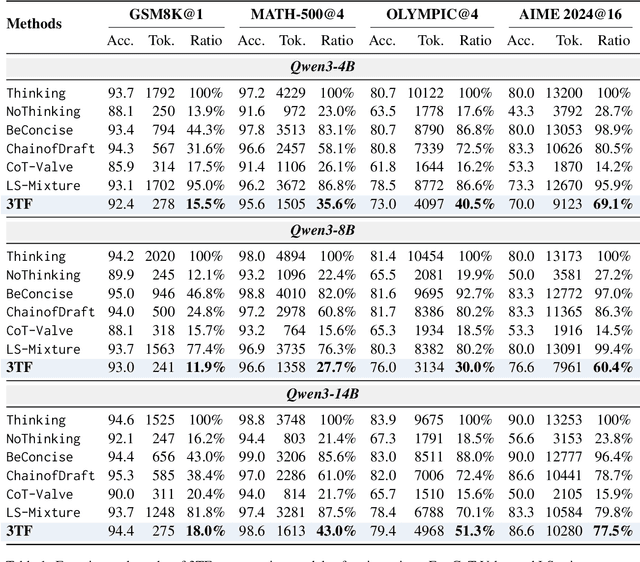
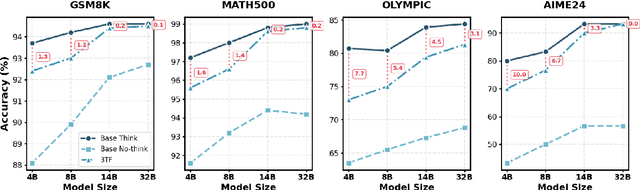
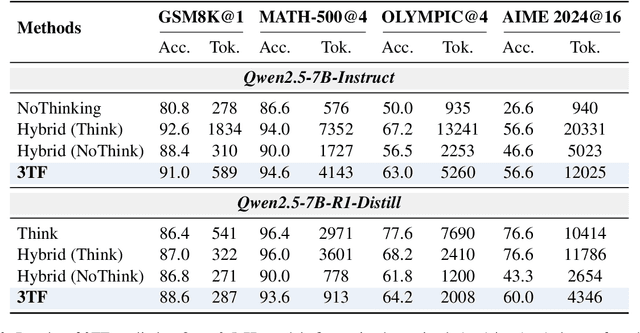
Recent advances in large language models (LLMs) have leveraged explicit Chain-of-Thought (CoT) prompting to improve reasoning accuracy. However, most existing methods primarily compress verbose reasoning outputs. These Long-to-Short transformations aim to improve efficiency, but still rely on explicit reasoning during inference. In this work, we introduce \textbf{3TF} (\textbf{T}hought-\textbf{T}raining and \textbf{T}hought-\textbf{F}ree inference), a framework for efficient reasoning that takes a Short-to-Long perspective. We first train a hybrid model that can operate in both reasoning and non-reasoning modes, and then further train it on CoT-annotated data to internalize structured reasoning, while enforcing concise, thought-free outputs at inference time using the no-reasoning mode. Unlike compression-based approaches, 3TF improves the reasoning quality of non-reasoning outputs, enabling models to perform rich internal reasoning implicitly while keeping external outputs short. Empirically, 3TF-trained models obtain large improvements on reasoning benchmarks under thought-free inference, demonstrating that high quality reasoning can be learned and executed implicitly without explicit step-by-step generation.