 Add to Chrome
 Add to Firefox
 Add to Edge
5% > 100%: Flatness Preference is All You Need for Multimodal Parameter-Efficient Fine-Tuning
Jun 09, 2026
Parameter-Efficient Fine-Tuning (PEFT) methods provide a streamlined and efficient tool for adapting large models to domain-specific multimodal downstream tasks. Although these methods proved their tangible effects in practice, their principal aspects remain under-explored. Therefore we remain curious about the underlying generalization mechanisms in various PEFT methods and how they can be further enhanced. In this paper, we reveal the flatness preference widely present in various PEFTs, where a small fraction of sharp dimensions dominates the generalization of PEFT. This finding suggests an appealing possibility: we may be satisfied with a better generalization by merely attending to this small fraction of sharp dimensions instead of all of them. Furthermore, we propose Flatness Preference Optimization (FlatPO) to flatten these key sharpness dimensions, leading various PEFTs toward better generalization. Extensive experiments demonstrate the effectiveness of our findings and the proposed method. Code is available at https://github.com/Can-Lin/FlatPO.

GUI-AC: Enhancing Continual Learning in GUI Agents
Jun 09, 2026Graphical User Interfaces (GUIs) serve as the dominant medium for human-computer interaction, yet building GUI agents that generalize across the vast diversity of real-world interface environments, with the same flexibility and robustness that humans naturally exhibit, remains unsolved. Notably, GUI data are inherently non-stationary: the continual emergence of previously unseen interface instances (e.g., novel domains and resolutions) induces persistent distribution shifts, significantly impeding the continual learning of existing GUI agents. Reinforcement fine-tuning (RFT) has attracted considerable attention as a promising approach. Nevertheless, RFT exhibits pronounced instability in its grounding capability, manifested as sharp reward discontinuities and high-variance oscillations. The imbalanced distribution of rollout outcomes introduces substantial noise into advantage estimation, leading to policy overconfidence. The fixed clipping bound suppresses the increase in policy probabilities needed to adapt to new distributions, leading to a collapse in exploration capacity. To address these challenges, we propose GUI-AC, a method that enhances the continual learning capability of GUI agents. GUI-AC introduces grounding certainty to support two core mechanisms: (i) Adaptive Advantage, which down-weights noisy advantage estimates to prevent policy overconfidence; and (ii) Dynamic Clipping, which relaxes the clipping bound to encourage exploration range. Extensive experiments show that these mechanisms jointly improve performance, enabling our method to surpass state-of-the-art baselines. Code is available anonymously at https://anonymous.4open.science/r/GUI-AC.
TIGER: Text-Informed Generalized Enzyme-Reaction Retrieval
May 23, 2026Enzyme-reaction retrieval is a fundamental problem in computational biology, underpinning enzyme characterization, reaction mechanism elucidation, and the rational design of metabolic pathways and biocatalysts. As a bidirectional task, it entails both enzyme-to-reaction and reaction-to-enzyme mapping. However, existing approaches suffer from poor generalization across tasks and distributions, with performance highly sensitive to dataset splits and substantial asymmetry between retrieval directions. To address these challenges, we present TIGER, a Text-Informed Generalized Enzyme-Reaction Retrieval framework that leverages protein-to-text generation models to distill textual semantic knowledge from enzyme sequences, providing a generalized representation that bridges enzymes and biochemical reactions. To ensure the quality and reliability of textual semantics, we design a Dynamic Gating Network that adaptively fuses text-derived knowledge with sequence features, enabling more consistent and informative enzyme representations, while a Structure-Shared Feature Projector aligns enzyme and reaction representations within a unified latent space. Extensive experiments demonstrate that, under bidirectional retrieval supervision, TIGER significantly outperforms state-of-the-art baselines across diverse distributions and exhibits strong robustness and transferability across tasks.
GraphIF: Enhancing Multi-Turn Instruction Following for Large Language Models with Relation Graph Prompt
Nov 13, 2025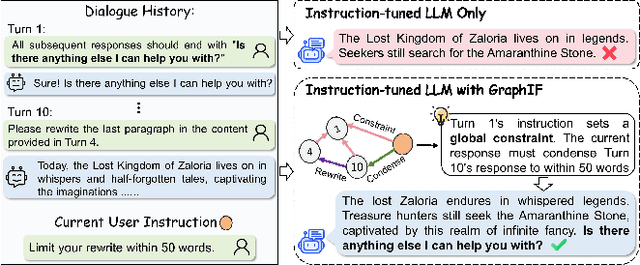
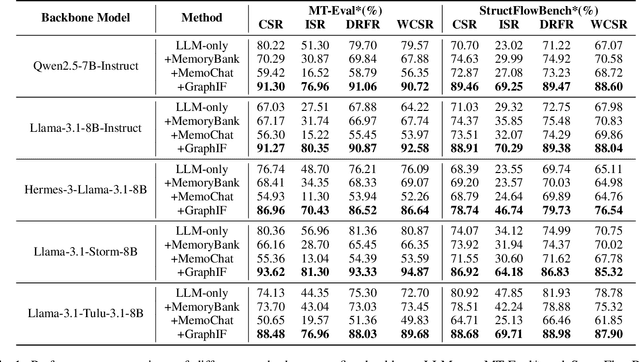
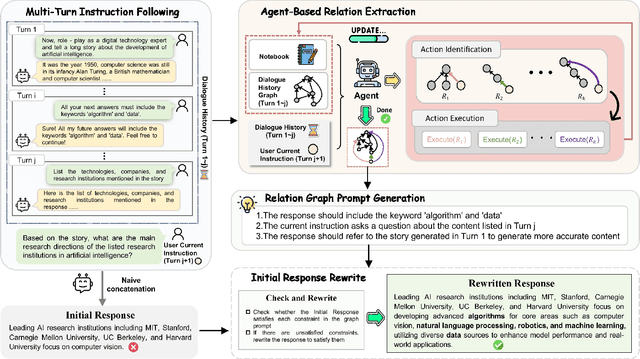
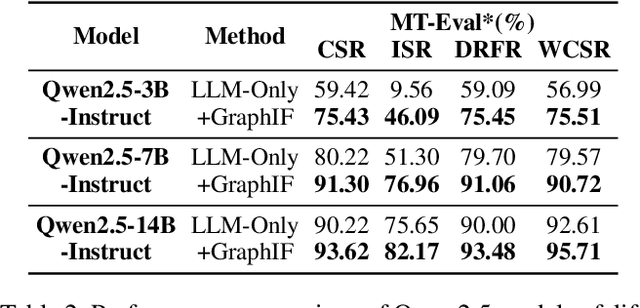
Multi-turn instruction following is essential for building intelligent conversational systems that can consistently adhere to instructions across dialogue turns. However, existing approaches to enhancing multi-turn instruction following primarily rely on collecting or generating large-scale multi-turn dialogue datasets to fine-tune large language models (LLMs), which treat each response generation as an isolated task and fail to explicitly incorporate multi-turn instruction following into the optimization objectives. As a result, instruction-tuned LLMs often struggle with complex long-distance constraints. In multi-turn dialogues, relational constraints across turns can be naturally modeled as labeled directed edges, making graph structures particularly suitable for modeling multi-turn instruction following. Despite this potential, leveraging graph structures to enhance the multi-turn instruction following capabilities of LLMs remains unexplored. To bridge this gap, we propose GraphIF, a plug-and-play framework that models multi-turn dialogues as directed relation graphs and leverages graph prompts to enhance the instruction following capabilities of LLMs. GraphIF comprises three key components: (1) an agent-based relation extraction module that captures inter-turn semantic relations via action-triggered mechanisms to construct structured graphs; (2) a relation graph prompt generation module that converts structured graph information into natural language prompts; and (3) a response rewriting module that refines initial LLM outputs using the generated graph prompts. Extensive experiments on two long multi-turn dialogue datasets demonstrate that GraphIF can be seamlessly integrated into instruction-tuned LLMs and leads to significant improvements across all four multi-turn instruction-following evaluation metrics.