 Add to Chrome
 Add to Firefox
 Add to Edge
EventDrive: Event Cameras for Vision-Language Driving Intelligence
Jun 16, 2026
Event cameras sense the world through asynchronous brightness changes with microsecond latency and high dynamic range, offering motion fidelity far beyond frame-based sensors and capturing temporal structure that conventional exposures often miss. These properties make events a powerful complement to RGB in autonomous driving, especially under blur, glare, and rapid motion, where frame-based perception can become unreliable. However, existing event-aware vision-language models remain limited to generic perception and do not reveal how event sensing contributes to reasoning and decision-making across the full driving loop. We present EventDrive, a large-scale benchmark and model suite that unifies event streams, RGB frames, and language supervision across four core dimensions: Perception, Understanding, Prediction, and Planning, covering captions, structured QA, grounding, motion-state recognition, trajectory forecasting, and planning tasks. Building on this foundation, EventDrive-VLM introduces a multi-horizon event pyramid and a temporal-horizon mixture-of-experts module to adaptively encode and fuse asynchronous and frame-based information for downstream reasoning. Comprehensive evaluation across diverse tasks shows that event streams provide substantial gains in temporal precision, motion awareness, and robustness, bringing event sensing into the center of driving intelligence.

FlexEvent: Event Camera Object Detection at Arbitrary Frequencies
Dec 09, 2024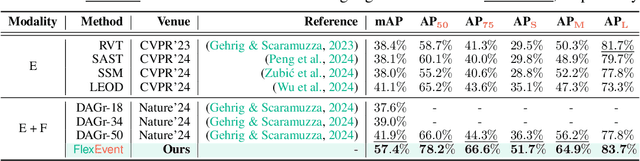

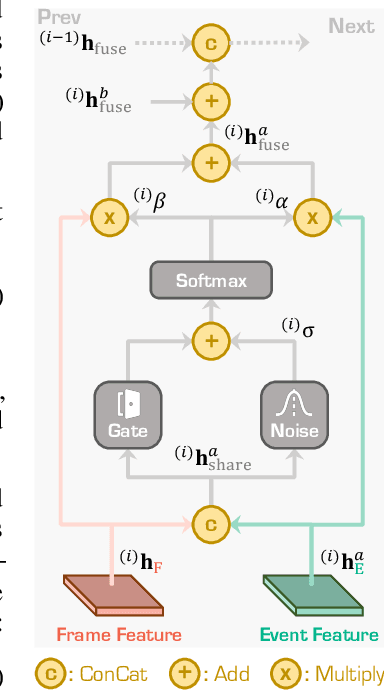
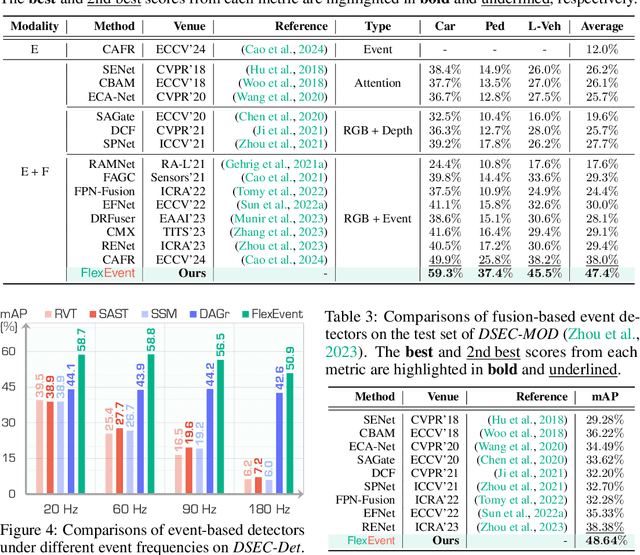
Event cameras offer unparalleled advantages for real-time perception in dynamic environments, thanks to their microsecond-level temporal resolution and asynchronous operation. Existing event-based object detection methods, however, are limited by fixed-frequency paradigms and fail to fully exploit the high-temporal resolution and adaptability of event cameras. To address these limitations, we propose FlexEvent, a novel event camera object detection framework that enables detection at arbitrary frequencies. Our approach consists of two key components: FlexFuser, an adaptive event-frame fusion module that integrates high-frequency event data with rich semantic information from RGB frames, and FAL, a frequency-adaptive learning mechanism that generates frequency-adjusted labels to enhance model generalization across varying operational frequencies. This combination allows our method to detect objects with high accuracy in both fast-moving and static scenarios, while adapting to dynamic environments. Extensive experiments on large-scale event camera datasets demonstrate that our approach surpasses state-of-the-art methods, achieving significant improvements in both standard and high-frequency settings. Notably, our method maintains robust performance when scaling from 20 Hz to 90 Hz and delivers accurate detection up to 180 Hz, proving its effectiveness in extreme conditions. Our framework sets a new benchmark for event-based object detection and paves the way for more adaptable, real-time vision systems.
An event-based implementation of saliency-based visual attention for rapid scene analysis
Jan 10, 2024Selective attention is an essential mechanism to filter sensory input and to select only its most important components, allowing the capacity-limited cognitive structures of the brain to process them in detail. The saliency map model, originally developed to understand the process of selective attention in the primate visual system, has also been extensively used in computer vision. Due to the wide-spread use of frame-based video, this is how dynamic input from non-stationary scenes is commonly implemented in saliency maps. However, the temporal structure of this input modality is very different from that of the primate visual system. Retinal input to the brain is massively parallel, local rather than frame-based, asynchronous rather than synchronous, and transmitted in the form of discrete events, neuronal action potentials (spikes). These features are captured by event-based cameras. We show that a computational saliency model can be obtained organically from such vision sensors, at minimal computational cost. We assess the performance of the model by comparing its predictions with the distribution of overt attention (fixations) of human observers, and we make available an event-based dataset that can be used as ground truth for future studies.