 Add to Chrome
 Add to Firefox
 Add to Edge
An Empirical Analysis of Static Analysis Methods for Detection and Mitigation of Code Library Hallucinations
Apr 09, 2026
Despite extensive research, Large Language Models continue to hallucinate when generating code, particularly when using libraries. On NL-to-code benchmarks that require library use, we find that LLMs generate code that uses non-existent library features in 8.1-40% of responses.One intuitive approach for detection and mitigation of hallucinations is static analysis. In this paper, we analyse the potential of static analysis tools, both in terms of what they can solve and what they cannot. We find that static analysis tools can detect 16-70% of all errors, and 14-85% of library hallucinations, with performance varying by LLM and dataset. Through manual analysis, we identify cases a static method could not plausibly catch, which gives an upper bound on their potential from 48.5% to 77%. Overall, we show that static analysis methods are cheap method for addressing some forms of hallucination, and we quantify how far short of solving the problem they will always be.

Do Text-to-Vis Benchmarks Test Real Use of Visualisations?
Jul 29, 2024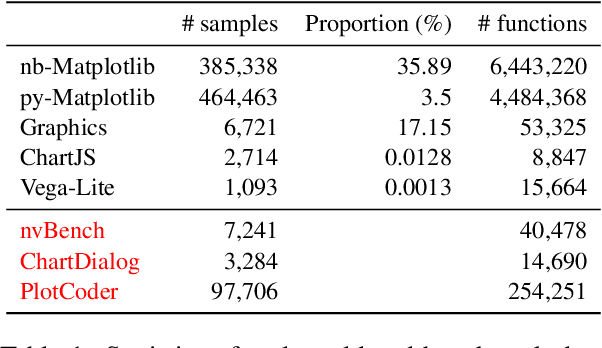
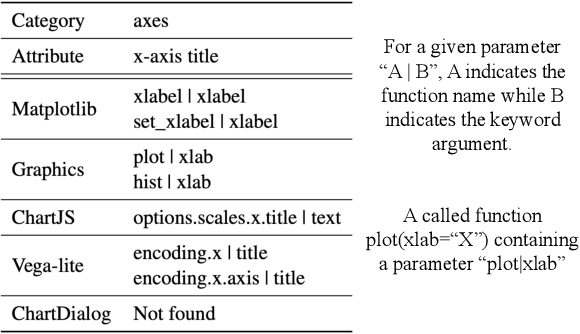
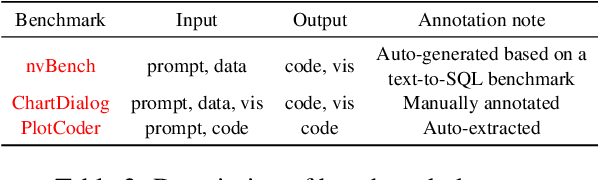
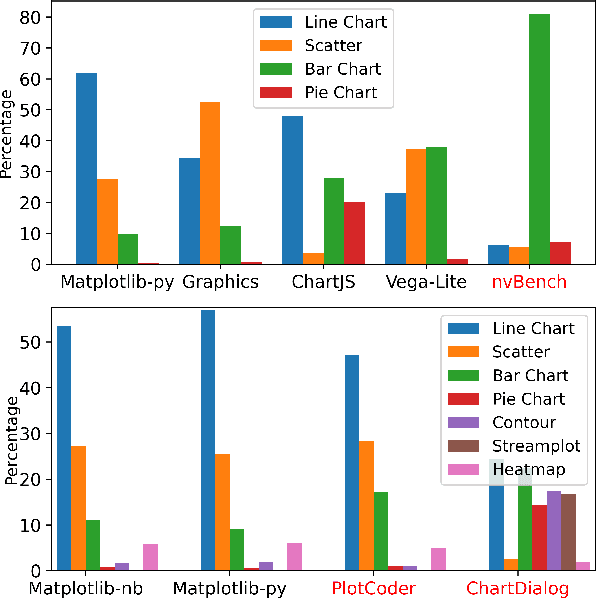
Large language models are able to generate code for visualisations in response to user requests. This is a useful application, and an appealing one for NLP research because plots of data provide grounding for language. However, there are relatively few benchmarks, and it is unknown whether those that exist are representative of what people do in practice. This paper aims to answer that question through an empirical study comparing benchmark datasets and code from public repositories. Our findings reveal a substantial gap in datasets, with evaluations not testing the same distribution of chart types, attributes, and the number of actions. The only representative dataset requires modification to become an end-to-end and practical benchmark. This shows that new, more benchmarks are needed to support the development of systems that truly address users' visualisation needs. These observations will guide future data creation, highlighting which features hold genuine significance for users.