 Add to Chrome
 Add to Firefox
 Add to Edge
Leveraging Image Editing Foundation Models for Data-Efficient CT Metal Artifact Reduction
Apr 07, 2026
Metal artifacts from high-attenuation implants severely degrade CT image quality, obscuring critical anatomical structures and posing a challenge for standard deep learning methods that require extensive paired training data. We propose a paradigm shift: reframing artifact reduction as an in-context reasoning task by adapting a general-purpose vision-language diffusion foundation model via parameter-efficient Low-Rank Adaptation (LoRA). By leveraging rich visual priors, our approach achieves effective artifact suppression with only 16 to 128 paired training examples reducing data requirements by two orders of magnitude. Crucially, we demonstrate that domain adaptation is essential for hallucination mitigation; without it, foundation models interpret streak artifacts as erroneous natural objects (e.g., waffles or petri dishes). To ground the restoration, we propose a multi-reference conditioning strategy where clean anatomical exemplars from unrelated subjects are provided alongside the corrupted input, enabling the model to exploit category-specific context to infer uncorrupted anatomy. Extensive evaluation on the AAPM CT-MAR benchmark demonstrates that our method achieves state-of-the-art performance on perceptual and radiological-feature metrics . This work establishes that foundation models, when appropriately adapted, offer a scalable alternative for interpretable, data-efficient medical image reconstruction. Code is available at https://github.com/ahmetemirdagi/CT-EditMAR.

Edit2Interp: Adapting Image Foundation Models from Spatial Editing to Video Frame Interpolation with Few-Shot Learning
Mar 16, 2026Pre-trained image editing models exhibit strong spatial reasoning and object-aware transformation capabilities acquired from billions of image-text pairs, yet they possess no explicit temporal modeling. This paper demonstrates that these spatial priors can be repurposed to unlock temporal synthesis capabilities through minimal adaptation - without introducing any video-specific architecture or motion estimation modules. We show that a large image editing model (Qwen-Image-Edit), originally designed solely for static instruction-based edits, can be adapted for Video Frame Interpolation (VFI) using only 64-256 training samples via Low-Rank Adaptation (LoRA). Our core contribution is revealing that the model's inherent understanding of "how objects transform" in static scenes contains latent temporal reasoning that can be activated through few-shot fine-tuning. While the baseline model completely fails at producing coherent intermediate frames, our parameter-efficient adaptation successfully unlocks its interpolation capability. Rather than competing with task-specific VFI methods trained from scratch on massive datasets, our work establishes that foundation image editing models possess untapped potential for temporal tasks, offering a data-efficient pathway for video synthesis in resource-constrained scenarios. This bridges the gap between image manipulation and video understanding, suggesting that spatial and temporal reasoning may be more intertwined in foundation models than previously recognized
Causal Transformer for Fusion and Pose Estimation in Deep Visual Inertial Odometry
Sep 13, 2024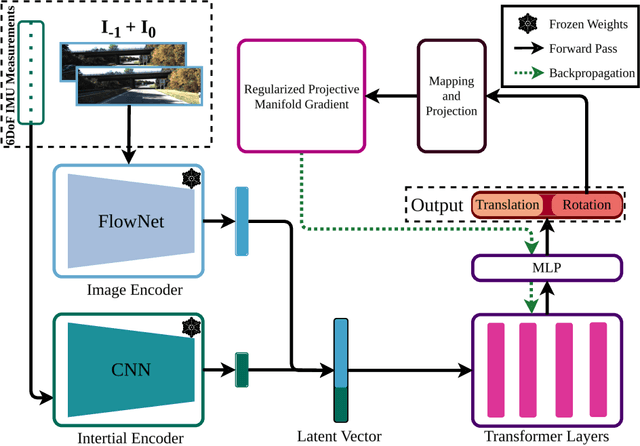
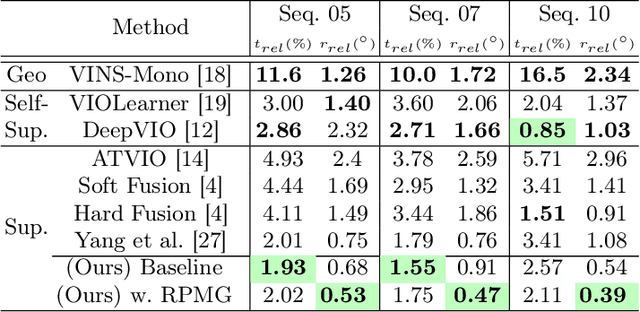
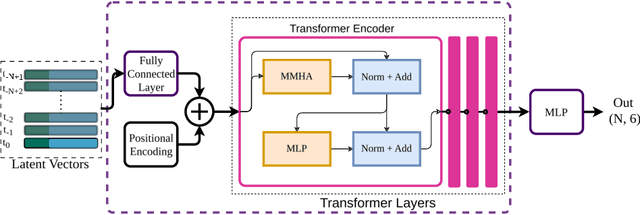
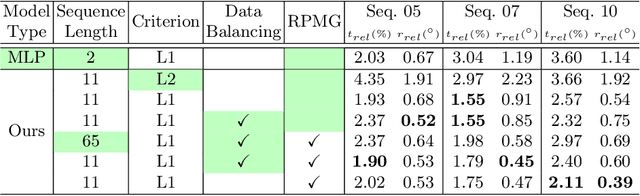
In recent years, transformer-based architectures become the de facto standard for sequence modeling in deep learning frameworks. Inspired by the successful examples, we propose a causal visual-inertial fusion transformer (VIFT) for pose estimation in deep visual-inertial odometry. This study aims to improve pose estimation accuracy by leveraging the attention mechanisms in transformers, which better utilize historical data compared to the recurrent neural network (RNN) based methods seen in recent methods. Transformers typically require large-scale data for training. To address this issue, we utilize inductive biases for deep VIO networks. Since latent visual-inertial feature vectors encompass essential information for pose estimation, we employ transformers to refine pose estimates by updating latent vectors temporally. Our study also examines the impact of data imbalance and rotation learning methods in supervised end-to-end learning of visual inertial odometry by utilizing specialized gradients in backpropagation for the elements of SE$(3)$ group. The proposed method is end-to-end trainable and requires only a monocular camera and IMU during inference. Experimental results demonstrate that VIFT increases the accuracy of monocular VIO networks, achieving state-of-the-art results when compared to previous methods on the KITTI dataset. The code will be made available at https://github.com/ybkurt/VIFT.