 Add to Chrome
 Add to Firefox
 Add to Edge
Explainable Transformer Models for Clinical Prediction Tasks on Structured Electronic Health Records
Aug 20, 2026
Predictive models over structured electronic health records (EHRs) remain central to machine learning for healthcare, but few have jointly emphasized quantitative laboratory information and interpretability with respect to input medical events. We present BERT-LER, a BERT-style model for coded EHR timelines pretrained and fine-tuned from a de-identified EHR dataset of 75 million patients, that encodes laboratory test results as discrete tokens while retaining graded information through percentile-based binning, paired with Integrated Gradients for token-level attributions grounded in the input EHR sequence. We benchmark our approach on the public EHRShot benchmark suite and on an asthma severity progression study based on real-world data. This addresses a methodological gap in EHR foundation-style modeling by unifying laboratory value representation and explainability in a single framework, while assessing whether both predictive performance and explanations generalize beyond standard clinical prediction tasks. Across EHRShot and asthma tasks, BERT-LER achieves predictive performance that is competitive with, and on laboratory-related tasks often exceeds, publicly available benchmark models, and provides attributions that align with clinically known risk factors. Our architecture and explainability approach can be applied to many therapeutic areas and prediction tasks using language models trained on structured EHRs.

Multiple Sclerosis Severity Classification From Clinical Text
Oct 29, 2020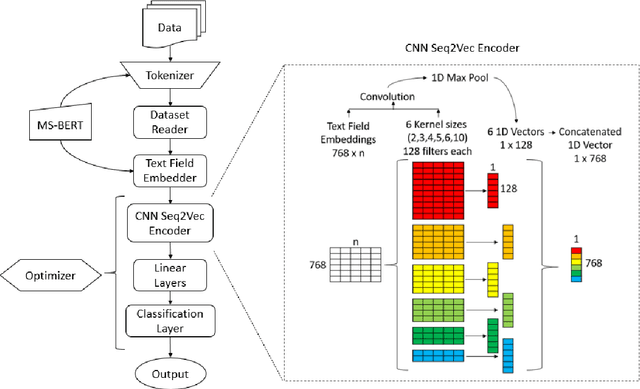
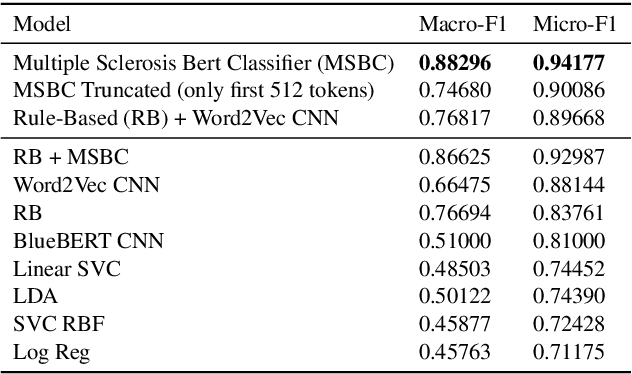
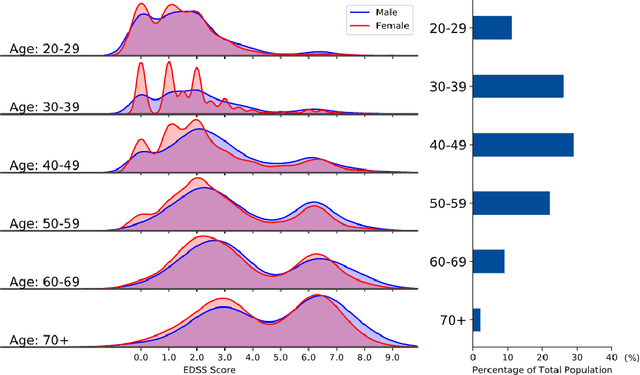
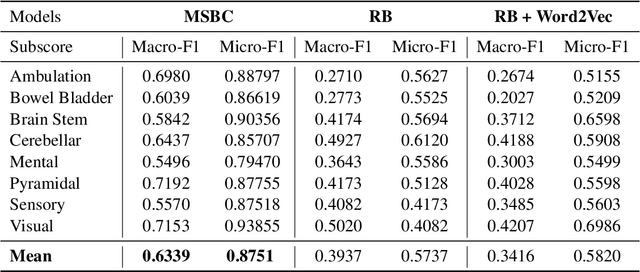
Multiple Sclerosis (MS) is a chronic, inflammatory and degenerative neurological disease, which is monitored by a specialist using the Expanded Disability Status Scale (EDSS) and recorded in unstructured text in the form of a neurology consult note. An EDSS measurement contains an overall "EDSS" score and several functional subscores. Typically, expert knowledge is required to interpret consult notes and generate these scores. Previous approaches used limited context length Word2Vec embeddings and keyword searches to predict scores given a consult note, but often failed when scores were not explicitly stated. In this work, we present MS-BERT, the first publicly available transformer model trained on real clinical data other than MIMIC. Next, we present MSBC, a classifier that applies MS-BERT to generate embeddings and predict EDSS and functional subscores. Lastly, we explore combining MSBC with other models through the use of Snorkel to generate scores for unlabelled consult notes. MSBC achieves state-of-the-art performance on all metrics and prediction tasks and outperforms the models generated from the Snorkel ensemble. We improve Macro-F1 by 0.12 (to 0.88) for predicting EDSS and on average by 0.29 (to 0.63) for predicting functional subscores over previous Word2Vec CNN and rule-based approaches.