 Add to Chrome
 Add to Firefox
 Add to Edge
Explainable Transformer Models for Clinical Prediction Tasks on Structured Electronic Health Records
Aug 20, 2026
Predictive models over structured electronic health records (EHRs) remain central to machine learning for healthcare, but few have jointly emphasized quantitative laboratory information and interpretability with respect to input medical events. We present BERT-LER, a BERT-style model for coded EHR timelines pretrained and fine-tuned from a de-identified EHR dataset of 75 million patients, that encodes laboratory test results as discrete tokens while retaining graded information through percentile-based binning, paired with Integrated Gradients for token-level attributions grounded in the input EHR sequence. We benchmark our approach on the public EHRShot benchmark suite and on an asthma severity progression study based on real-world data. This addresses a methodological gap in EHR foundation-style modeling by unifying laboratory value representation and explainability in a single framework, while assessing whether both predictive performance and explanations generalize beyond standard clinical prediction tasks. Across EHRShot and asthma tasks, BERT-LER achieves predictive performance that is competitive with, and on laboratory-related tasks often exceeds, publicly available benchmark models, and provides attributions that align with clinically known risk factors. Our architecture and explainability approach can be applied to many therapeutic areas and prediction tasks using language models trained on structured EHRs.

Solvaformer: an SE(3)-equivariant graph transformer for small molecule solubility prediction
Nov 12, 2025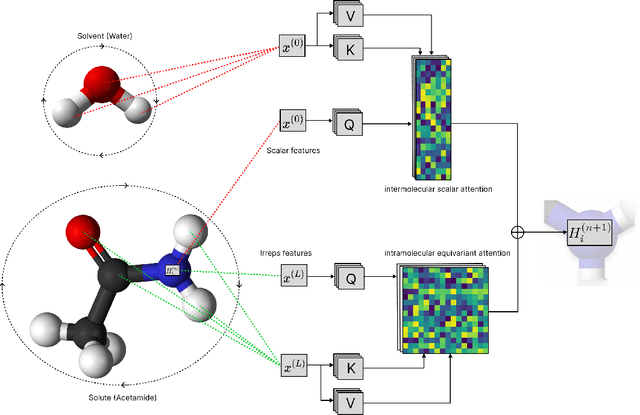
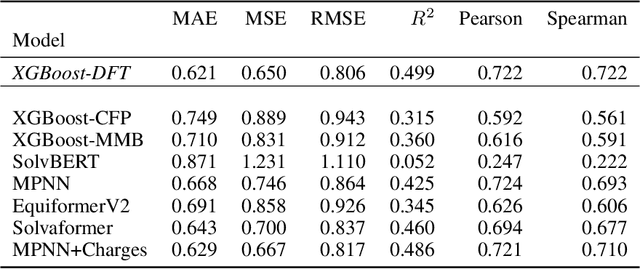
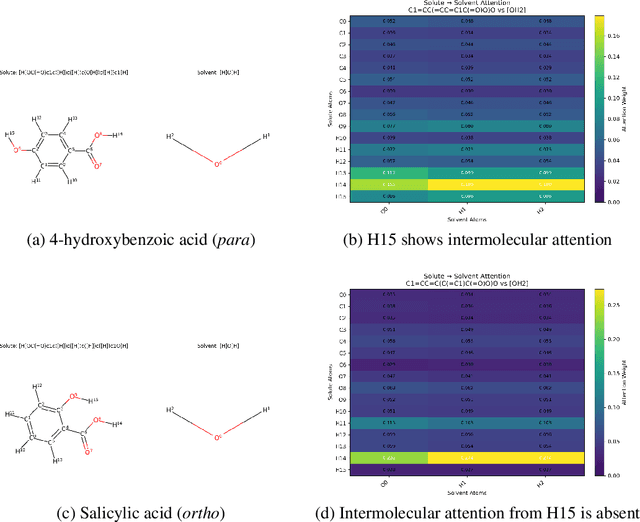
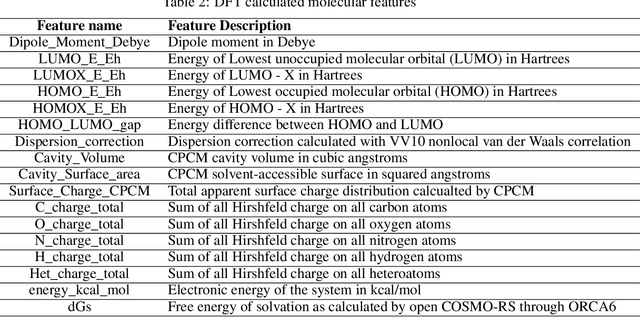
Accurate prediction of small molecule solubility using material-sparing approaches is critical for accelerating synthesis and process optimization, yet experimental measurement is costly and many learning approaches either depend on quantumderived descriptors or offer limited interpretability. We introduce Solvaformer, a geometry-aware graph transformer that models solutions as multiple molecules with independent SE(3) symmetries. The architecture combines intramolecular SE(3)-equivariant attention with intermolecular scalar attention, enabling cross-molecular communication without imposing spurious relative geometry. We train Solvaformer in a multi-task setting to predict both solubility (log S) and solvation free energy, using an alternating-batch regimen that trains on quantum-mechanical data (CombiSolv-QM) and on experimental measurements (BigSolDB 2.0). Solvaformer attains the strongest overall performance among the learned models and approaches a DFT-assisted gradient-boosting baseline, while outperforming an EquiformerV2 ablation and sequence-based alternatives. In addition, token-level attention produces chemically coherent attributions: case studies recover known intra- vs. inter-molecular hydrogen-bonding patterns that govern solubility differences in positional isomers. Taken together, Solvaformer provides an accurate, scalable, and interpretable approach to solution-phase property prediction by uniting geometric inductive bias with a mixed dataset training strategy on complementary computational and experimental data.
Distilling and exploiting quantitative insights from Large Language Models for enhanced Bayesian optimization of chemical reactions
Apr 11, 2025Machine learning and Bayesian optimization (BO) algorithms can significantly accelerate the optimization of chemical reactions. Transfer learning can bolster the effectiveness of BO algorithms in low-data regimes by leveraging pre-existing chemical information or data outside the direct optimization task (i.e., source data). Large language models (LLMs) have demonstrated that chemical information present in foundation training data can give them utility for processing chemical data. Furthermore, they can be augmented with and help synthesize potentially multiple modalities of source chemical data germane to the optimization task. In this work, we examine how chemical information from LLMs can be elicited and used for transfer learning to accelerate the BO of reaction conditions to maximize yield. Specifically, we show that a survey-like prompting scheme and preference learning can be used to infer a utility function which models prior chemical information embedded in LLMs over a chemical parameter space; we find that the utility function shows modest correlation to true experimental measurements (yield) over the parameter space despite operating in a zero-shot setting. Furthermore, we show that the utility function can be leveraged to focus BO efforts in promising regions of the parameter space, improving the yield of the initial BO query and enhancing optimization in 4 of the 6 datasets studied. Overall, we view this work as a step towards bridging the gap between the chemistry knowledge embedded in LLMs and the capabilities of principled BO methods to accelerate reaction optimization.
Many-Shot In-Context Learning for Molecular Inverse Design
Jul 26, 2024Large Language Models (LLMs) have demonstrated great performance in few-shot In-Context Learning (ICL) for a variety of generative and discriminative chemical design tasks. The newly expanded context windows of LLMs can further improve ICL capabilities for molecular inverse design and lead optimization. To take full advantage of these capabilities we developed a new semi-supervised learning method that overcomes the lack of experimental data available for many-shot ICL. Our approach involves iterative inclusion of LLM generated molecules with high predicted performance, along with experimental data. We further integrated our method in a multi-modal LLM which allows for the interactive modification of generated molecular structures using text instructions. As we show, the new method greatly improves upon existing ICL methods for molecular design while being accessible and easy to use for scientists.