 Add to Chrome
 Add to Firefox
 Add to Edge
SpecDrop: Parameter-Free Category-Conditioned Routing for Modular Specialization
Aug 04, 2026
Mixture-of-experts (MoE) networks pursue specialization through learned routers, gates, and load-balancing losses, yet at matched total-parameter budgets learned routers can underperform equal-weight No-Routing baselines. Is the bottleneck the routing algorithm, or the alignment between training-signal granularity and the target categories? We probe the question with SpecDrop, a fixed parameter-free routing scheme: each of $K$ branches receives weight $p_a$ for its assigned category and a small leakage $p_i > 0$ otherwise, merged through a category-independent fixed denominator, with no learned routing parameters and no auxiliary losses; the category label is required at inference. On vision tasks where each image has one superclass label (CIFAR-100 on ResNet-110; ImageNet-1K on ViT-S/16), SpecDrop reaches 79.23% on CIFAR-100 and 79.89% on ImageNet-1K, exceeding parameter-matched baselines that do not use the label (+4.75 over dense on CIFAR-100; +6.53 over the No-Routing+SE control on ImageNet-1K). These gains quantify what category supervision buys when deployed through routing -- not an advantage over label-aware deployments of the baselines: given the same label, masking a dense model's outputs is stronger for accuracy alone (85.2 / 83.7). SpecDrop's contribution is converting the label into trained-in modular structure: 58%/100% branch-category alignment, and masking gains of 0.00 (CIFAR) / +1.06 (ImageNet) -- the output-space restriction is largely internalized during training. On fuzzy partitions, where training units span multiple categories (SlimPajama-6B language modeling with a 30M Transformer; SuperNI instruction tuning over Llama-3.2-1B with LoRA), the routing mechanism reduces to the matched No-Routing controls within seed noise, the null our thesis predicts. Granularity alignment, not algorithm choice, localizes when routing helps. Code: https://github.com/Beryex/SpecDrop

Adapt-Pruner: Adaptive Structural Pruning for Efficient Small Language Model Training
Feb 05, 2025Small language models (SLMs) have attracted considerable attention from both academia and industry due to their broad range of applications in edge devices. To obtain SLMs with strong performance, conventional approaches either pre-train the models from scratch, which incurs substantial computational costs, or compress/prune existing large language models (LLMs), which results in performance drops and falls short in comparison to pre-training. In this paper, we investigate the family of acceleration methods that involve both structured pruning and model training. We found 1) layer-wise adaptive pruning (Adapt-Pruner) is extremely effective in LLMs and yields significant improvements over existing pruning techniques, 2) adaptive pruning equipped with further training leads to models comparable to those pre-training from scratch, 3) incremental pruning brings non-trivial performance gain by interleaving pruning with training and only removing a small portion of neurons ($\sim$5%) at a time. Experimental results on LLaMA-3.1-8B demonstrate that Adapt-Pruner outperforms conventional pruning methods, such as LLM-Pruner, FLAP, and SliceGPT, by an average of 1%-7% in accuracy on commonsense benchmarks. Additionally, Adapt-Pruner restores the performance of MobileLLM-125M to 600M on the MMLU benchmark with 200$\times$ fewer tokens via pruning from its larger counterparts, and discovers a new 1B model that surpasses LLaMA-3.2-1B in multiple benchmarks.
RL-Pruner: Structured Pruning Using Reinforcement Learning for CNN Compression and Acceleration
Nov 10, 2024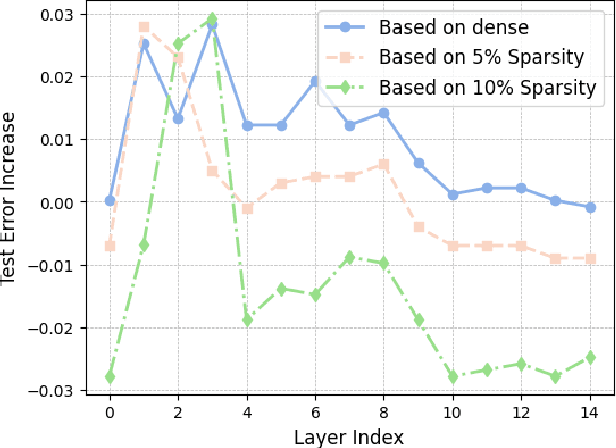
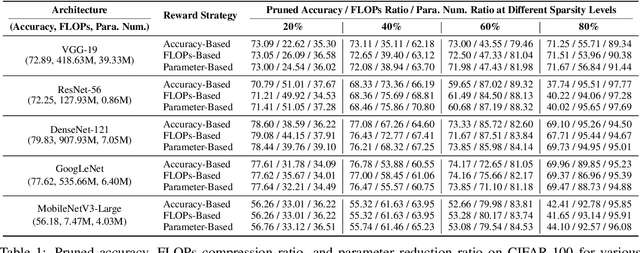
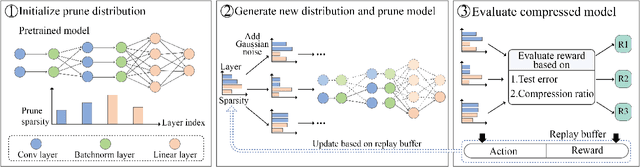
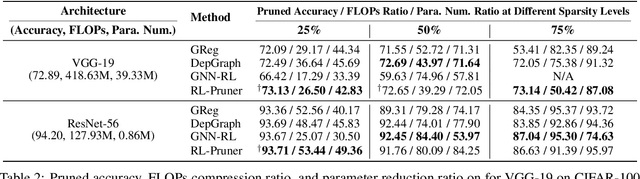
Convolutional Neural Networks (CNNs) have demonstrated exceptional performance in recent years. Compressing these models not only reduces storage requirements, making deployment to edge devices feasible, but also accelerates inference, thereby reducing latency and computational costs. Structured pruning, which removes filters at the layer level, directly modifies the model architecture. This approach achieves a more compact architecture while maintaining target accuracy, ensuring that the compressed model retains good compatibility and hardware efficiency. Our method is based on a key observation: filters in different layers of a neural network have varying importance to the model's performance. When the number of filters to prune is fixed, the optimal pruning distribution across different layers is uneven to minimize performance loss. Layers that are more sensitive to pruning should account for a smaller proportion of the pruning distribution. To leverage this insight, we propose RL-Pruner, which uses reinforcement learning to learn the optimal pruning distribution. RL-Pruner can automatically extract dependencies between filters in the input model and perform pruning, without requiring model-specific pruning implementations. We conducted experiments on models such as GoogleNet, ResNet, and MobileNet, comparing our approach to other structured pruning methods to validate its effectiveness. Our code is available at https://github.com/Beryex/RLPruner-CNN.