 Add to Chrome
 Add to Firefox
 Add to Edge
Cluster-Aware Neural Collapse Prompt Tuning for Long-Tailed Generalization of Vision-Language Models
May 12, 2026
Prompt learning has emerged as an efficient alternative to fine-tuning pre-trained vision-language models (VLMs). Despite its promise, current methods still struggle to maintain tail-class discriminability when adapting to class-imbalanced datasets. In this work, we propose cluster-aware neural collapse prompt tuning (CPT), which enhances the discriminability of tail classes in prompt-tuned VLMs without sacrificing their overall generalization. First, we design a cluster-invariant space by mining semantic assignments from the pre-trained VLM and mapping them to prompt-tuned features. This computes cluster-level boundaries and restricts the constraints to local neighborhoods, which reduces interference with the global semantic structure of the pre-trained VLM. Second, we introduce neural-collapse-driven discriminability optimization with three losses: textual Equiangular Tight Frame (ETF) separation loss, class-wise convergence loss, and rotation stabilization loss. These losses work together to shape intra-cluster geometry for better inter-class separation and intra-class alignment. Extensive experiments on 11 diverse datasets demonstrate that CPT outperforms SOTA methods, with stronger performance on long-tail classes and good generalization to unseen classes.

ExpPortrait: Expressive Portrait Generation via Personalized Representation
Feb 23, 2026While diffusion models have shown great potential in portrait generation, generating expressive, coherent, and controllable cinematic portrait videos remains a significant challenge. Existing intermediate signals for portrait generation, such as 2D landmarks and parametric models, have limited disentanglement capabilities and cannot express personalized details due to their sparse or low-rank representation. Therefore, existing methods based on these models struggle to accurately preserve subject identity and expressions, hindering the generation of highly expressive portrait videos. To overcome these limitations, we propose a high-fidelity personalized head representation that more effectively disentangles expression and identity. This representation captures both static, subject-specific global geometry and dynamic, expression-related details. Furthermore, we introduce an expression transfer module to achieve personalized transfer of head pose and expression details between different identities. We use this sophisticated and highly expressive head model as a conditional signal to train a diffusion transformer (DiT)-based generator to synthesize richly detailed portrait videos. Extensive experiments on self- and cross-reenactment tasks demonstrate that our method outperforms previous models in terms of identity preservation, expression accuracy, and temporal stability, particularly in capturing fine-grained details of complex motion.
One Shot, One Talk: Whole-body Talking Avatar from a Single Image
Dec 02, 2024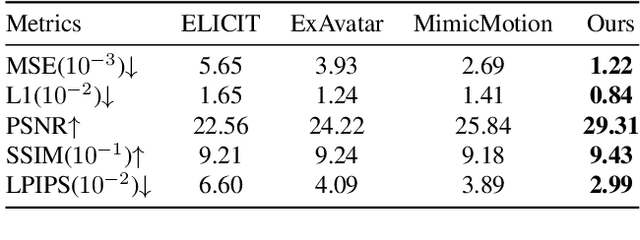
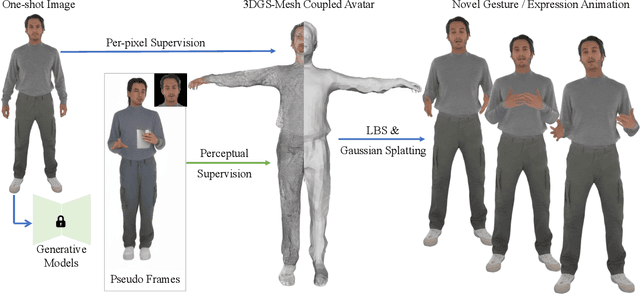
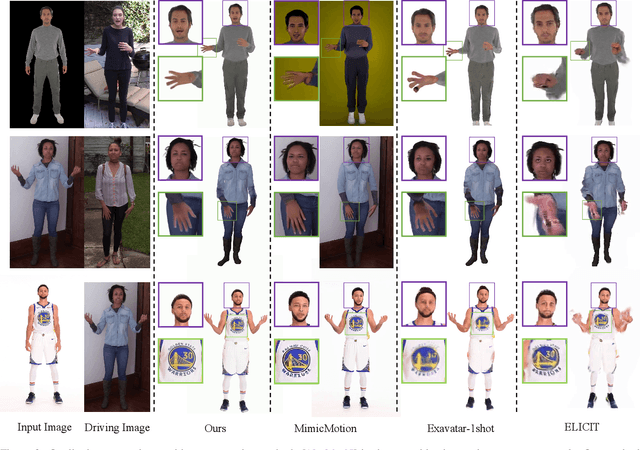
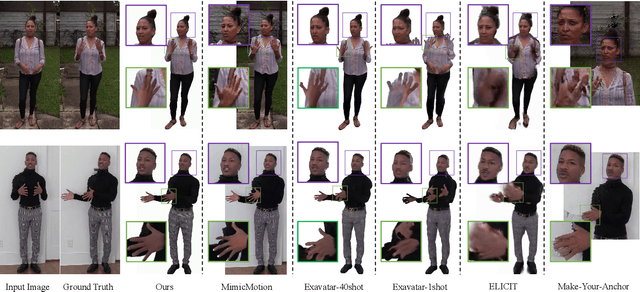
Building realistic and animatable avatars still requires minutes of multi-view or monocular self-rotating videos, and most methods lack precise control over gestures and expressions. To push this boundary, we address the challenge of constructing a whole-body talking avatar from a single image. We propose a novel pipeline that tackles two critical issues: 1) complex dynamic modeling and 2) generalization to novel gestures and expressions. To achieve seamless generalization, we leverage recent pose-guided image-to-video diffusion models to generate imperfect video frames as pseudo-labels. To overcome the dynamic modeling challenge posed by inconsistent and noisy pseudo-videos, we introduce a tightly coupled 3DGS-mesh hybrid avatar representation and apply several key regularizations to mitigate inconsistencies caused by imperfect labels. Extensive experiments on diverse subjects demonstrate that our method enables the creation of a photorealistic, precisely animatable, and expressive whole-body talking avatar from just a single image.