 Add to Chrome
 Add to Firefox
 Add to Edge
Cluster-Aware Neural Collapse Prompt Tuning for Long-Tailed Generalization of Vision-Language Models
May 12, 2026
Prompt learning has emerged as an efficient alternative to fine-tuning pre-trained vision-language models (VLMs). Despite its promise, current methods still struggle to maintain tail-class discriminability when adapting to class-imbalanced datasets. In this work, we propose cluster-aware neural collapse prompt tuning (CPT), which enhances the discriminability of tail classes in prompt-tuned VLMs without sacrificing their overall generalization. First, we design a cluster-invariant space by mining semantic assignments from the pre-trained VLM and mapping them to prompt-tuned features. This computes cluster-level boundaries and restricts the constraints to local neighborhoods, which reduces interference with the global semantic structure of the pre-trained VLM. Second, we introduce neural-collapse-driven discriminability optimization with three losses: textual Equiangular Tight Frame (ETF) separation loss, class-wise convergence loss, and rotation stabilization loss. These losses work together to shape intra-cluster geometry for better inter-class separation and intra-class alignment. Extensive experiments on 11 diverse datasets demonstrate that CPT outperforms SOTA methods, with stronger performance on long-tail classes and good generalization to unseen classes.

HAM: A Training-Free Style Transfer Approach via Heterogeneous Attention Modulation for Diffusion Models
Mar 25, 2026Diffusion models have demonstrated remarkable performance in image generation, particularly within the domain of style transfer. Prevailing style transfer approaches typically leverage pre-trained diffusion models' robust feature extraction capabilities alongside external modular control pathways to explicitly impose style guidance signals. However, these methods often fail to capture complex style reference or retain the identity of user-provided content images, thus falling into the trap of style-content balance. Thus, we propose a training-free style transfer approach via $\textbf{h}$eterogeneous $\textbf{a}$ttention $\textbf{m}$odulation ($\textbf{HAM}$) to protect identity information during image/text-guided style reference transfer, thereby addressing the style-content trade-off challenge. Specifically, we first introduces style noise initialization to initialize latent noise for diffusion. Then, during the diffusion process, it innovatively employs HAM for different attention mechanisms, including Global Attention Regulation (GAR) and Local Attention Transplantation (LAT), which better preserving the details of the content image while capturing complex style references. Our approach is validated through a series of qualitative and quantitative experiments, achieving state-of-the-art performance on multiple quantitative metrics.
Salient Object Detection in Complex Weather Conditions via Noise Indicators
Dec 11, 2025Salient object detection (SOD), a foundational task in computer vision, has advanced from single-modal to multi-modal paradigms to enhance generalization. However, most existing SOD methods assume low-noise visual conditions, overlooking the degradation of segmentation accuracy caused by weather-induced noise in real-world scenarios. In this paper, we propose a SOD framework tailored for diverse weather conditions, encompassing a specific encoder and a replaceable decoder. To enable handling of varying weather noises, we introduce a one-hot vector as a noise indicator to represent different weather types and design a Noise Indicator Fusion Module (NIFM). The NIFM takes both semantic features and the noise indicator as dual inputs and is inserted between consecutive stages of the encoder to embed weather-aware priors via adaptive feature modulation. Critically, the proposed specific encoder retains compatibility with mainstream SOD decoders. Extensive experiments are conducted on the WXSOD dataset under varying training data scales (100%, 50%, 30% of the full training set), three encoder and seven decoder configurations. Results show that the proposed SOD framework (particularly the NIFM-enhanced specific encoder) improves segmentation accuracy under complex weather conditions compared to a vanilla encoder.
Multi-Granularity Class Prototype Topology Distillation for Class-Incremental Source-Free Unsupervised Domain Adaptation
Nov 25, 2024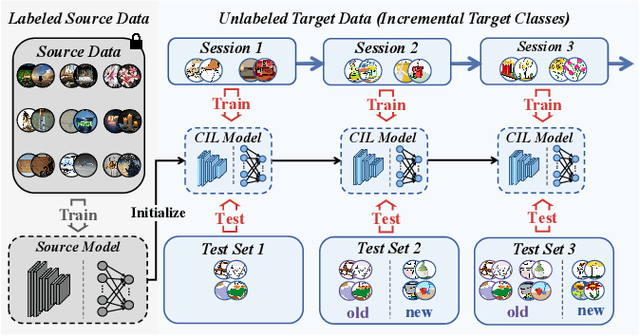
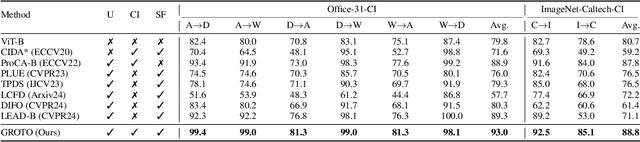
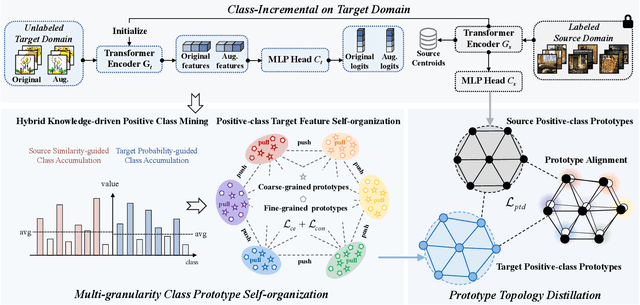

This paper explores the Class-Incremental Source-Free Unsupervised Domain Adaptation (CI-SFUDA) problem, where the unlabeled target data come incrementally without access to labeled source instances. This problem poses two challenges, the disturbances of similar source-class knowledge to target-class representation learning and the new target knowledge to old ones. To address them, we propose the Multi-Granularity Class Prototype Topology Distillation (GROTO) algorithm, which effectively transfers the source knowledge to the unlabeled class-incremental target domain. Concretely, we design the multi-granularity class prototype self-organization module and prototype topology distillation module. Firstly, the positive classes are mined by modeling two accumulation distributions. Then, we generate reliable pseudo-labels by introducing multi-granularity class prototypes, and use them to promote the positive-class target feature self-organization. Secondly, the positive-class prototypes are leveraged to construct the topological structures of source and target feature spaces. Then, we perform the topology distillation to continually mitigate the interferences of new target knowledge to old ones. Extensive experiments demonstrate that our proposed method achieves state-of-the-art performances on three public datasets.