 Add to Chrome
 Add to Firefox
 Add to Edge
Enhancing Agentic Autonomous Scientific Discovery with Vision-Language Model Capabilities
Nov 18, 2025
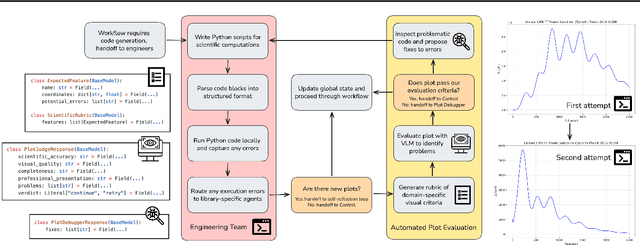

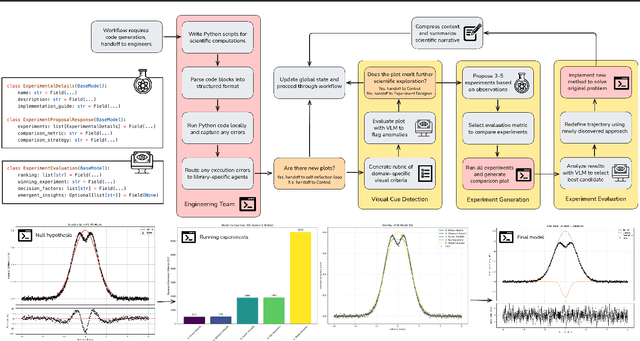
We show that multi-agent systems guided by vision-language models (VLMs) improve end-to-end autonomous scientific discovery. By treating plots as verifiable checkpoints, a VLM-as-a-judge evaluates figures against dynamically generated domain-specific rubrics, enabling agents to correct their own errors and steer exploratory data analysis in real-time. Case studies in cosmology and astrochemistry demonstrate recovery from faulty reasoning paths and adaptation to new datasets without human intervention. On a 10-task benchmark for data-driven discovery, VLM-augmented systems achieve pass at 1 scores of 0.7-0.8, compared to 0.2-0.3 for code-only and 0.4-0.5 for code-and-text baselines, while also providing auditable reasoning traces that improve interpretability. Code available here: https://github.com/CMBAgents/cmbagent

Open Source Planning & Control System with Language Agents for Autonomous Scientific Discovery
Jul 09, 2025We present a multi-agent system for automation of scientific research tasks, cmbagent. The system is formed by about 30 Large Language Model (LLM) agents and implements a Planning & Control strategy to orchestrate the agentic workflow, with no human-in-the-loop at any point. Each agent specializes in a different task (performing retrieval on scientific papers and codebases, writing code, interpreting results, critiquing the output of other agents) and the system is able to execute code locally. We successfully apply cmbagent to carry out a PhD level cosmology task (the measurement of cosmological parameters using supernova data) and evaluate its performance on two benchmark sets, finding superior performance over state-of-the-art LLMs. The source code is available on GitHub, demonstration videos are also available, and the system is deployed on HuggingFace and will be available on the cloud.