 Add to Chrome
 Add to Firefox
 Add to Edge
LoCA: Forward-Only LLM Tuning after One-Shot Calibration with Local Credit Assignment
Aug 07, 2026
Parameter-efficient post-training reduces the number of trainable parameters, but still requires repeated end-to-end backpropagation through the frozen backbone. Every adaptation step therefore needs backward-capable hardware and must store or recompute activations. We ask whether this repeated backward chain can be replaced by a one-time calibration. We introduce Local Credit Assignment (LoCA), a two-stage method for small-shift adaptation. One probe backward pass fits a low-rank map at each transformer block from the final prediction error to a local hidden-state correction. LoCA then reuses these maps to form blockwise regression targets from forward activations and fits low-rank adapters with closed-form ridge solves. No further backbone backward pass is required. We evaluate LoCA on five discriminative benchmarks with Qwen2.5 models from 0.5B to 14B. In 16 of 25 reported task--scale comparisons, LoCA yields lower evaluation cross-entropy than the corresponding LoRA run. Its measured full-run GPU peak, including calibration, is 26--29\% lower than LoRA's. After calibration, its CPU steady-state memory is 36--52\% lower and its per-pass time is 43--48\% lower. A shared scale-normalized candidate set is reused across all tested Qwen2.5 sizes and on SmolLM2-1.7B. LoCA thus amortizes global credit assignment into one calibration and enables later forward-only tuning when repeated backpropagation is impractical. The code associated with this paper is available \href{https://github.com/Xia12121/LoCA}{here}.

Evolving in the Agent Jungle via History-Informed Opponent Awareness
Aug 03, 2026Learning to adapt strategies through interaction is a key step toward more general and autonomous LLM agents. Existing approaches typically achieve behavioral adaptation by revising skill libraries. However, in multi-agent environments, opponents may simultaneously update their strategies, causing the environment itself to evolve continuously. Applying skill-revision methods designed for static environments in such settings therefore amounts to updating against an obsolete reference. To address this challenge, we introduce OASE (Opponent-Aware Selective Evolution), which identifies and adopts genuinely beneficial skill revisions in dynamic multi-agent environments. Specifically, OASE conducts paired comparisons between a candidate skill and the incumbent under identical conditions anchored by historical snapshots of opponent strategies, and adopts the candidate only when its estimated payoff gain exceeds an acceptance threshold. We evaluate OASE in two decision-making scenarios: first-price auctions and private-cost Cournot competition. Experimental results show that, compared with a Reflexion-style baseline, OASE achieves a lower final equilibrium distance in both environments while accepting substantially fewer skill revisions, thereby suppressing strategy changes that lack sufficient payoff support. OASE therefore replaces blind updating with evidence-anchored selection, allowing agents to adapt stably and efficiently even as opponents continuously evolve.
Listening makes Vision Clear for VLMs
Jun 22, 2026Recent work typically assesses vision--language consistency using attention distributions of answer-side tokens. However, we observe that highest attention regions are not always consistent with the intended semantic token. This probably stems from decoding drift, where language priors from previously generated answer tokens accumulate and mismatch with visual attention. Besides the priors from previous answer tokens, we find that structural tokens, e.g., modality boundary markers, may encompass the entire context and generate high attention to areas unrelated to the target. To avoid these distortions and provide consistency evaluation for large VLMs, we adopt prompt-side semantics and propose Prompt-Vision Token Activation Map (PV-TAM). PV-TAM further incorporates a filter to remove systematic bias induced by modality boundary markers. Unlike traditional methods that evaluate overlap solely through masks while ignoring activation intensity, our metrics leverage the peak distribution of attention to measure the alignment between prompts and visual regions. In experiments, PV-TAM consistently improves both attention-based and IoU-style localization metrics over answer-side baselines on various datasets.
Dynamical softassign and adaptive parameter tuning for graph matching
Aug 17, 2022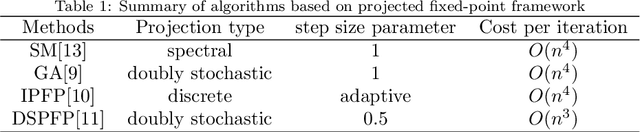
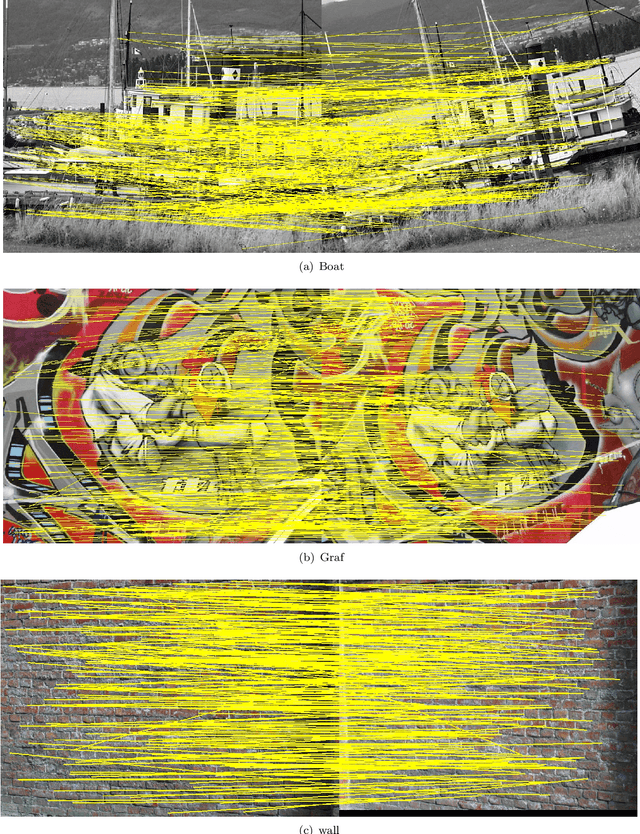
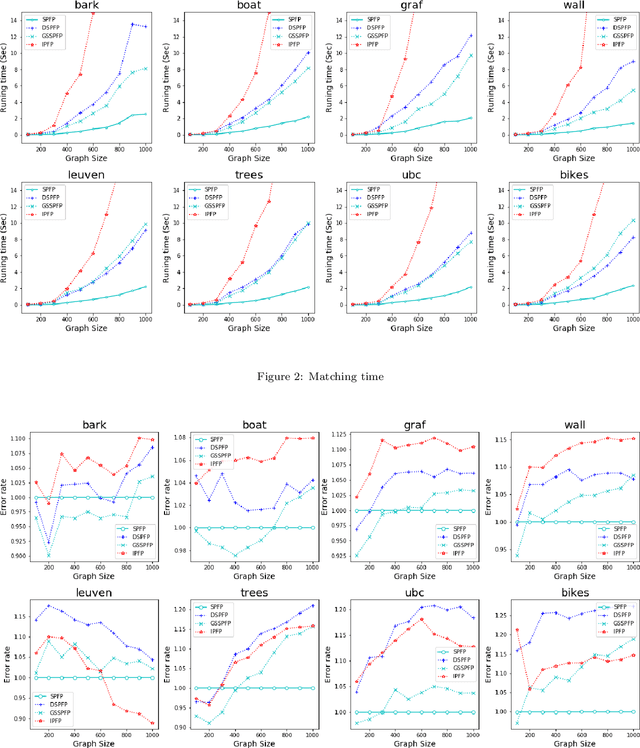

This paper studies a framework, projected fixed-point method, for graph matching. The framework contains a class of popular graph matching algorithms, including graduated assignment (GA), integer projected fixed-point method (IPFP) and doubly stochastic projected fixed-point method (DSPFP). We propose an adaptive strategy to tune the step size parameter in this framework. Such a strategy improves these algorithms in efficiency and accuracy. Further, it guarantees the convergence of the underlying algorithms. Some preliminary analysis based on distance geometry seems to support that the optimal step size parameter has a high probability of 1 when graphs are fully connected. Secondly, it is observed that a popular projection method, softassign, is sensitive to graphs' cardinality(size). We proposed a dynamical softassign algorithm that is robust to graphs' cardinality. Combining the adaptive step size and the dynamical softassign, we propose a novel graph matching algorithm: the adaptive projected fixed-point method with dynamical softassign. Various experiments demonstrate that the proposed algorithm is significantly faster than several other state-of-art algorithms with no loss of accuracy.
Fabricated Pictures Detection with Graph Matching
Jan 16, 2020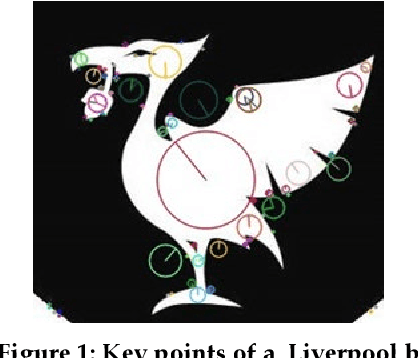
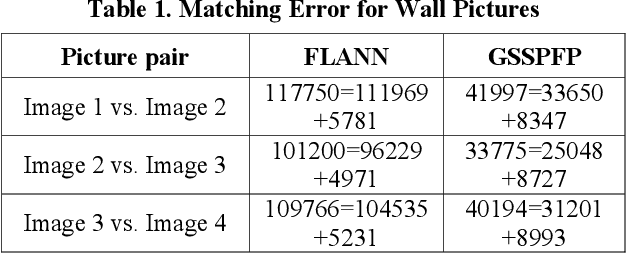
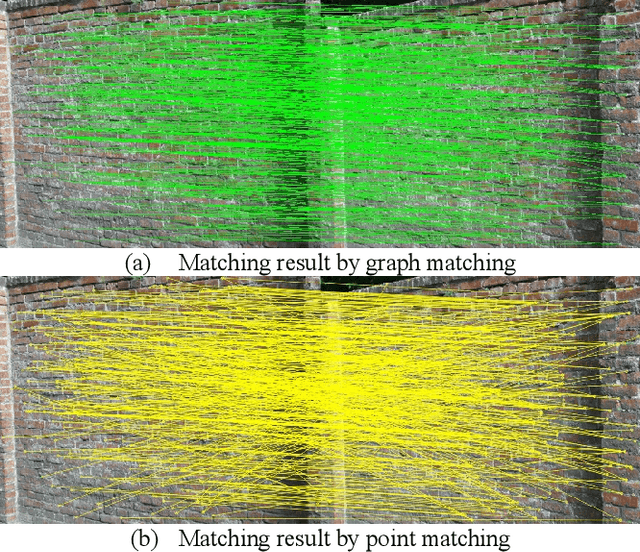
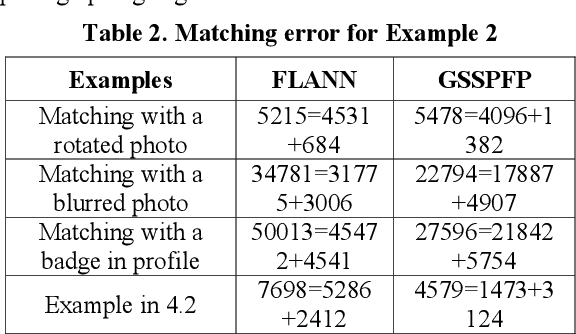
Fabricating experimental pictures in research work is a serious academic misconduct, which should better be detected in the reviewing process. However, due to large number of submissions, the detection whether a picture is fabricated or reused is laborious for reviewers, and sometimes is indistinct with human eyes. A tool for detecting similarity between images may help to alleviate this problem. Some methods based on local feature points matching work for most of the time, while these methods may result in mess of matchings due to ignorance of global relationship between features. We present a framework to detect similar, or perhaps fabricated, pictures with the graph matching techniques. A new iterative method is proposed, and experiments show that such a graph matching technique is better than the methods based only on local features for some cases.