 Add to Chrome
 Add to Firefox
 Add to Edge
Cross-Modality Structural Guidance in 3D Latent Diffusion for Robust FLAIR Super-Resolution
Jun 24, 2026
High-resolution (HR) MRI acquisition is often hampered by scan time constraints, resulting in anisotropic or low-resolution scans (e.g., thick-slice FLAIR) that limit diagnostic accuracy. While deep learning-based super-resolution (SR) methods show promise, they often hallucinate anatomical details, which can compromise brain structural integrity. To mitigate this limitation, we introduce MR-DiffuSR, a Multi-Resolution Diffusion-based Super-Resolution framework that incorporates HR T1w structural image priors to guide the restoration of thick-slice FLAIR scans and operates in the 3D latent space. Our architecture introduces cross-modality structural swin-attention, which derives structural attention maps from the HR T1w and applies them to the low-resolution FLAIR latent features. This design disentangles anatomical structure from modality-specific contrast, effectively preventing hallucinations. Furthermore, we employ a mixed-scale degradation strategy, training the model on a continuum of downsampling factors to ensure robustness to varying slice thicknesses, while optimizing with a DINOv3-based perceptual loss to preserve high-frequency semantic details. Evaluated on the ADNI-4 dataset, MR-DiffuSR surpasses both CNN and 2D diffusion approaches, achieving an average PSNR of 32.46dB, SSIM of 0.97, and LPIPS of 0.07 across all downsampling factors. In downstream white matter hyperintensity segmentation, our model demonstrates exceptional robustness. While baseline performance collapses at 10x down-sampling (Dice: 0.51), MR-DiffuSR maintains a Dice score of 0.63, preserving utility even at 7mm equivalent slice thickness.

Longitudinal Ensemble Integration for sequential classification with multimodal data
Nov 08, 2024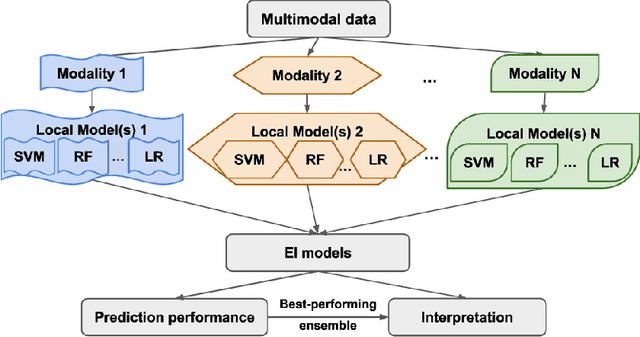


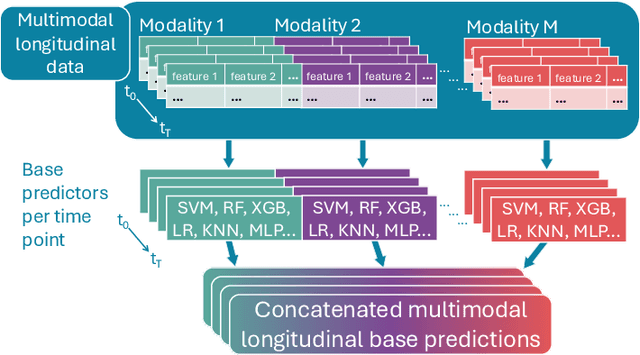
Effectively modeling multimodal longitudinal data is a pressing need in various application areas, especially biomedicine. Despite this, few approaches exist in the literature for this problem, with most not adequately taking into account the multimodality of the data. In this study, we developed multiple configurations of a novel multimodal and longitudinal learning framework, Longitudinal Ensemble Integration (LEI), for sequential classification. We evaluated LEI's performance, and compared it against existing approaches, for the early detection of dementia, which is among the most studied multimodal sequential classification tasks. LEI outperformed these approaches due to its use of intermediate base predictions arising from the individual data modalities, which enabled their better integration over time. LEI's design also enabled the identification of features that were consistently important across time for the effective prediction of dementia-related diagnoses. Overall, our work demonstrates the potential of LEI for sequential classification from longitudinal multimodal data.
Benchmarking features from different radiomics toolkits / toolboxes using Image Biomarkers Standardization Initiative
Jun 23, 2020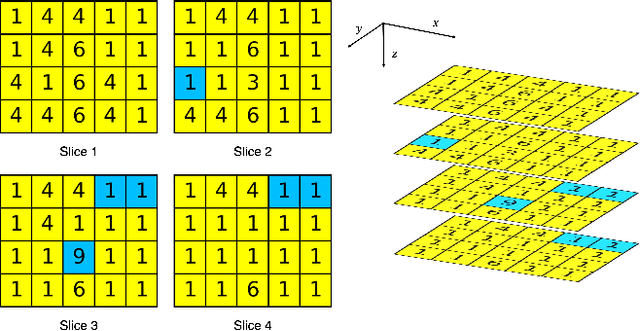
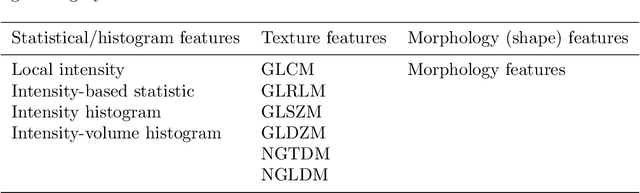
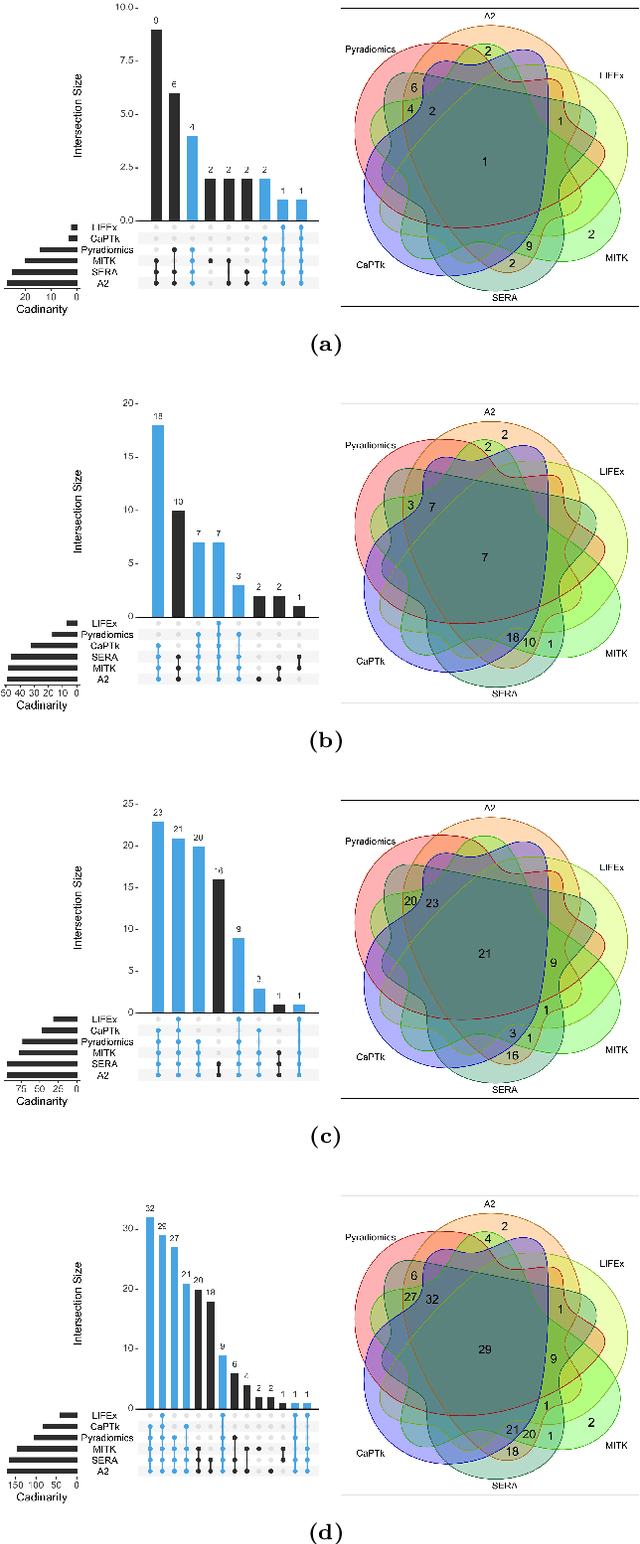
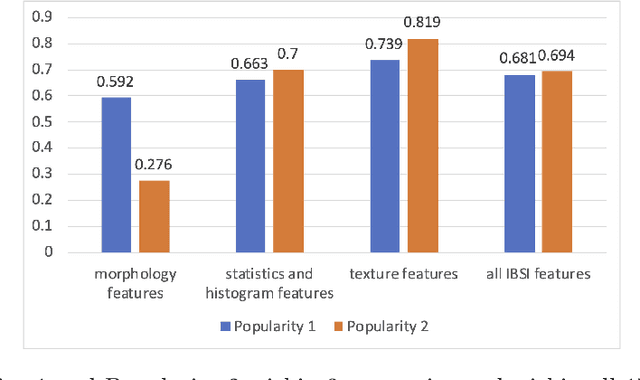
There is no consensus regarding the radiomic feature terminology, the underlying mathematics, or their implementation. This creates a scenario where features extracted using different toolboxes could not be used to build or validate the same model leading to a non-generalization of radiomic results. In this study, the image biomarker standardization initiative (IBSI) established phantom and benchmark values were used to compare the variation of the radiomic features while using 6 publicly available software programs and 1 in-house radiomics pipeline. All IBSI-standardized features (11 classes, 173 in total) were extracted. The relative differences between the extracted feature values from the different software and the IBSI benchmark values were calculated to measure the inter-software agreement. To better understand the variations, features are further grouped into 3 categories according to their properties: 1) morphology, 2) statistic/histogram and 3)texture features. While a good agreement was observed for a majority of radiomics features across the various programs, relatively poor agreement was observed for morphology features. Significant differences were also found in programs that use different gray level discretization approaches. Since these programs do not include all IBSI features, the level of quantitative assessment for each category was analyzed using Venn and the UpSet diagrams and also quantified using two ad hoc metrics. Morphology features earns lowest scores for both metrics, indicating that morphological features are not consistently evaluated among software programs. We conclude that radiomic features calculated using different software programs may not be identical and reliable. Further studies are needed to standardize the workflow of radiomic feature extraction.