 Add to Chrome
 Add to Firefox
 Add to Edge
Cross-Modality Structural Guidance in 3D Latent Diffusion for Robust FLAIR Super-Resolution
Jun 24, 2026
High-resolution (HR) MRI acquisition is often hampered by scan time constraints, resulting in anisotropic or low-resolution scans (e.g., thick-slice FLAIR) that limit diagnostic accuracy. While deep learning-based super-resolution (SR) methods show promise, they often hallucinate anatomical details, which can compromise brain structural integrity. To mitigate this limitation, we introduce MR-DiffuSR, a Multi-Resolution Diffusion-based Super-Resolution framework that incorporates HR T1w structural image priors to guide the restoration of thick-slice FLAIR scans and operates in the 3D latent space. Our architecture introduces cross-modality structural swin-attention, which derives structural attention maps from the HR T1w and applies them to the low-resolution FLAIR latent features. This design disentangles anatomical structure from modality-specific contrast, effectively preventing hallucinations. Furthermore, we employ a mixed-scale degradation strategy, training the model on a continuum of downsampling factors to ensure robustness to varying slice thicknesses, while optimizing with a DINOv3-based perceptual loss to preserve high-frequency semantic details. Evaluated on the ADNI-4 dataset, MR-DiffuSR surpasses both CNN and 2D diffusion approaches, achieving an average PSNR of 32.46dB, SSIM of 0.97, and LPIPS of 0.07 across all downsampling factors. In downstream white matter hyperintensity segmentation, our model demonstrates exceptional robustness. While baseline performance collapses at 10x down-sampling (Dice: 0.51), MR-DiffuSR maintains a Dice score of 0.63, preserving utility even at 7mm equivalent slice thickness.

Multi-Modality Conditioned Variational U-Net for Field-of-View Extension in Brain Diffusion MRI
Sep 20, 2024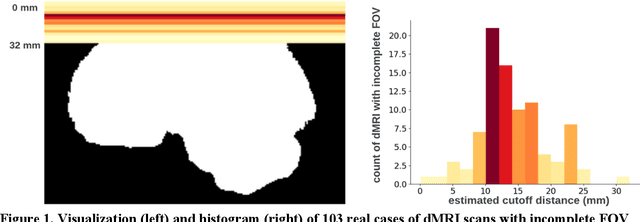

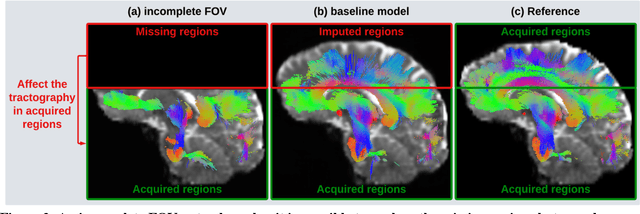
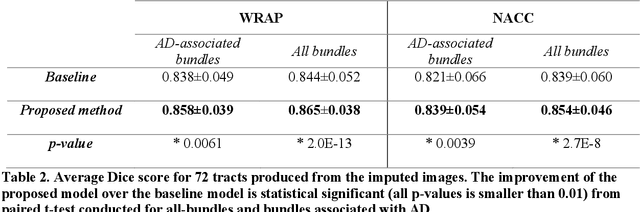
An incomplete field-of-view (FOV) in diffusion magnetic resonance imaging (dMRI) can severely hinder the volumetric and bundle analyses of whole-brain white matter connectivity. Although existing works have investigated imputing the missing regions using deep generative models, it remains unclear how to specifically utilize additional information from paired multi-modality data and whether this can enhance the imputation quality and be useful for downstream tractography. To fill this gap, we propose a novel framework for imputing dMRI scans in the incomplete part of the FOV by integrating the learned diffusion features in the acquired part of the FOV to the complete brain anatomical structure. We hypothesize that by this design the proposed framework can enhance the imputation performance of the dMRI scans and therefore be useful for repairing whole-brain tractography in corrupted dMRI scans with incomplete FOV. We tested our framework on two cohorts from different sites with a total of 96 subjects and compared it with a baseline imputation method that treats the information from T1w and dMRI scans equally. The proposed framework achieved significant improvements in imputation performance, as demonstrated by angular correlation coefficient (p < 1E-5), and in downstream tractography accuracy, as demonstrated by Dice score (p < 0.01). Results suggest that the proposed framework improved imputation performance in dMRI scans by specifically utilizing additional information from paired multi-modality data, compared with the baseline method. The imputation achieved by the proposed framework enhances whole brain tractography, and therefore reduces the uncertainty when analyzing bundles associated with neurodegenerative.
Evaluating U-net Brain Extraction for Multi-site and Longitudinal Preclinical Stroke Imaging
Mar 11, 2022

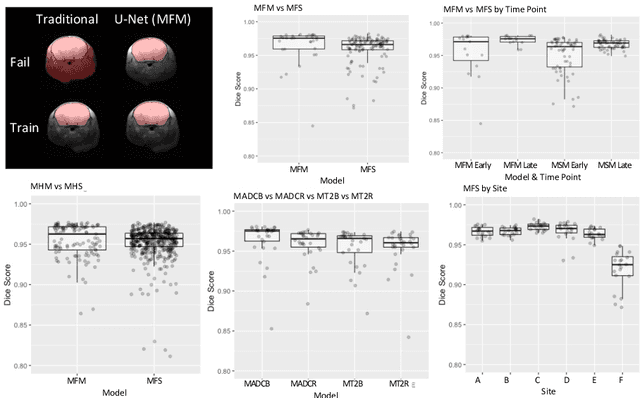
Rodent stroke models are important for evaluating treatments and understanding the pathophysiology and behavioral changes of brain ischemia, and magnetic resonance imaging (MRI) is a valuable tool for measuring outcome in preclinical studies. Brain extraction is an essential first step in most neuroimaging pipelines; however, it can be challenging in the presence of severe pathology and when dataset quality is highly variable. Convolutional neural networks (CNNs) can improve accuracy and reduce operator time, facilitating high throughput preclinical studies. As part of an ongoing preclinical stroke imaging study, we developed a deep-learning mouse brain extraction tool by using a U-net CNN. While previous studies have evaluated U-net architectures, we sought to evaluate their practical performance across data types. We ask how performance is affected with data across: six imaging centers, two time points after experimental stroke, and across four MRI contrasts. We trained, validated, and tested a typical U-net model on 240 multimodal MRI datasets including quantitative multi-echo T2 and apparent diffusivity coefficient (ADC) maps, and performed qualitative evaluation with a large preclinical stroke database (N=1,368). We describe the design and development of this system, and report our findings linking data characteristics to segmentation performance. We consistently found high accuracy and ability of the U-net architecture to generalize performance in a range of 95-97% accuracy, with only modest reductions in performance based on lower fidelity imaging hardware and brain pathology. This work can help inform the design of future preclinical rodent imaging studies and improve their scalability and reliability.
Image-based Stroke Assessment for Multi-site Preclinical Evaluation of Cerebroprotectants
Mar 11, 2022

Ischemic stroke is a leading cause of death worldwide, but there has been little success translating putative cerebroprotectants from preclinical trials to patients. We investigated computational image-based assessment tools for practical improvement of the quality, scalability, and outlook for large scale preclinical screening for potential therapeutic interventions. We developed, evaluated, and deployed a pipeline for image-based stroke outcome quantification for the Stroke Prelinical Assessment Network (SPAN), which is a multi-site, multi-arm, multi-stage study evaluating a suite of cerebroprotectant interventions. Our fully automated pipeline combines state-of-the-art algorithmic and data analytic approaches to assess stroke outcomes from multi-parameter MRI data collected longitudinally from a rodent model of middle cerebral artery occlusion (MCAO), including measures of infarct volume, brain atrophy, midline shift, and data quality. We tested our approach with 1,368 scans and report population level results of lesion extent and longitudinal changes from injury. We validated our system by comparison with manual annotations of coronal MRI slices and tissue sections from the same brain, using crowdsourcing from blinded stroke experts from the network. Our results demonstrate the efficacy and robustness of our image-based stroke assessments. The pipeline may provide a promising resource for ongoing preclinical studies conducted by SPAN and other networks in the future.