 Add to Chrome
 Add to Firefox
 Add to Edge
Cross-Modality Structural Guidance in 3D Latent Diffusion for Robust FLAIR Super-Resolution
Jun 24, 2026
High-resolution (HR) MRI acquisition is often hampered by scan time constraints, resulting in anisotropic or low-resolution scans (e.g., thick-slice FLAIR) that limit diagnostic accuracy. While deep learning-based super-resolution (SR) methods show promise, they often hallucinate anatomical details, which can compromise brain structural integrity. To mitigate this limitation, we introduce MR-DiffuSR, a Multi-Resolution Diffusion-based Super-Resolution framework that incorporates HR T1w structural image priors to guide the restoration of thick-slice FLAIR scans and operates in the 3D latent space. Our architecture introduces cross-modality structural swin-attention, which derives structural attention maps from the HR T1w and applies them to the low-resolution FLAIR latent features. This design disentangles anatomical structure from modality-specific contrast, effectively preventing hallucinations. Furthermore, we employ a mixed-scale degradation strategy, training the model on a continuum of downsampling factors to ensure robustness to varying slice thicknesses, while optimizing with a DINOv3-based perceptual loss to preserve high-frequency semantic details. Evaluated on the ADNI-4 dataset, MR-DiffuSR surpasses both CNN and 2D diffusion approaches, achieving an average PSNR of 32.46dB, SSIM of 0.97, and LPIPS of 0.07 across all downsampling factors. In downstream white matter hyperintensity segmentation, our model demonstrates exceptional robustness. While baseline performance collapses at 10x down-sampling (Dice: 0.51), MR-DiffuSR maintains a Dice score of 0.63, preserving utility even at 7mm equivalent slice thickness.

Diffusion based multi-domain neuroimaging harmonization method with preservation of anatomical details
Sep 01, 2024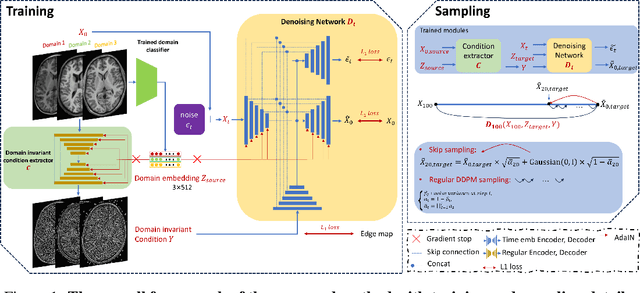
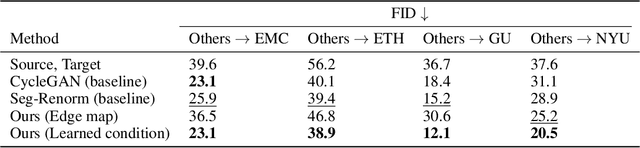
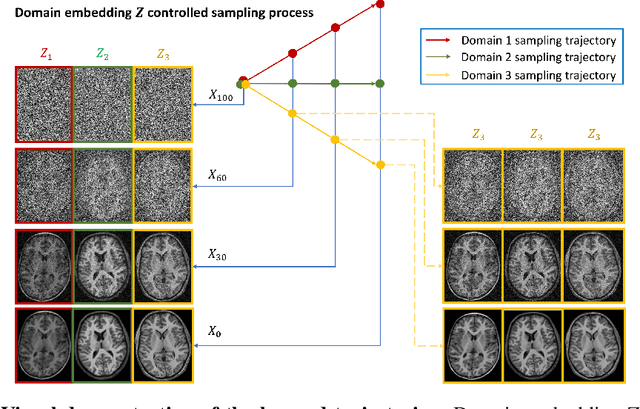
Multi-center neuroimaging studies face technical variability due to batch differences across sites, which potentially hinders data aggregation and impacts study reliability.Recent efforts in neuroimaging harmonization have aimed to minimize these technical gaps and reduce technical variability across batches. While Generative Adversarial Networks (GAN) has been a prominent method for addressing image harmonization tasks, GAN-harmonized images suffer from artifacts or anatomical distortions. Given the advancements of denoising diffusion probabilistic model which produces high-fidelity images, we have assessed the efficacy of the diffusion model for neuroimaging harmonization. we have demonstrated the diffusion model's superior capability in harmonizing images from multiple domains, while GAN-based methods are limited to harmonizing images between two domains per model. Our experiments highlight that the learned domain invariant anatomical condition reinforces the model to accurately preserve the anatomical details while differentiating batch differences at each diffusion step. Our proposed method has been tested on two public neuroimaging dataset ADNI1 and ABIDE II, yielding harmonization results with consistent anatomy preservation and superior FID score compared to the GAN-based methods. We have conducted multiple analysis including extensive quantitative and qualitative evaluations against the baseline models, ablation study showcasing the benefits of the learned conditions, and improvements in the consistency of perivascular spaces (PVS) segmentation through harmonization.