 Add to Chrome
 Add to Firefox
 Add to Edge
3D Magnetic Field Reconstruction and Mapping with Physics-Informed Neural Networks
May 25, 2026
Accurate reconstruction of magnetic fields in inaccessible regions is vital for many high-precision experiments in physics. Traditional methods, such as spherical harmonic expansion, often suffer from truncation errors that limit their precision. This study proposes an advanced Physics-Informed Neural Network (PINN) framework for high-precision 3D magnetic field mapping. Unlike conventional data-driven models, the proposed PINN integrates Maxwell's equations directly into the loss function, enforcing divergence-free and curl-free conditions across the entire domain. A key innovation is the inclusion of explicit physics-residual losses at measurement locations, ensuring rigorous physical consistency beyond random collocation sampling. Validation using simulated data achieves a reconstruction accuracy of $10^{-4}$, a tenfold improvement over existing PINN benchmarks. Furthermore, experimental validation using a custom coil assembly demonstrates robust reconstruction with sub-percent relative accuracy, reaching the $10^{-3}$ level under ambient conditions. This AI-driven methodology provides a robust, high-precision solution for field monitoring and measurement in complex experimental environments where direct sensor placement is restricted.

SLOG: A Structural Generalization Benchmark for Semantic Parsing
Oct 23, 2023The goal of compositional generalization benchmarks is to evaluate how well models generalize to new complex linguistic expressions. Existing benchmarks often focus on lexical generalization, the interpretation of novel lexical items in syntactic structures familiar from training; structural generalization tasks, where a model needs to interpret syntactic structures that are themselves unfamiliar from training, are often underrepresented, resulting in overly optimistic perceptions of how well models can generalize. We introduce SLOG, a semantic parsing dataset that extends COGS (Kim and Linzen, 2020) with 17 structural generalization cases. In our experiments, the generalization accuracy of Transformer models, including pretrained ones, only reaches 40.6%, while a structure-aware parser only achieves 70.8%. These results are far from the near-perfect accuracy existing models achieve on COGS, demonstrating the role of SLOG in foregrounding the large discrepancy between models' lexical and structural generalization capacities.
Assessing the Capacity of Transformer to Abstract Syntactic Representations: A Contrastive Analysis Based on Long-distance Agreement
Dec 08, 2022The long-distance agreement, evidence for syntactic structure, is increasingly used to assess the syntactic generalization of Neural Language Models. Much work has shown that transformers are capable of high accuracy in varied agreement tasks, but the mechanisms by which the models accomplish this behavior are still not well understood. To better understand transformers' internal working, this work contrasts how they handle two superficially similar but theoretically distinct agreement phenomena: subject-verb and object-past participle agreement in French. Using probing and counterfactual analysis methods, our experiments show that i) the agreement task suffers from several confounders which partially question the conclusions drawn so far and ii) transformers handle subject-verb and object-past participle agreements in a way that is consistent with their modeling in theoretical linguistics.
Are Transformers a Modern Version of ELIZA? Observations on French Object Verb Agreement
Sep 21, 2021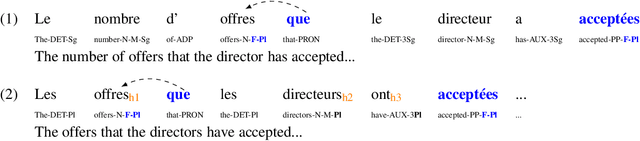
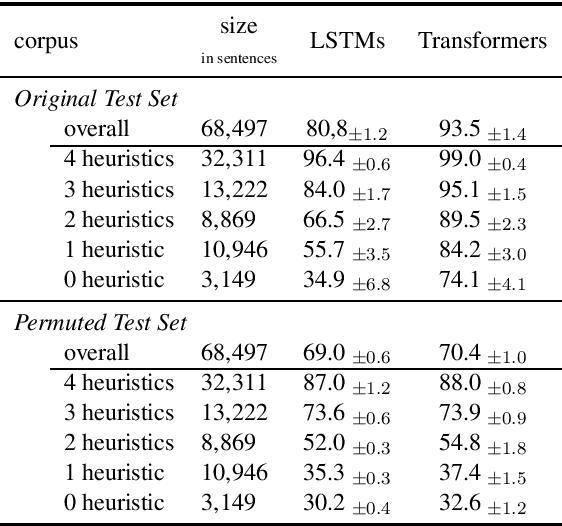
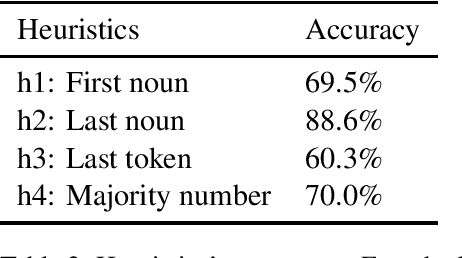
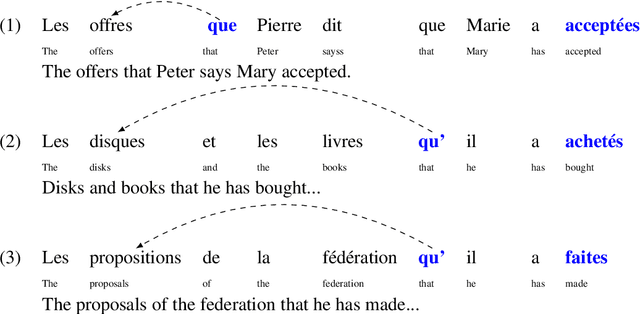
Many recent works have demonstrated that unsupervised sentence representations of neural networks encode syntactic information by observing that neural language models are able to predict the agreement between a verb and its subject. We take a critical look at this line of research by showing that it is possible to achieve high accuracy on this agreement task with simple surface heuristics, indicating a possible flaw in our assessment of neural networks' syntactic ability. Our fine-grained analyses of results on the long-range French object-verb agreement show that contrary to LSTMs, Transformers are able to capture a non-trivial amount of grammatical structure.