 Add to Chrome
 Add to Firefox
 Add to Edge
A Beamforming Microwave Interferometric Radiometer for High-resolution Passive Imaging: Concept, Modeling, and Preliminary Demonstration
Jun 26, 2026
High-resolution passive microwave imaging is important for numerical weather prediction, disaster monitoring, and oceanographic studies, but kilometer-level spatial resolution remains difficult to achieve because of aperture limitations and the high complexity of large interferometric arrays. This paper proposes a beamforming microwave interferometric radiometer (BF-MIR) for high-resolution passive microwave imaging. BF-MIR employs beamforming-capable antennas as interferometric elements in a large sparse array. The enlarged spatial-frequency sampling interval reduces the required number of elements and the cross-correlation burden, while a large aperture-to-sampling-interval ratio factor (ASRF) array design enables narrow-beam spatial filtering to suppress brightness temperature (TB) aliasing caused by spatial-frequency under sampling. In addition, beamforming enables dynamic beam steering across multiple pointing directions, thereby compensating for the limited instantaneous coverage of narrow beams. A beamforming interferometric imaging model is established, and the relationships among spatial resolution, radiometric sensitivity, and effective field of view are analyzed. An image-domain Shift-Accumulate method is further introduced to analyze aliasing, based on which an aliasing suppression strategy is developed. In addition, a three-element proof-of-concept prototype provides preliminary experimental validation of dynamic beam interferometric measurement and dynamic beam observation modes. These results indicate that BF-MIR is a promising architecture for further spaceborne high-resolution passive microwave imaging.

A Novel Semi-Supervised Data-Driven Method for Chiller Fault Diagnosis with Unlabeled Data
Oct 31, 2020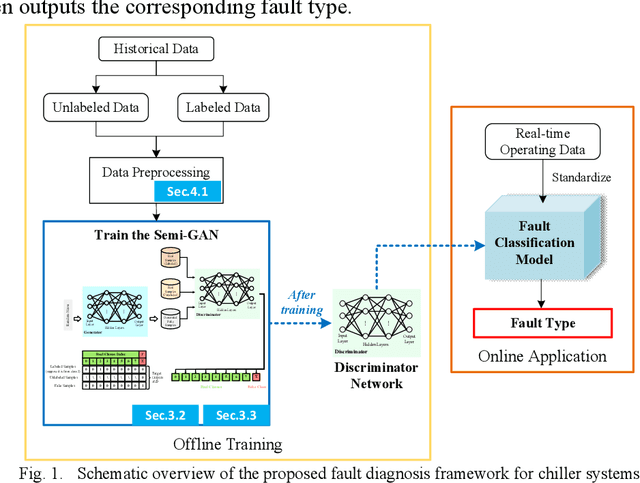

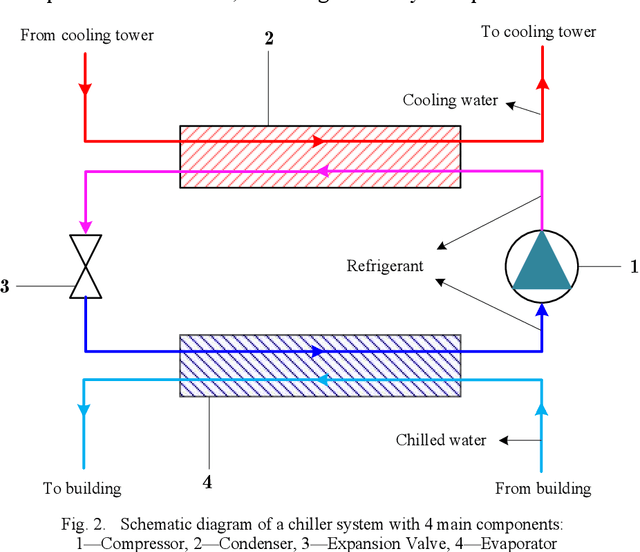
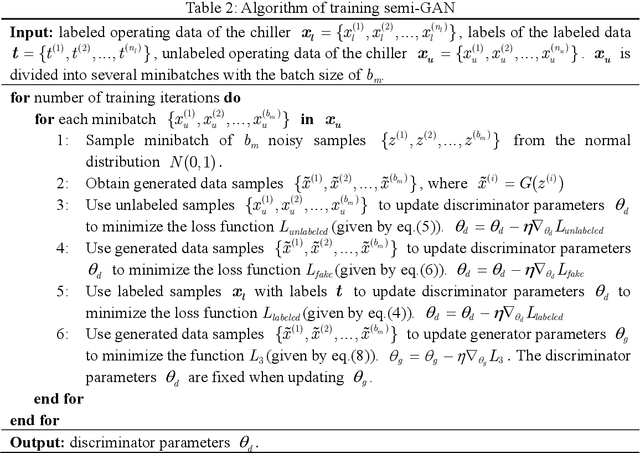
In practical chiller systems, applying efficient fault diagnosis techniques can significantly reduce energy consumption and improve energy efficiency of buildings. The success of the existing methods for fault diagnosis of chillers relies on the condition that sufficient labeled data are available for training. However, label acquisition is laborious and costly in practice. Usually, the number of labeled data is limited and most data available are unlabeled. The existing methods cannot exploit the information contained in unlabeled data, which significantly limits the improvement of fault diagnosis performance in chiller systems. To make effective use of unlabeled data to further improve fault diagnosis performance and reduce the dependency on labeled data, we proposed a novel semi-supervised data-driven fault diagnosis method for chiller systems based on the semi-generative adversarial network, which incorporates both unlabeled and labeled data into learning process. The semi-generative adversarial network can learn the information of data distribution from unlabeled data and this information can help to significantly improve the diagnostic performance. Experimental results demonstrate the effectiveness of the proposed method. Under the scenario that there are only 80 labeled samples and 16000 unlabeled samples, the proposed method can improve the diagnostic accuracy to 84%, while the supervised baseline methods only reach the accuracy of 65% at most. Besides, the minimal required number of labeled samples can be reduced by about 60% with the proposed method when there are enough unlabeled samples.