 Add to Chrome
 Add to Firefox
 Add to Edge
DRDN: Decoupled Representation Dynamic Network for From-Scratch ViT Class-Incremental Learning
Jul 02, 2026
Dynamic expansion methods for class-incremental learning (CIL) protect task-specific knowledge by growing dedicated tokens or subnetworks, yet our analyses suggest that classification supervision alone does not sufficiently preserve task-agnostic shared backbone representations over long incremental sequences. We identify two intertwined challenges: cross-task confusion from sequential training on predominantly current-task data, which biases decision boundaries toward recent tasks; and under-optimized shared representations in the backbone that cap long-term discriminability as tasks accumulate. We propose the Decoupled Representation Dynamic Network (DRDN), which addresses these challenges via two orthogonal mechanisms. For shared backbone representations, DRDN continuously applies masked image modeling (MIM) at every incremental step, with reconstruction gradients routed exclusively through the backbone, encouraging it to retain general visual structure beyond class-discriminative cues. For task-specific discrimination, DRDN employs hierarchical task token expansion across all transformer layers, with a modified per-task attention rule that reduces inter-task interference. We support this design with accuracy degradation analysis and cross-task confusion rate measurements. In the from-scratch ViT CIL setting (no external pretraining), DRDN consistently improves over strong token-expansion baselines with comparable backbone scale. On CIFAR100-B0 (10 steps), DRDN achieves 77.19% average accuracy, outperforming DKT by 1.36 points and DyTox by 3.53 points, with an advantage that grows at longer incremental sequences. Multi-seed validation confirms stability (+/-0.31%). The MIM decoder is active only during training, adding no inference-time parameters or computation.

Retrieved Images as Visual Thought: Training-Free Multimodal In-Context Learning for the Open-vs-Closed Gap
Jul 01, 2026Recent work on Thinking with Images makes vision a dynamic part of reasoning, but does so through generation: the model invokes external tools, synthesizes code, or imagines new imagery, each at the cost of a tool protocol, brittle code, or an expensive training pipeline. A fourth route makes vision dynamic without generating anything, by retrieving labeled exemplar images and reasoning over them, yet it remains underexplored despite being train-free. We present ReVisIT, a train-free framework that realizes this retrieval-based route by treating each retrieved image-label pair as a unit of visual thought. ReVisIT combines structured class definitions, per-query multimodal retrieval of exemplars, and alternating user/assistant injection of those exemplars before joint multi-attribute decoding, and degrades gracefully to whichever components a task admits. On VL-ICL Bench Fast Open MiniImageNet, Qwen3-VL-30B-A3B with ReVisIT reaches 98.5% at 4-shot, statistically indistinguishable from the 72B LLaVA-OneVision SOTA (98.7%) on this near-saturated task at about 1/2.4 the parameters, while the same backbone without the scaffold sits at chance. The turns layer alone adds 26.1 points to GPT-4.1 on free-form concept induction (Bongard-OpenWorld), and the full stack yields a 4-6 point macro gain across three backbones on MAAC-Bench, a new license-clean 27-class, 5-attribute benchmark, significant by paired bootstrap on the curator-derived attributes. Component analysis shows that retrieval-plus-turns is the universal lever while structured definitions are need-adaptive, and that 83% of the retrieval gain comes from retrieval quality rather than from the presence of exemplars. MAAC-Bench is released with a rubric-grounded LLM verification protocol that replaces author spot-check on subjective attributes.
Resolving Task Confusion in Dynamic Expansion Architectures for Class Incremental Learning
Jan 03, 2023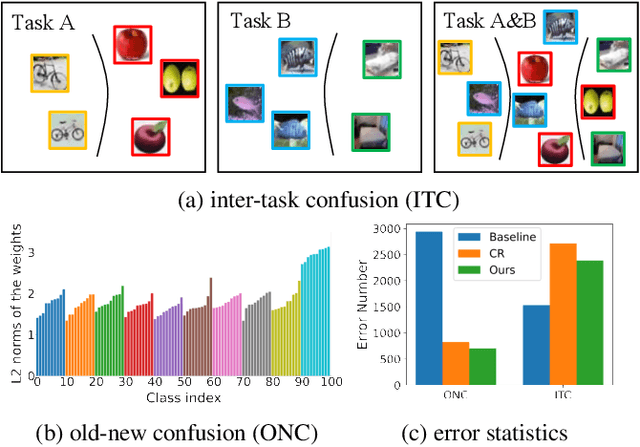


The dynamic expansion architecture is becoming popular in class incremental learning, mainly due to its advantages in alleviating catastrophic forgetting. However, task confusion is not well assessed within this framework, e.g., the discrepancy between classes of different tasks is not well learned (i.e., inter-task confusion, ITC), and certain priority is still given to the latest class batch (i.e., old-new confusion, ONC). We empirically validate the side effects of the two types of confusion. Meanwhile, a novel solution called Task Correlated Incremental Learning (TCIL) is proposed to encourage discriminative and fair feature utilization across tasks. TCIL performs a multi-level knowledge distillation to propagate knowledge learned from old tasks to the new one. It establishes information flow paths at both feature and logit levels, enabling the learning to be aware of old classes. Besides, attention mechanism and classifier re-scoring are applied to generate more fair classification scores. We conduct extensive experiments on CIFAR100 and ImageNet100 datasets. The results demonstrate that TCIL consistently achieves state-of-the-art accuracy. It mitigates both ITC and ONC, while showing advantages in battle with catastrophic forgetting even no rehearsal memory is reserved.