 Add to Chrome
 Add to Firefox
 Add to Edge
G3T Up! Gravity Aligned Coordinate Frames Simplify Pointmap Processing
May 26, 2026
Modern feed-forward 3D reconstruction methods like VGGT predict pixel-aligned pointmaps in camera-centric coordinate frames. However, this choice of coordinate frame is not always optimal. We propose instead to predict pointmaps in upright, gravity-aligned frames that exploit strong structural cues present in many real-world scenes. Unlike camera-centric frames, gravity-aligned frames share a common vertical axis across viewpoints, reducing the rotational degrees of freedom needed to relate pointmaps to one another. To this end, we introduce the Gravity Grounded Geometry Transformer (G3T), fine-tuned from existing models on gravity-aligned 3D data. G3T produces highly accurate gravity-aware predictions, including upright pointmaps and camera-to-gravity poses. We further introduce G3T-Long, a submap-based incremental 3D reconstruction pipeline that leverages the reduced rotational degrees of freedom afforded by upright frames to achieve significantly improved reconstruction accuracy.

Flat-Pack Bench: Evaluating Spatio-Temporal Understanding in Large Vision-Language Models through Furniture Assembly
May 20, 2026The emergence of Large Vision-Language Models (LVLMs) has significantly advanced video understanding capabilities. However, existing benchmarks focus predominantly on coarse-grained tasks such as action segmentation, classification, captioning, and retrieval. Furthermore, these benchmarks often rely on entities that can be easily identified verbally, like household objects, animals, human subjects, etc., limiting their applicability to complex, in-the-wild video scenarios. But, many applications such as furniture assembly, cooking, etc., require step-by-step fine-grained spatio-temporal understanding of the video, which is not sufficiently evaluated in current benchmarks. To address this gap, we introduce Flat-Pack Bench, a novel benchmark centered on furniture assembly tasks. Our benchmark evaluates LVLMs on nuanced tasks, including temporal ordering of assembly actions, temporal localization of assembly state, understanding part mating, and tracking, using multiple-choice questions paired with visual prompts highlighting relevant parts as references for fine-grained questions. Our experiments reveal that state-of-the-art LVLMs struggle significantly with fine-grained spatio-temporal reasoning, highlighting their limitations in effectively leveraging temporal information from videos, limited tracking ability, and understanding of spatial interactions like physical contact.
UpFusion: Novel View Diffusion from Unposed Sparse View Observations
Jan 04, 2024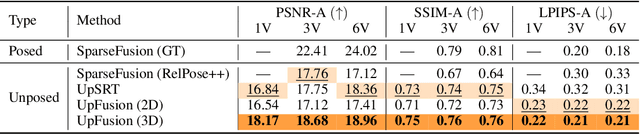


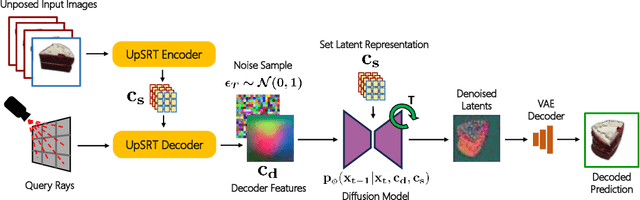
We propose UpFusion, a system that can perform novel view synthesis and infer 3D representations for an object given a sparse set of reference images without corresponding pose information. Current sparse-view 3D inference methods typically rely on camera poses to geometrically aggregate information from input views, but are not robust in-the-wild when such information is unavailable/inaccurate. In contrast, UpFusion sidesteps this requirement by learning to implicitly leverage the available images as context in a conditional generative model for synthesizing novel views. We incorporate two complementary forms of conditioning into diffusion models for leveraging the input views: a) via inferring query-view aligned features using a scene-level transformer, b) via intermediate attentional layers that can directly observe the input image tokens. We show that this mechanism allows generating high-fidelity novel views while improving the synthesis quality given additional (unposed) images. We evaluate our approach on the Co3Dv2 and Google Scanned Objects datasets and demonstrate the benefits of our method over pose-reliant sparse-view methods as well as single-view methods that cannot leverage additional views. Finally, we also show that our learned model can generalize beyond the training categories and even allow reconstruction from self-captured images of generic objects in-the-wild.