 Add to Chrome
 Add to Firefox
 Add to Edge
Rethinking Patient Education as Multi-turn Multi-modal Interaction
Apr 16, 2026
Most medical multimodal benchmarks focus on static tasks such as image question answering, report generation, and plain-language rewriting. Patient education is more demanding: systems must identify relevant evidence across images, show patients where to look, explain findings in accessible language, and handle confusion or distress. Yet most patient education work remains text-only, even though combined image-and-text explanations may better support understanding. We introduce MedImageEdu, a benchmark for multi-turn, evidence-grounded radiology patient education. Each case provides a radiology report with report text and case images. A DoctorAgent interacts with a PatientAgent, conditioned on a hidden profile that captures factors such as education level, health literacy, and personality. When a patient question would benefit from visual support, the DoctorAgent can issue drawing instructions grounded in the report, case images, and the current question to a benchmark-provided drawing tool. The tool returns image(s), after which the DoctorAgent produces a final multimodal response consisting of the image(s) and a grounded plain-language explanation. MedImageEdu contains 150 cases from three sources and evaluates both the consultation process and the final multimodal response along five dimensions: Consultation, Safety and Scope, Language Quality, Drawing Quality, and Image-Text Response Quality. Across representative open- and closed-source vision-language model agents, we find three consistent gaps: fluent language often outpaces faithful visual grounding, safety is the weakest dimension across disease categories, and emotionally tense interactions are harder than low education or low health literacy. MedImageEdu provides a controlled testbed for assessing whether multimodal agents can teach from evidence rather than merely answer from text.

Sam-Guided Enhanced Fine-Grained Encoding with Mixed Semantic Learning for Medical Image Captioning
Nov 02, 2023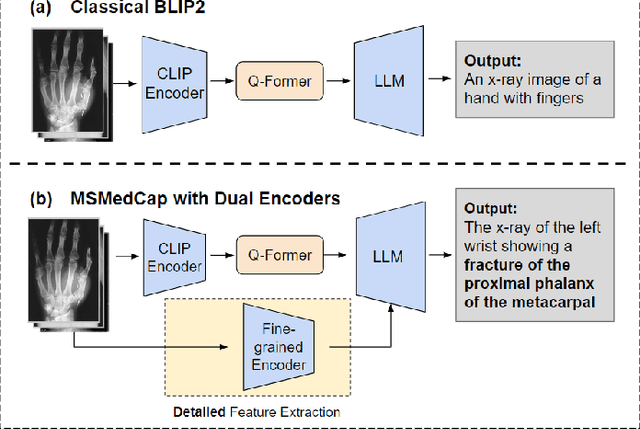
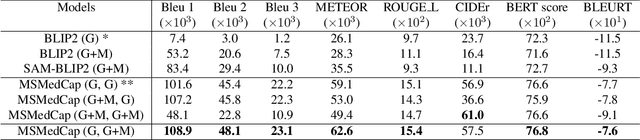
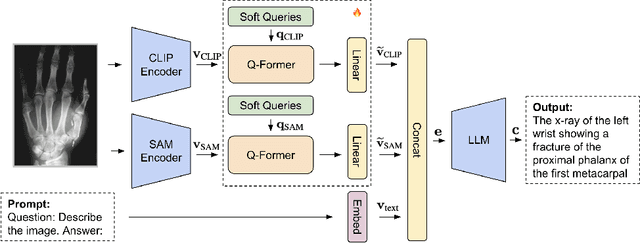
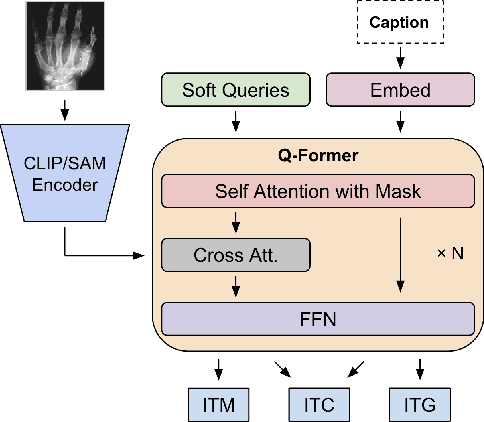
With the development of multimodality and large language models, the deep learning-based technique for medical image captioning holds the potential to offer valuable diagnostic recommendations. However, current generic text and image pre-trained models do not yield satisfactory results when it comes to describing intricate details within medical images. In this paper, we present a novel medical image captioning method guided by the segment anything model (SAM) to enable enhanced encoding with both general and detailed feature extraction. In addition, our approach employs a distinctive pre-training strategy with mixed semantic learning to simultaneously capture both the overall information and finer details within medical images. We demonstrate the effectiveness of this approach, as it outperforms the pre-trained BLIP2 model on various evaluation metrics for generating descriptions of medical images.