 Add to Chrome
 Add to Firefox
 Add to Edge
How AI Prompts Can Teach Us About the Structure of Human Behavior
Aug 18, 2026
We introduce a general, easy-to-implement AI-based method for studying the structure and complexity of human behavior. We assign a large language model a ``type vector'' and then prompt it to choose actions across settings in which we observe human choices. For instance, the type vector (2,4) becomes ``You are a player characterized by the following profile: 2 out of 5 in Altruism, 4 out of 5 in Risk Aversion,'' after which it is prompted to make choices. We vary the dimensions (e.g., Altruism, Fairness, Trust, $\dots$) and values (e.g., 1--5) to minimize distance to human choices. Applying the method to 119,147 decisions made by 78,657 subjects from more than 35 countries across 10 classic economic game roles, we find that human behavior can be closely matched using three dimensions: Risk Aversion, Strategic Sophistication, and Trust. Moreover, the types needed to fit individuals across games cluster into fewer than a dozen groups, and can predict behavior in held-out games with different rules and available actions. The results suggest that behavior across diverse settings can be approximated by a low-dimensional, portable representation, supporting the possibility of general yet parsimonious theories across the behavioral sciences. More broadly, the method can provide insights into the structure of many human behaviors.

Understanding Economic Tradeoffs Between Human and AI Agents in Bargaining Games
Sep 11, 2025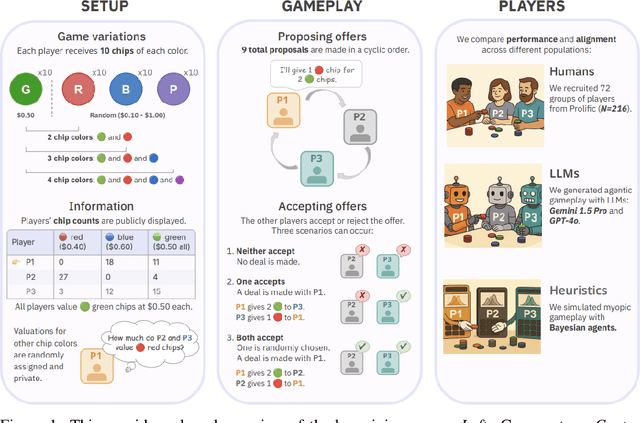

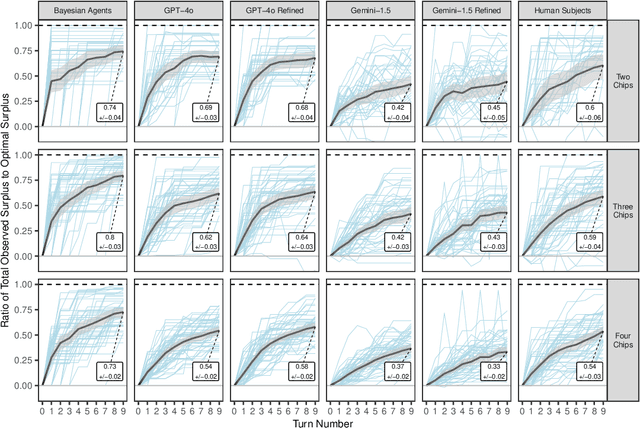

Coordination tasks traditionally performed by humans are increasingly being delegated to autonomous agents. As this pattern progresses, it becomes critical to evaluate not only these agents' performance but also the processes through which they negotiate in dynamic, multi-agent environments. Furthermore, different agents exhibit distinct advantages: traditional statistical agents, such as Bayesian models, may excel under well-specified conditions, whereas large language models (LLMs) can generalize across contexts. In this work, we compare humans (N = 216), LLMs (GPT-4o, Gemini 1.5 Pro), and Bayesian agents in a dynamic negotiation setting that enables direct, identical-condition comparisons across populations, capturing both outcomes and behavioral dynamics. Bayesian agents extract the highest surplus through aggressive optimization, at the cost of frequent trade rejections. Humans and LLMs can achieve similar overall surplus, but through distinct behaviors: LLMs favor conservative, concessionary trades with few rejections, while humans employ more strategic, risk-taking, and fairness-oriented behaviors. Thus, we find that performance parity -- a common benchmark in agent evaluation -- can conceal fundamental differences in process and alignment, which are critical for practical deployment in real-world coordination tasks.