 Add to Chrome
 Add to Firefox
 Add to Edge
Refining Word-Based Grammatical Error Annotation for L2 Korean
May 28, 2026
Korean grammatical error correction (K-GEC) presents a structural mismatch between word-based evaluation and the morpheme-level locus of many learner errors. Postpositions and verbal endings are bound to lexical hosts, but they encode grammatical relations that must be represented in correction and evaluation. This paper refines word-based grammatical error annotation for L2 Korean by addressing three connected problems in existing resources: surface target realization, Korean-specific edit annotation, and single-reference evaluation. We reconstruct target sentences from the National Institute of Korean Language (NIKL) L2 corpus under morphologically constrained realization rules and convert its morpheme-level annotations into word-level \texttt{m2} edits. We then define a Korean ERRANT-style annotation scheme that preserves the MRU core while distinguishing functional morpheme errors, spelling errors, word boundary errors, and word order errors. We also augment the KoLLA corpus with an additional reference correction, yielding a multi-reference evaluation setting for Korean GEC. Empirical validation shows that the refined NIKL targets yield lower perplexity, the converted \texttt{m2} files achieve higher agreement with source-target edit representations, and the refined resources improve KoBART-based correction under the same model setting. Multi-reference KoLLA evaluation further reduces the penalty imposed on valid corrections that diverge from a single reference, especially for neural and prompted GEC systems. These results show that Korean GEC evaluation depends not only on correction models, but also on reference data and edit annotations that reflect Korean morphology, spacing, and correction variability.

Distributed Transition Systems with Tags for Privacy Analysis
Apr 06, 2022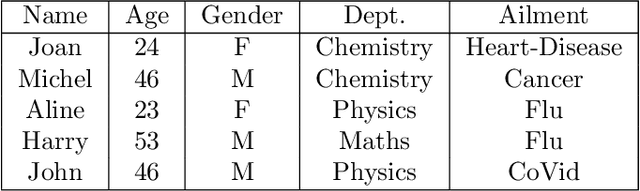
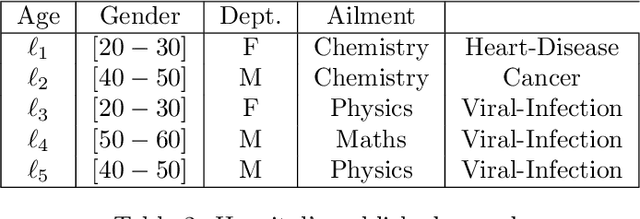
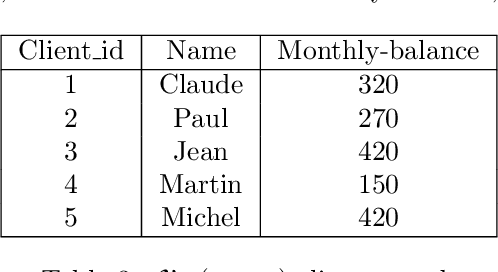
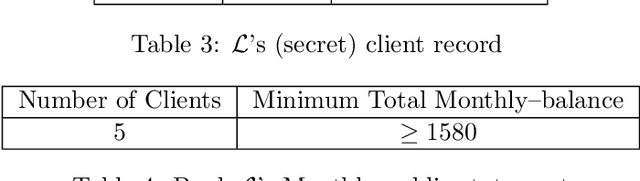
We present a logical framework that formally models how a given private information P stored on a given database D, can get captured progressively, by an agent/adversary querying the database repeatedly.Named DLTTS (Distributed Labeled Tagged Transition System), the frame-work borrows ideas from several domains: Probabilistic Automata of Segala, Probabilistic Concurrent Systems, and Probabilistic labelled transition systems. To every node on a DLTTS is attached a tag that represents the 'current' knowledge of the adversary, acquired from the responses of the answering mechanism of the DBMS to his/her queries, at the nodes traversed earlier, along any given run; this knowledge is completed at the same node, with further relational deductions, possibly in combination with 'public' information from other databases given in advance. A 'blackbox' mechanism is also part of a DLTTS, and it is meant as an oracle; its role is to tell if the private information has been deduced by the adversary at the current node, and if so terminate the run. An additional special feature is that the blackbox also gives information on how 'close',or how 'far', the knowledge of the adversary is, from the private information P , at the current node. A metric is defined for that purpose, on the set of all 'type compatible' tuples from the given database, the data themselves being typed with the headers of the base. Despite the transition systems flavor of our framework, this metric is not 'behavioral' in the sense presented in some other works. It is exclusively database oriented,and allows to define new notions of adjacency and of -indistinguishabilty between databases, more generally than those usually based on the Hamming metric (and a restricted notion of adjacency). Examples are given all along to illustrate how our framework works. Keywords:Database, Privacy, Transition System, Probability, Distribution.
Janus: Automatic Ontology Builder from XSD Files
Jan 27, 2010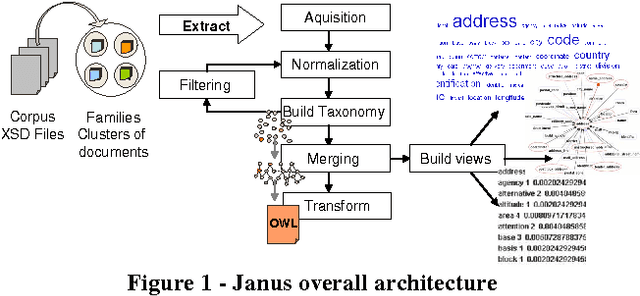
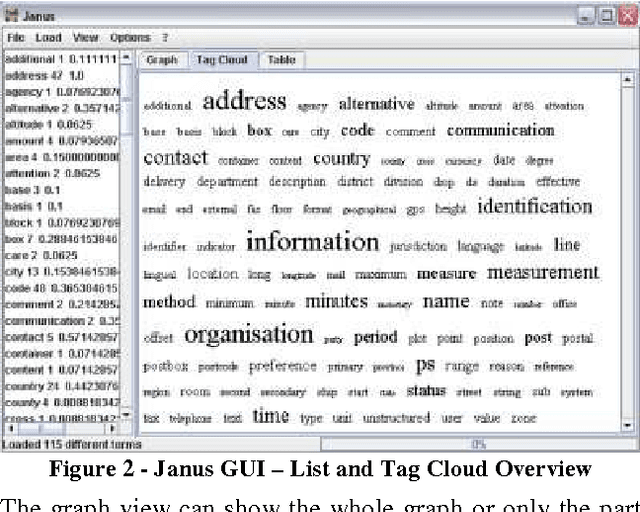
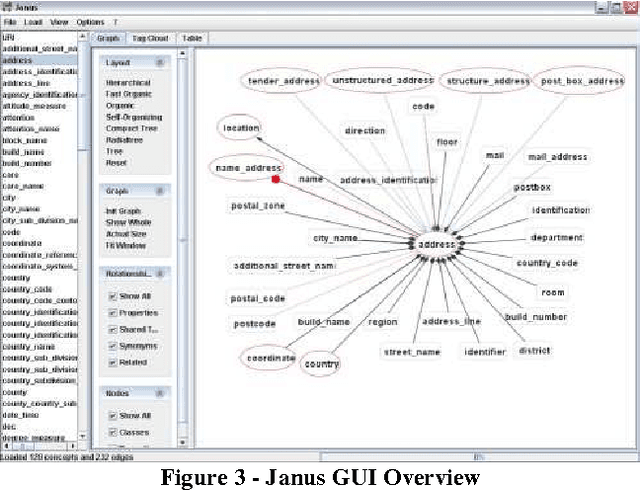
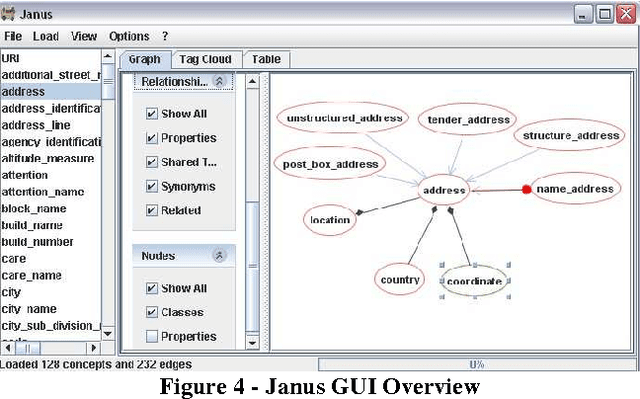
The construction of a reference ontology for a large domain still remains an hard human task. The process is sometimes assisted by software tools that facilitate the information extraction from a textual corpus. Despite of the great use of XML Schema files on the internet and especially in the B2B domain, tools that offer a complete semantic analysis of XML schemas are really rare. In this paper we introduce Janus, a tool for automatically building a reference knowledge base starting from XML Schema files. Janus also provides different useful views to simplify B2B application integration.